

HuinBrain Cloud Secures RMB 50 Million Series A Funding to Advance Multimodal Brain Imaging AI Platform
VCBeat (WeChat ID: vcbeat) has learned that on August 5, 2019, Beijing Intelligent Brain Cloud, Inc. announced the successful completion of its Series A financing round, raising RMB 50 million. The round was exclusively invested by the Nanjing Jiangbei New Area Medical Innovation Industry Fund, managed by Haisong Medical Fund. Previously, Intelligent Brain Cloud had received angel-round investment from Guoke Jiahe Fund.
Zhou Liang, CEO of Intelligent Brain Cloud, stated that this round of financing will be used to expand the company’s scale, increase sales of its multimodal brain imaging data analysis and computing platform, and implement market deployment through private cloud, hybrid cloud, and public cloud models. The company will further enhance the research and development of its quantitative brain structure analysis platform, magnetoencephalography (MEG) analysis platform, and products for cerebral small vessel disease, early diagnosis of Alzheimer’s disease (AD), and precise localization of epileptic foci. Additionally, it aims to establish a nationwide sales and technical service network. The company has already set up a research institute and a wholly-owned subsidiary in the Nanjing Jiangbei New Area. With strong support from the Nanjing Jiangbei New Area, the company will facilitate comprehensive integration of talent, technology, and markets, thereby supporting its all-around industrial layout.
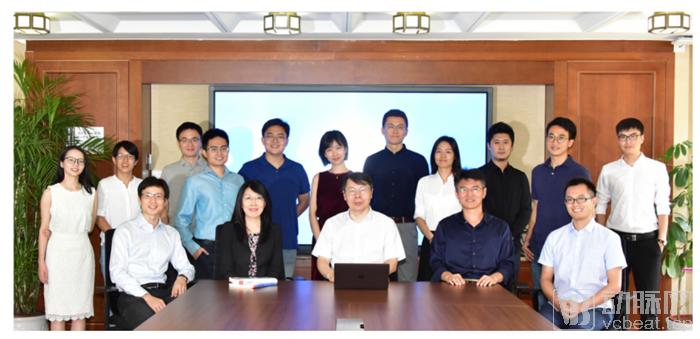
Intelligent Brain Cloud Announces Successful Completion of RMB 50 Million Series A Financing (Source: Company-provided photo)
Beijing Intelligent Brain Cloud, Inc. is dedicated to exploring brain science and advancing scientific research and clinical applications in brain medicine. Its Phase I product, the Multimodal Brain Imaging Data Management, Computing, and Analysis Cloud Platform, is a pioneering innovation both domestically and internationally. The product effectively addresses a series of pain points and challenges faced by physicians and researchers in the processing and analysis of multimodal brain imaging data. The platform has been sold to Grade A tertiary hospitals, universities, and research institutes, with coverage extending across Beijing-Tianjin, Shanghai, Shenzhen, Zhengzhou, and other regions. The company also collaborates with multiple hospitals to develop a series of AI-assisted diagnostic and therapeutic products for brain disorders, including a quantitative brain structure analysis platform, a magnetoencephalography (MEG) analysis platform, and solutions for cerebral small vessel disease, early diagnosis of Alzheimer’s disease (AD), and precise localization of epileptic foci, thereby addressing substantial market demand in healthcare.
HuiNao Cloud has established a joint laboratory with the Peking University Magnetic Resonance Imaging Research Center, gaining access to the most advanced technological support in the field of brain science. The company brings together scientists and young scholars in the field of brain science, with core members having years of work experience at renowned universities, well-known enterprises, and multinational corporations both domestically and internationally. It possesses interdisciplinary talent proficient in cutting-edge technologies and core algorithms in the fields of brain imaging, big data, cloud computing, and artificial intelligence.
The brain is the most complex organ in the human body, and brain science initiatives have become global endeavors following the Human Genome Project and the Precision Medicine Initiative. China’s Brain Science Project adopts a “one body, two wings” framework, which conducts research on the diagnosis and treatment of brain disorders, neuromorphic computing, brain-computer interfaces, and other emerging fields of artificial intelligence, all based on neural networks underlying cognitive functions. Exploring the mechanisms behind cognitive functions holds significant importance for the diagnosis and intervention of major brain disorders, as well as for the advancement of artificial intelligence.
Brain imaging is the most critical tool for understanding the human brain and diagnosing neurological disorders. Imaging modalities include Magnetic Resonance Imaging (MRI), Magnetoencephalography (MEG), and Electroencephalography (EEG). Structural MRI scans depict the morphology of gray matter, white matter, and cerebrospinal fluid to identify lesions or injuries. Functional MRI (fMRI) captures brain region activation patterns during specific tasks. Diffusion Tensor Imaging (DTI), another form of magnetic resonance imaging, enables the mapping of structural connectivity in neuroimaging. These brain imaging devices are widely used in both clinical and research settings. Hospitals and research institutions continuously generate massive amounts of multimodal brain imaging data, posing significant challenges for analysis and processing. Meanwhile, clinical decision-making for neurological disorders is increasingly reliant on the results of multimodal imaging data analysis.
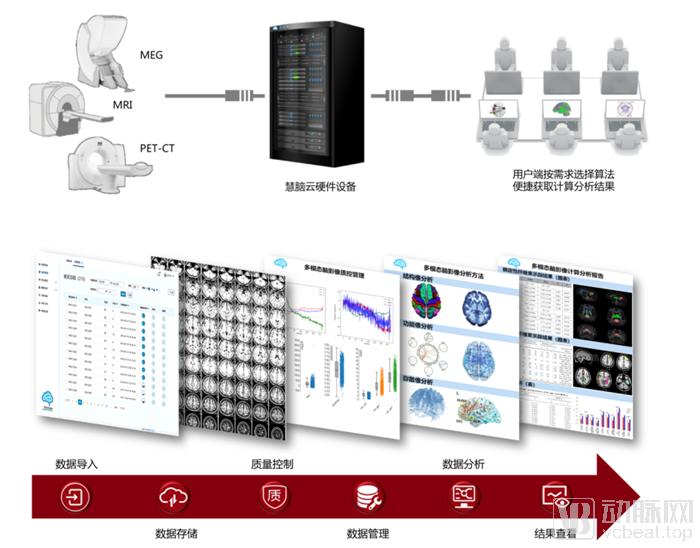
Intelligent Brain Cloud Platform (Source: Provided by the company)
The HuiNao Cloud Platform is a one-stop solution for the acquisition, management, storage, quality control, analysis, and visualization of multimodal brain imaging data. It effectively addresses long-standing challenges characterized by time-consuming, labor-intensive, and methodologically flawed processes, enabling rapid and accurate computational analysis of brain images to support scientific research and assist in clinical diagnosis. Through the HuiNao Cloud Platform, users can access standardized databases for artificial intelligence data mining, including categorized raw images, intermediate result images, and final result images. By leveraging AI algorithms and specialized brain imaging algorithms, the platform generates comprehensive insights, helping physicians obtain imaging information that is not discernible to the naked eye.
The integration of medical imaging and artificial intelligence has led many companies to develop products focused on early screening for lung cancer and breast cancer. In contrast, brain imaging data is more complex, covers a broader scope, and contains a greater volume of information. Much of this information cannot be extracted using conventional AI methods; instead, it requires the combination of core algorithms from neuroscience and cutting-edge technologies from the field of artificial intelligence. Intelligent Brain Cloud focuses on “multimodal brain imaging + AI” to develop a series of products for the diagnosis and treatment of major brain disorders, which will be widely used in the auxiliary diagnosis of brain diseases.
Traditional approaches have seen few breakthroughs in treating brain diseases. HuiNaoYun (Intelligent Brain Cloud) provides new solutions and tools for physicians and researchers in the field of brain science. Guoke Jiahe Fund has long focused on the “AI + Healthcare” sector, favoring AI applications that enhance medical efficiency. It has also invested in multiple AI enterprises, including Leyue Health, Lianxin Medical, Ruixin Intelligence, Zhongzhi Daxin, Timi Robot, Bowei Robot, and Precision Robotics.