

China Establishes Inter-Ministerial Joint Conference System for Elderly Care Services
VCBeat (WeChat ID: vcbeat) has learned that on August 5, the General Office of the State Council issued a letter approving the establishment of an inter-ministerial joint conference system for elderly care services.
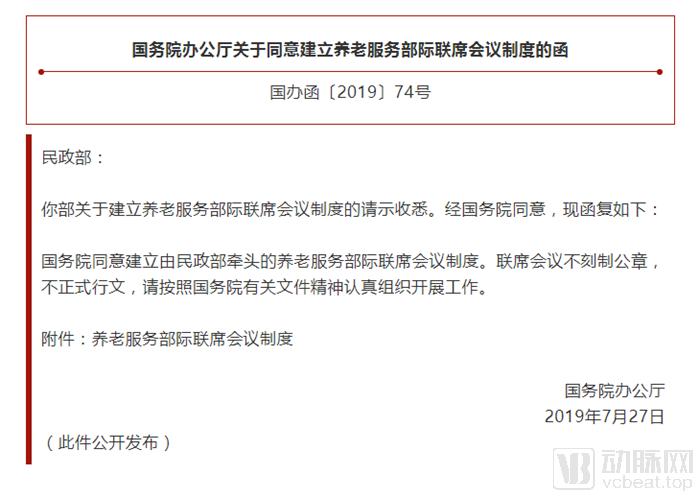
Source: The Chinese Government Website
To implement the major decisions and arrangements of the CPC Central Committee and the State Council on accelerating the development of elderly care services, and in accordance with the requirements of the “Opinions of the General Office of the State Council on Promoting the Development of Elderly Care Services” (Guo Ban Fa [2019] No. 5), we will further strengthen leadership over elderly care service work, enhance overall coordination, and form a synergistic workforce. With the approval of the State Council, an inter-ministerial joint conference system on elderly care services (hereinafter referred to as the Joint Conference) is hereby established.
I. Main Functions
Under the leadership of the CPC Central Committee and the State Council, coordinate nationwide elderly care services, study and resolve major issues in elderly care services, and improve the elderly care service system; review proposed regulations and important policies on elderly care services, and formulate annual key work plans to promote the development of elderly care services; deploy and implement key initiatives for reform and innovation in elderly care services, and supervise and inspect the implementation of relevant policy measures; strengthen information exchange and mutual collaboration among various regions and departments, promptly summarize work achievements, and promote advanced practices and experiences; and complete other tasks assigned by the CPC Central Committee and the State Council.
II. Member Units
The joint conference consists of 21 departments and units, including the Ministry of Civil Affairs, the National Development and Reform Commission, the Ministry of Education, the Ministry of Science and Technology, the Ministry of Industry and Information Technology, the Ministry of Public Security, the Ministry of Finance, the Ministry of Human Resources and Social Security, the Ministry of Natural Resources, the Ministry of Housing and Urban-Rural Development, the Ministry of Commerce, the National Health Commission, the Ministry of Emergency Management, the People’s Bank of China, the State-owned Assets Supervision and Administration Commission, the State Taxation Administration, the State Administration for Market Regulation, the National Bureau of Statistics, the National Healthcare Security Administration, the China Banking and Insurance Regulatory Commission, and the Leading Group Office of Poverty Alleviation and Development. The Ministry of Civil Affairs serves as the lead unit.
The joint conference is convened by the principal official of the Ministry of Civil Affairs, with relevant officials from other member units serving as members of the joint conference (list attached). The member units of the joint conference may be adjusted according to work needs, without requiring separate approval from the State Council. Adjustments to joint conference members due to changes in their work assignments shall be proposed by their respective units and determined by the joint conference.
The Joint Conference Office is housed within the Ministry of Civil Affairs, primarily responsible for daily operations such as organizational liaison and coordination. The Director of the Office shall be concurrently held by the official from the Ministry of Civil Affairs in charge of elderly care services. The Joint Conference shall appoint liaisons, who shall be officials from the relevant departments of each member unit; these liaisons shall also serve as members of the Office to participate in specific tasks. Any adjustment to the liaisons shall be proposed by their respective units and filed with the Joint Conference Office for record.
III. Work Rules
The Joint Conference shall convene regular or ad hoc meetings as required by work needs, presided over by the convener or a colleague designated by the convener. Prior to the Joint Conference, a liaison officers’ meeting may be held to study and discuss the agenda items for the Joint Conference, matters requiring determination by the Joint Conference, and other relevant issues. When conducting specialized studies on specific matters, other relevant departments, entities, and experts may be invited to participate. The decisions made at the Joint Conference shall be documented in meeting minutes, which shall be distributed to all member units and relevant parties for implementation. Major matters shall be submitted for approval in accordance with established procedures, and the status of implementation shall be reported regularly to the Joint Conference. The Office of the Joint Conference may, as needed, organize joint research activities involving member units to provide guidance on elderly care services.
IV. Work Requirements
The Ministry of Civil Affairs shall coordinate with all member units to carry out the work of the Joint Conference. Each member unit shall, in accordance with its assigned responsibilities, diligently implement the tasks and decisions determined by the Joint Conference, conduct in-depth research on issues related to the development of elderly care services, and formulate supporting policy measures or put forward policy recommendations. The Office of the Joint Conference shall strengthen follow-up supervision and implementation of the decisions made by the Joint Conference, and promptly inform all member units of relevant developments.
List of Members of the Inter-Ministerial Joint Conference on Elderly Care Services
Convener: Huang Shuxian, Minister of Civil Affairs
Member: Lian Weiliang, Deputy Director of the National Development and Reform Commission
Sun Yao, Vice Minister of the Ministry of Education
Xu Nanping, Vice Minister of the Ministry of Science and Technology
Wang Jiangping, Vice Minister of the Ministry of Industry and Information Technology
Meng Qingfeng, Vice Minister of the Ministry of Public Security
Gao Xiaobing, Vice Minister of the Ministry of Civil Affairs
Yu Weiping, Vice Minister of Finance
Tang Tao, Vice Minister of the Ministry of Human Resources and Social Security
Wang Guanghua, Vice Minister of the Ministry of Natural Resources
Yi Jun, Vice Minister of the Ministry of Housing and Urban-Rural Development
Wang Bingnan, Vice Minister of the Ministry of Commerce
Wang Jianjun, Member of the Party Leadership Group of the National Health Commission and Executive Deputy Director of the China National Committee on Ageing
Fu Jianhua, Deputy Minister of the Ministry of Emergency Management
Zhu Hexin, Deputy Governor of the People's Bank of China
Ren Hongbin, Deputy Director of the State-owned Assets Supervision and Administration Commission (SASAC)
Sun Ruibiao, Deputy Director of the State Taxation Administration
Tian Shihong, Deputy Director of the State Administration for Market Regulation and Director of the Standardization Administration
Sheng Laiyun, Deputy Director of the National Bureau of Statistics
Chen Jinfu, Deputy Director of the National Healthcare Security Administration
Huang Hong Vice Chairman of the China Banking and Insurance Regulatory Commission
Xia Gengsheng, Deputy Director of the Poverty Alleviation Office
Source: Chinese Government Website