

Ruijie Medical Cloud Desktop Powers Over 10,000 Terminals Across 100+ Hospitals Nationwide
On August 1, the grading and evaluation standard system for smart hospital services was officially implemented, making the level of hospital intelligence a component of hospital accreditation assessments. With the development of medical informatics in recent years, information technology in many hospitals has matured. To achieve further advancements, support from technologies such as big data and artificial intelligence is required. RUIJIE NETWORKS CO.,Ltd., with over a decade of deep engagement in the healthcare industry, recognized the potential of smart healthcare and made early strategic investments. It has developed innovative solutions and products specifically tailored to the operational scenarios and needs of healthcare institutions.
Xu Wei, General Manager of Ruijie Networks’ Healthcare Division, introduced that Ruijie Networks’ NBAI (Network Business Artificial Intelligence) Smart Hospital Solution encompasses a range of offerings, including smart networking, medical cloud desktops, mobile healthcare, medical IoT, hospital cybersecurity, and medical IT operations management. This integrated approach enables healthcare institutions to achieve automated deployment of enterprise-wide services and seamless, non-intrusive access control for IP devices, ensuring optimal application performance. It eliminates the need for substantial manpower and time spent on troubleshooting and issue resolution, thereby comprehensively supporting healthcare organizations in their transition toward “Smart Healthcare.”
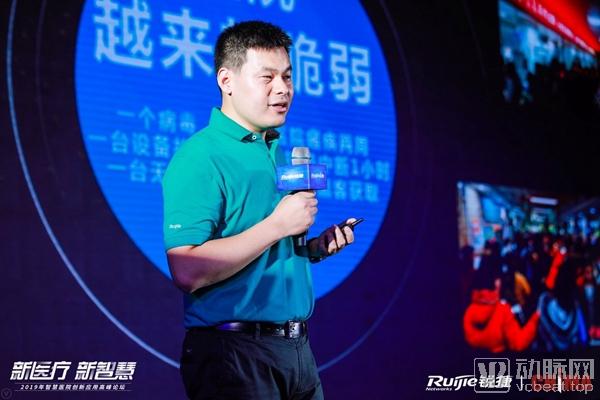
Xu Wei, General Manager of the Healthcare Industry Division at Ruijie Networks
Medical Cloud Desktop: Innovating Terminal O&M Experience to Enhance Continuity of Clinical Services
Currently, the difficulty ordinary people face in accessing medical care has become a cliché issue. Tertiary and secondary hospitals across China have been expanding their facilities to increase the number of hospital beds and improve the doctor-to-patient ratio. Consequently, the number of terminal computers requiring maintenance in these hospitals has surged, rising sharply from hundreds to thousands within a short period.
The hospital’s Information Technology Department is overwhelmed daily by a variety of terminal failures, particularly software and hardware issues. These problems are exacerbated during peak patient visit hours, leading to prolonged maintenance times, increased patient waiting periods, decreased patient satisfaction, and loss of patients in non-key specialties, thereby significantly impairing the hospital’s social and economic benefits. Although the department has attempted to address terminal maintenance challenges by increasing staff headcount and outsourcing services, these measures have failed to effectively reduce fault resolution time.
Xu Wei told VCBeat that some hospitals have attempted to adopt VDI solutions provided by virtualization vendors. However, due to high procurement costs, demanding maintenance skill requirements, and a clinical user experience inferior to that of PCs, these technical approaches have failed to resolve the current challenges. With the widespread adoption of smart hospitals, there will be increasingly stringent requirements for the response time and recovery speed of terminal computers.
Ruijie Networks’ medical cloud desktop solution enables hospitals to build a cloud service-based virtualized office platform by integrating VDI (Virtual Desktop Infrastructure) and IDV (Intelligent Desktop Virtualization) architectures, all without altering the workflow habits of healthcare professionals. This solution helps hospital IT departments reduce workstation troubleshooting and maintenance time, improve clinical departments’ satisfaction with IT services, and lower the total cost of ownership for medical endpoints. According to Xu Wei, the cloud desktop functions as a virtualization layer situated between the hardware and the operating system, consuming approximately 5% to 10% of computing resources. Similar to local PCs, users can access HIS systems, software, and peripherals. “It adds value atop existing PC infrastructure, delivering an experience indistinguishable from that of a traditional PC while offering higher efficiency.”
In terms of investment protection, Ruijie Cloud Desktop solutions achieve compatibility with Windows XP and Windows 7 on the latest CPU architectures, providing reliable support for mainstream hospital application systems currently available in the market. For management purposes, VDI simulates virtual machines with VLAN tags to implement logical isolation between internal and external networks. Users can access both internal and external network services using different accounts on a single terminal device.
In terms of security, even in extreme scenarios where the network and data centers are completely down, cloud terminals can still operate normally, ensuring that medical staff can execute hospital emergency plans and continue their work without interruption. Furthermore, both IDV and VDI provide cloud disk services. Users can directly access their personal cloud disks via drive letters within the operating system upon logging in from any cloud endpoint. This approach enables user-level data portability while adhering to security policies that prevent data from being stored locally.
To date, this solution has been successfully deployed at the First Affiliated Hospital of University of Science and Technology of China (Anhui Provincial Hospital), Yijishan Hospital, the Second Affiliated Hospital of Heilongjiang University of Chinese Medicine, Suzhou Stomatological Hospital, Shijiazhuang Hospital of Traditional Chinese Medicine, and other institutions. It is currently in use at over one hundred hospitals across China, with more than 10,000 terminal units installed.
Cloud Desktop + NBAI Smart Network: Safeguarding Smart Hospitals
“Smart hospital development is a key focus in informatization initiatives,” Xu Wei told VCBeat. First, the scale of smart hospital deployment is substantial; it was projected that by 2020, at least 1,000 new smart hospitals would be established across China. Second, there remains significant room for improvement in existing smart hospitals. In its future development, Ruijie Networks will enhance customer interaction and user experience, while continuing to strengthen its cloud desktop technology to optimize the critical component of user terminals.
Security will also be a key focus area for Ruijie Networks in the future.
Smart hospitals must cater to three key groups—medical staff, patients, and administrators—and be implemented through the pathways of smart medical care, smart services, and smart management. As these three pillars increasingly rely on networks and data, network outages or data loss could cause catastrophic damage and irreparable losses to both hospitals and patients. Furthermore, hospital information systems involve a vast amount of sensitive data, including hospital operations and patients’ medical records; any leakage or dissemination of such information would pose significant security risks to hospitals, society, and patients.
To this end, Ruijie NBAI Smart Network Solution provides one-stop unified management across connectivity, desktop, and security dimensions, delivering safer, more reliable, and more convenient support for the three major domains of smart hospitals.
Regarding 5G deployment, Xu Wei noted that many commercially available supporting 5G chips are still in the laboratory research phase, indicating that the technology is not yet mature. Ruijie Networks has successfully developed a 5G digital indoor distribution solution, and its next focus will be to develop tailored solutions based on the actual needs of hospitals. “In response to diverse hospital requirements—such as telemedicine, remote guidance, or low-latency, high-bandwidth applications related to remote connectivity and video interaction—Ruijie Networks will launch corresponding solutions designed for these specific scenarios.”
The healthcare industry is characterized by high barriers to entry, substantial capital investment, and high returns. It is reported that over the past two years, Ruijie Networks has closely followed industry trends, maintaining strong growth momentum with a growth rate of approximately 30%. At the onset of the rise in mobile nursing, Ruijie Networks developed zero-roaming wireless services, achieving seamless integration between backend data and ward-round operations. This year, aligning with the trends in cloud desktops and smart hospital construction, Ruijie Networks has developed more in-depth, personalized solutions for its users. Xu Wei revealed that the construction of smart hospitals has become an irreversible trend. Ruijie will seize this historical opportunity to forge more premium smart healthcare products, collaborate with hospitals at all levels, and jointly create “new intelligence” for the new era of healthcare.