

LummyBio Focuses on Enhancing Anti-PD-1 Efficacy and Addressing PD-1 Non-Responders Amid Tumor Immunotherapy Challenges

Leads Biolabs
Innovative Therapy Developer
In the late 1990s, Kang Xiaoqiang, upon completing his postdoctoral fellowship in Steven Rosenberg’s laboratory, faced the precarious situation of nearly being unable to find employment—a outcome he had long anticipated. After earning his Ph.D. in Biomedical Sciences from the University of North Texas, Kang devoted himself entirely to research in tumor immunotherapy. Although his impressive academic record—nine papers published in four years—attested to his exceptional research capabilities, tumor immunotherapy lacked public recognition at the time due to numerous clinical failures, and researchers working in this field were largely undervalued.
At that time, ImClone Systems (later acquired by Eli Lilly and Company), a biotechnology company, had an opening in its tumor vaccine research division. Although tumor vaccines represented a highly niche segment within the already specialized field of cancer immunotherapy, Dr. Kang Xiaoqiang chose to join ImClone Systems as a Senior R&D Team Leader. He began with target screening and progressed through druggability assessment, optimization, and animal studies, ultimately advancing the company’s first melanoma vaccine into Phase I clinical trials.
Looking back after many years, Kang Xiaoqiang, one of the most senior researchers in tumor immunotherapy, could not be considered fortunate: the tumor vaccine project he led at ImClone Systems was ultimately terminated due to poor market prospects. Yet Kang was also fortunate: the first indication he targeted for tumor vaccine development more than two decades ago was melanoma, which was later proven to exhibit specific efficacy with PD-1 targeting. The surge of interest in monoclonal antibodies ignited by PD-1 has even advanced the field of tumor immunotherapy as a whole.
When discussing his early experiences, Dr. Kang has consistently emphasized two points to VCBeat. First, he possesses a genuine passion for research in tumor immunotherapy and believes it represents the most promising pathway toward curing cancer. Second, the various research endeavors he undertook during those years, whether directly or indirectly related to tumor immunotherapy, honed his robust practical capabilities.

Dr. Xiaoqiang Kang
“I have engaged with more than ten therapeutic targets and advanced two monoclonal antibodies and one tumor vaccine into Phase I clinical trials, which has been a highly critical experience.” Whether the market approval of immune-oncology drugs is directly attributable to him is of little importance. After all, in Kang Xiaoqiang’s view, even PD-1 monoclonal antibodies, with multiple products already approved and launched, are in urgent need of optimization. With the clinical feasibility of tumor immunotherapy firmly established, the primary task for researchers is to refine pathways and details to benefit a broader population of cancer patients—a mission that Kang Xiaoqiang and his partner, Dr. Lai Shoupeng, are actively pursuing.
In 2014, Kang Xiaoqiang and Lai Shoupeng founded Nanjing Leadsbiolabs Co., Ltd. in Nanjing. The two had previously worked together at a postdoctoral workstation under the supervision of Dr. Steven Rosenberg, a towering figure in the field of cancer immunotherapy in the United States. In October 2017, the second CAR-T cell therapy ever approved by the FDA for market launch was developed by Dr. Rosenberg. In 2018, the Albany Medical Center Prize in Medicine and Biomedical Research, the highest medical science award in the United States, was awarded to three researchers, including Dr. Rosenberg, in recognition of their outstanding contributions to the field of immune system research.
Unlike Kang Xiaoqiang, who specializes in antibody drug development and preclinical research, Lai Shoupeng focuses more on drug commercialization, with extensive experience in biopharmaceutical manufacturing process development, GMP production facilities, and project management. Their collaboration effectively bridges all critical stages of tumor immunotherapy development. Kang Xiaoqiang told VCBeat that Leads Biolabs is dedicated to the R&D of innovative antibody drugs and fusion protein therapeutics, focusing on the development and industrialization of novel cancer immunotherapies. The company has established a pipeline of more than ten candidates, spanning immunotherapies, targeted therapies, and bispecific antibodies. In the coming years, it aims to leverage its accumulated strengths to submit 1–2 Investigational New Drug (IND) applications annually.
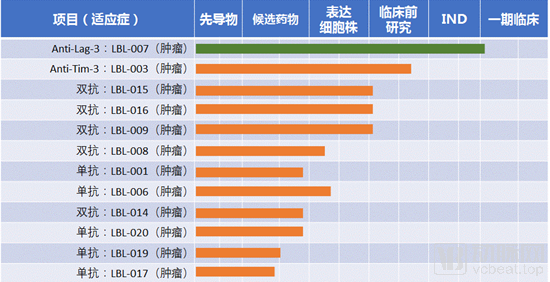
Leads Biolabs' R&D Pipeline
LBL-007, a novel antibody drug targeting the Lag-3 protein, is the most advanced candidate in Leads Biolabs’ research and development pipeline. According to Kang Xiaoqiang, Leads Biolabs has submitted an Investigational New Drug (IND) application for LBL-007, an anti-Lag-3 antibody therapeutic. The application has been reviewed by the Center for Drug Evaluation (CDE), and Phase I clinical trials are set to commence shortly.
The LAG-3 protein helps enhance T-cell activity against tumors and can inhibit other T-cell activities that might otherwise hinder T-cell attacks on tumor cells. As early as 2017, Bristol-Myers Squibb (BMS) began exploring a combination therapy regimen involving the LAG-3 protein and its own PD-1 inhibitor, Opdivo. Clinical studies of this approach demonstrated that the response rate to Opdivo was threefold higher in LAG-3-positive patients.
In September 2017, Bristol Myers Squibb (BMS) presented data from a Phase 1/2a clinical trial at the European Society for Medical Oncology (ESMO) Annual Meeting, focusing on patients with melanoma who had not responded to or had developed resistance to immunotherapy. The results showed that among third-line treatment patients with LAG-3 expression exceeding 1%, 18% responded to the LAG-3/PD-1 combination therapy, whereas only 5% of those with LAG-3 expression below 1% responded to the combination regimen.
Kang Xiaoqiang stated that, due to the low response rates of existing tumor immunotherapies in patients, the combined use of multiple biomarkers and targets has become a mainstream research direction. Leads Biolabs adopted this approach in the development of LBL-007, where the Lag-3 and PD-1 targets act complementarily to benefit patients who are resistant or non-responsive to PD-1 therapy.
Data show that the response rate to PD-1/PD-L1 antibody therapies is approximately 20% in patients with tumor-infiltrating T cells, while 20%–30% of responders develop resistance after about two years of treatment. Furthermore, PD-1/PD-L1 antibodies demonstrate very poor efficacy in patients lacking tumor-infiltrating T cells. “More than 80% of patients who are unresponsive or resistant to PD-(L)1 antibodies require updated immunotherapy regimens.” This represents the strategic entry point for Leads Biolabs’ LBL-007 pipeline.
According to Kang Xiaoqiang, LBL-007 achieved superior results in animal studies compared with BMS data, owing to its selection of antigenic sites distinct from those targeted by BMS’s Lag-3/PD-1 regimen.
Since its inception, Leads Biolabs has completed three rounds of financing. In addition to advancing LBL-007 to the Investigational New Drug (IND) stage, four other pipeline projects have entered preclinical research. For a novel drug company established only five years ago, this represents a remarkably rapid achievement. This May, Leads Biolabs transferred the development rights for an independently developed tumor immunotherapy monoclonal antibody and fusion protein molecule to Pneuma Respiratory, a U.S.-based company, through an exclusive licensing agreement, as previously reported by VCBeat. Historically, Chinese pharmaceutical companies have typically acted solely as licensees in the global new drug market. Consequently, Leads Biolabs’ recent License-out deal has attracted significant attention within the industry.
Kang Xiaoqiang jokingly referred to Leads Biolabs as a “model worker” enterprise, stating, “We independently complete the early-stage development of all our projects.” Behind the “model worker” label is actually Kang Xiaoqiang’s consideration of the cost-effectiveness of project in-licensing at the current stage. On one hand, in-licensing projects requires substantial capital, which would significantly increase the pressure on Leads Biolabs’ cash flow. On the other hand, after in-licensing a project, it takes nearly eight months to conduct validation, “a period long enough for us to carry out independent R&D.”
In Kang Xiaoqiang’s view, monoclonal antibody drugs have advanced rapidly in recent years, undergoing several iterations since Leads Biolabs first entered the field. This progress has been fueled, in part, by R&D bubbles. As a veteran in the field of tumor immunotherapy, Kang Xiaoqiang takes a more rational perspective on the current overhyped enthusiasm for PD-1 inhibitors. “While R&D bubbles certainly lead to significant resource waste, the transition from bubble-driven excess to rationality genuinely drives technological advancement. If leveraged properly, this presents a rare opportunity for tumor immunotherapy.”
However, tumor immunotherapy must avoid the pitfalls of high homogeneity, rampant bandwagoning, and a lack of originality. In reality, both the tumor microenvironment and tumor immunity involve highly complex mechanisms; a single antibody cannot possibly address all issues, necessitating combination with other therapeutic modalities. “The rising popularity of bispecific antibodies, and even trispecific antibodies, since last year demonstrates this point.” Kang Xiaoqiang believes that bispecific antibodies, or the combination of monoclonal and bispecific antibodies, along with tumor microenvironment modulation, will elevate tumor immunotherapy to a new level.
Therefore, in selecting antibody development strategies, Kang Xiaoqiang has defined three main directions for Leads Biolabs: first, antibodies complementary to PD-1, primarily targeting patients who are non-responsive or resistant to PD-1 antibodies; second, PD-1 2.0, which involves simultaneous inhibition of PD-1 and the tumor microenvironment; and third, antibodies targeting tumors lacking anti-tumor T cells.
Kang Xiaoqiang told VCBeat that, in terms of commercialization strategy, Leads Biolabs will independently advance its project to Phase I clinical trials before seeking partners to jointly complete Phase II and Phase III clinical trials. Identifying suitable R&D partners requires a pragmatic global perspective; to this end, Leads Biolabs has established a Scientific and Medical Advisory Board in the United States to provide recommendations on the company’s clinical trial protocols and its pipeline of next-generation novel antibody drugs for tumor immunotherapy.
This year, Leads Biolabs will initiate a new round of financing amounting to approximately RMB 200 million. The funds will be primarily allocated to Phase II clinical trials for the Lag-3 target, Phase I clinical trials for two antibodies, and pipeline development.