

Deepwise AI Lab Achieves Dual Milestones: Five Papers Accepted at MICCAI 2019 and Filing of IPO Prospectus

DeepWise
Developer of Artificial Intelligence Medical Imaging Diagnosis System
The acceptance results for the 2019 International Conference on Medical Image Computing and Computer-Assisted Intervention (MICCAI 2019) have been announced, with five papers from Deepwise AI Lab accepted.
MICCAI, organized by the Medical Image Computing and Computer Assisted Intervention Society, is a comprehensive academic conference spanning the fields of Medical Image Computing (MIC) and Computer Assisted Intervention (CAI). As a premier conference in this domain, it attracts research teams from 134 top-tier scientific and academic institutions worldwide, and is recognized for its substantial international influence and high academic authority.
With the booming development of artificial intelligence across various fields, the number of paper submissions to MICCAI this year has reached a new historical high, representing a 70% increase compared to last year. Adhering to MICCAI’s rigorous standards for the depth and quality of academic exchange, only 540 papers were accepted this year, resulting in an acceptance rate of just 31%. The accepted papers represent the cutting-edge technologies in computational imaging and computer-assisted interventions, serving as a bellwether for frontier hotspots in medical image analysis and guiding the future direction of the field.
Since its establishment, the DeepWise Research Institute has consistently participated in MICCAI submissions. This year, DeepWise submitted 10 papers, with 5 accepted, achieving an impressive acceptance rate of 50%. This demonstrates that the DeepWise Research Institute is a scientific research team that prioritizes quality over quantity. The five accepted papers cover research directions such as semantic segmentation, object detection, and multi-task learning, marking innovative breakthroughs in the field of AI-driven medical applications. Furthermore, these cutting-edge scientific achievements have been partially integrated into DeepWise’s Dr.Wise® AI-assisted diagnostic products, yielding favorable outcomes in clinical practice.
Below is an overview of the research achievements of the five selected papers:
1. Yuhang Liu, Shu Zhang, Ling Luo, Qianyi Zhang, Fandong Zhang, Xiuli Li, Yizhou Wang, Yizhou Yu. From Unilateral to Bilateral Learning: Detecting Mammogram Mass with Contrasted Bilateral Network. International Conference on Medical Image Computing and Computer Assisted Intervention (MICCAI),2019.
It is well known that mass detection based on mammography images holds significant clinical value for the early diagnosis of breast cancer. This paper proposes a deep learning-based algorithm for mammographic mass detection that explicitly models bilateral information in mammograms. By employing a deformation-tolerant module to accommodate non-rigid variations in local regions of bilateral breasts, and by embedding the intrinsic logic of radiologists’ image interpretation into a logical bilateral module, the proposed method significantly improves performance. On the public DDSM mammography dataset, our method achieves a detection sensitivity up to 5 percentage points higher than existing methods at the same number of false positives, fully validating the effectiveness of the algorithm.
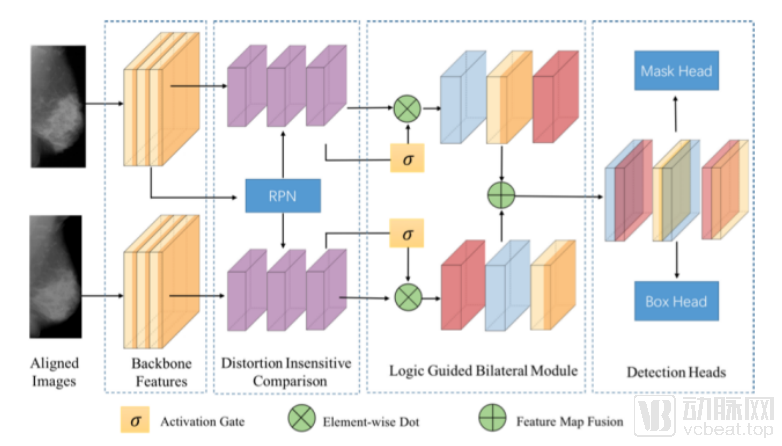
(Network framework diagram. The model takes registered bilateral breast images as input, where the Distortion Insensitive Comparison Module mitigates local non-rigid variations caused by registration through ROI Align; the Logic Guided Bilateral Module incorporates domain knowledge from radiologists’ image interpretation, thereby enhancing model performance.)
2. Zihao Li, Shu Zhang, Junge Zhang, Kaiqi Huang, Yizhou Wang, Yizhou Yu. MVP-Net: Multi-view FPN with Position-aware Attention for Deep Universal Lesion Detection. International Conference on Medical Image Computing and Computer Assisted Intervention (MICCAI),2019.
This paper presents a research exploration by DeepWise Research Institute and the Institute of Automation, Chinese Academy of Sciences, on a whole-organ lesion detector based on CT images. This technology is playing an increasingly important role in routine clinical diagnosis and treatment of conditions such as pulmonary nodules and stroke. Although general-purpose lesion detectors with a unified framework hold immense application potential, there remains a scarcity of research in this area. Leveraging DeepLesion, the largest CT image dataset released by the NIH to date, we have developed a general-purpose lesion detector capable of identifying various lesions throughout the body.
Leveraging clinicians’ professional expertise in diagnostic practice, researchers proposed a multi-view object detection network to fuse image information across multiple window width and level settings. The network effectively integrates information from different window widths and levels through a position-sensitive attention module. Experimental results demonstrate that our model improved the detection accuracy at 4 false positives per scan from 84.37% to 91.30%.
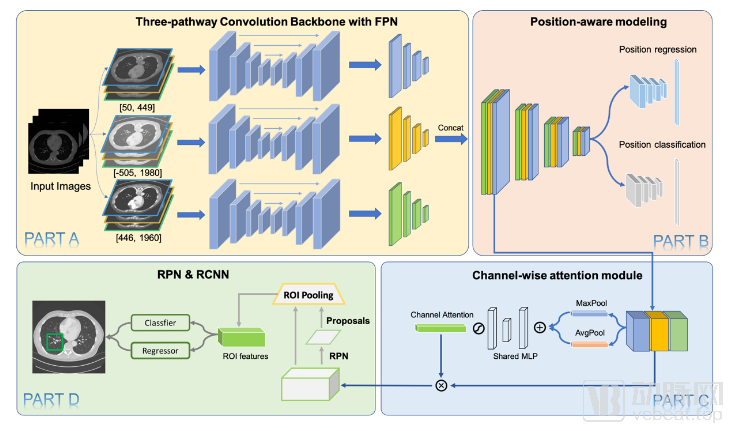
(Network architecture of MVP-Net. Part A illustrates the multi-view FPN detection network for modeling multi-window width and level information fusion. Part B presents our proposed position-sensitive module. Part C employs an attention module to fuse features from different window widths and levels.)
Pancreatic cancer, known as the "king of cancers," is regarded as the last fortress in oncology in the 21st century. Despite significant progress in diagnosis, treatment, and basic research, challenges remain substantial. Due to the high variability in pancreatic size and shape, low contrast with surrounding tissues, and its small volume within the abdominal cavity, automatic segmentation of the pancreas from abdominal CT images presents a major challenge. DeepWise Research Institute has had two papers accepted that propose innovative approaches to address this challenge.
3. Chaowei Fang, Guanbin Li, Chengwei Pan, Yiming Li, Yizhou Yu. Globally Guided Progressive Fusion Network for 3D Pancreas Segmentation. International Conference on Medical Image Computing and Computer Assisted Intervention (MICCAI), 2019.
The main contribution of this paper is the proposal of an innovative semantic segmentation model that addresses the limitation of existing methods in failing to balance global features and local contextual information. We propose a voxel segmentation model equipped with a progressive fusion module and a global guidance branch. This model can more effectively and efficiently leverage 3D features by learning 3D local features from the 3D neighborhood extracted from the current CT slice, while predicting the corresponding 2D segmentation results. Meanwhile, the global guidance branch supplements global features by utilizing the downsampled full image of the current CT slice. Our method achieves state-of-the-art performance on two pancreatic segmentation datasets.
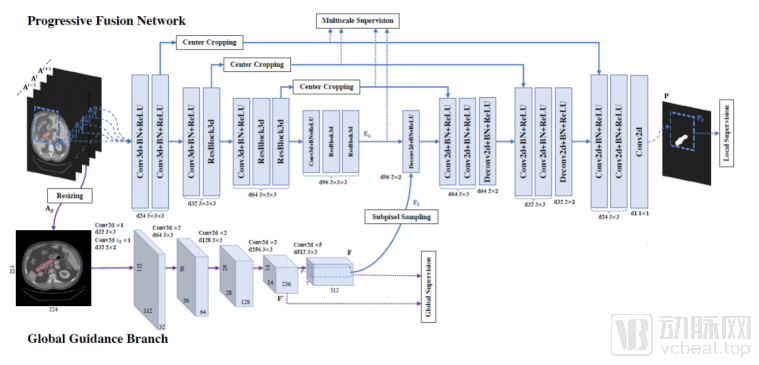
(Overall Framework of Our Method)
4. Huai Chen, Xiuying Wang, Yi-Jie Huang, Xiyi Wu, Yizhou Yu, Lisheng Wang. Harnessing 2D Networks and 3D Features for Automated Pancreas Segmentation from Volumetric CT Images. International Conference on Medical Image Computing and Computer Assisted Intervention (MICCAI), 2019.
This paper presents a collaborative research achievement between DeepWise Research Institute and Shanghai Jiao Tong University. In this study, the research team developed a novel method that, for the first time, introduces a dimension-adaptive module to bridge three-dimensional (3D) information with pre-trained two-dimensional (2D) networks, thereby fully leveraging 3D data. Tested and validated on the NIH pancreas segmentation dataset, the method achieves an average computation time of approximately 0.4 minutes, demonstrating strong clinical practicality.
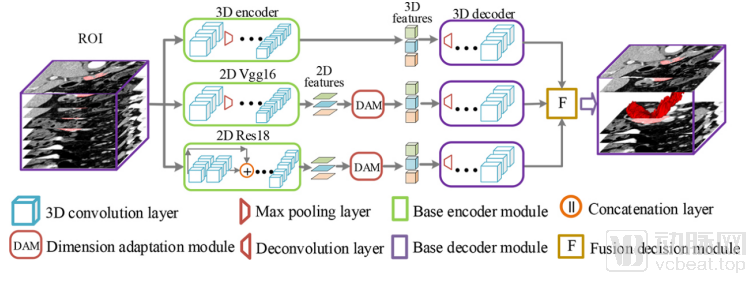
(To enable precise prediction by integrating multi-source features, the Dimension-Adaptive Module (DAMS) incorporates internal features from a pre-trained 2D network into the 3D network and the fusion decision module.)
5. Wei Zhang, Guanbin Li, Fuyu Wang, Longjiang E, Yizhou Yu, Liang Lin, Huiying Liang. Simultaneous Lung Field Detection and Segmentation for Pediatric ChestRadiographs. International Conference on Medical Image Computing and Computer Assisted Intervention (MICCAI), 2019.
Lung region segmentation based on X-ray images is of significant importance in clinical diagnosis and treatment. However, research on pediatric lung region segmentation has lagged behind due to the scarcity of public datasets and the substantial domain differences between pediatric and adult X-ray images (e.g., scale, size, orientation).
Led by Professor Liang Huiying from Guangzhou Women and Children’s Medical Center, this study was conducted in collaboration with DeepWise Research Institute and Sun Yat-sen University. It proposes for the first time SDSLung, a multi-task convolutional neural network framework designed for simultaneous detection and segmentation of pulmonary regions in pediatric chest X-rays. Experimental results demonstrate that the proposed algorithm significantly improves the accuracy of pulmonary region segmentation in pediatric chest X-rays, while also achieving state-of-the-art performance on adult chest X-ray data. Accurate segmentation of pulmonary regions in children is crucial for subsequent analysis of pediatric pulmonary diseases and for assisting surgical treatments.
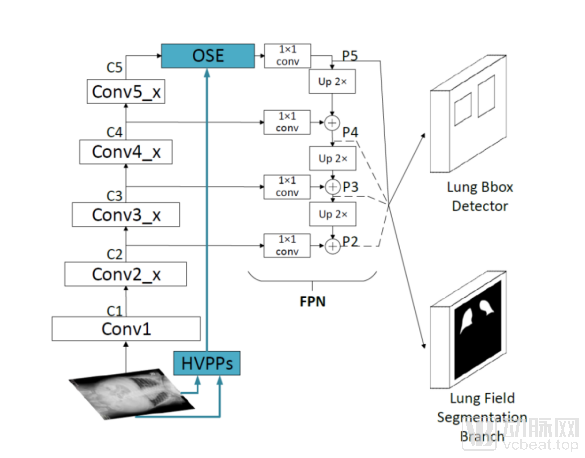
(The Overall Framework of Our Deep Neural Network)
About Deepwise AI Lab
DeepWise Research Institute is one of the largest research institutions in the industry dedicated to artificial intelligence in healthcare. Since its establishment, it has been committed to exploring cutting-edge medical technologies. By integrating technology with clinical practice, the institute has produced numerous scientific achievements that combine clinical value with technological innovation, which have been successively accepted by top international journals and conferences.
To date, DeepWise Research Institute has published nearly 30 papers in top-tier journals and conferences on artificial intelligence and machine learning, such as Science Robotics, TPAMI, TCyb, TIP, ICML, CVPR, ICCV, ECCV, and AAAI. These publications cover the three premier international conferences in computer vision and pattern recognition. Notably, the institute has presented academic achievements at the highly prestigious CVPR conference (ranked in the Top 10 of Google Scholar’s 2019 metrics) for two consecutive years, placing it among the leading technology companies in China’s AI sector. Additionally, in the field of medical image computing and analysis, the institute has published more than 20 papers at top-tier conferences such as IPMI, MICCAI, ISBI, and RSNA.