

UNIZ Technology Files for IPO: Global Leader in High-Speed Medical 3D Printing with 90% Revenue from Overseas Markets
According to the latest data released by Allied Market Research, the global 3D printing healthcare market was valued at $579 million in 2014 and is projected to reach $2.3195 billion by 2020, with a compound annual growth rate (CAGR) of 26.2% during the forecast period from 2015 to 2020.
In the global 3D printing healthcare market, North America holds the largest share. Apart from North America, Europe is the second-largest market for 3D printing medical applications. Furthermore, the Asia-Pacific region is poised to become the fastest-growing market for 3D printing in healthcare.
VCBeat has learned that in China, a 3D printing company named UNIZ Technology, founded in 2014, primarily sells its printers to the European and American markets. Currently, approximately 75% of UNIZ Technology’s products are exported to Europe and the United States, while its domestic market share accounts for about 10%. Japan and South Korea are also key markets for the company. In the United States, UNIZ Technology collaborates with Glidewell Labs, the world’s largest dental prosthetics manufacturer.
In overseas markets where 3D printing technology is more mature, what core advantages have enabled UNIZ Technology to win customer favor? VCBeat (WeChat ID: vcbeat) interviewed Li Houmin, founder of UNIZ Technology.
The industrial chain for 3D printing in medical applications comprises multiple segments, including raw materials, scanners, core components, and 3D printers. UNIZ Technology does not cover the entire industrial chain; instead, it focuses deeply on the 3D printing equipment segment, encompassing 3D printers themselves as well as related consumables and software.
Within the 3D printing industry chain, printing equipment represents the segment with the largest output value. From a market perspective, the trend of import substitution for industrial printers is evident. As domestic enterprises advance and mature their technologies, Chinese-made 3D printers have become highly competitive. The desktop printer market is intensely competitive, and market concentration is unlikely to increase in the short term.
UNIZ Technologies’ product portfolio includes industrial-grade and desktop 3D printers. In this highly competitive market, the core competitive advantage established by UNIZ Technologies is printing speed. UNIZ Technologies’ printers utilize continuous unidirectional peeling cUDPTM technology, which Li Houmin describes as the world’s fastest vat photopolymerization 3D printing technology. Furthermore, UNIZ Technologies’ printers leverage cUDPTM technology to address the issue of resin-based parts not being truly “rapid” in rapid prototyping.
Compared with other mainstream SLA printing technologies, laser SLA printing takes approximately 3.1 hours, DLP-SLA takes about 2 hours, while the continuous unidirectional peeling cUDPTM technology requires as little as 2.5 minutes.
While pursuing printer speed, UNIZ Technology has not compromised on precision. UNIZ Technology’s printers achieve machining-grade high precision with an accuracy of 0.02 mm.
In medical applications, where does the value of high-speed printing lie? Li Houmin stated, “We do not directly serve hospitals and physicians; rather, we support the intermediaries that provide products and services to them. The speed of product delivery is a key metric for hospitals when deciding whether to adopt these intermediaries’ products.”
Li Houmin cited the successful collaboration between UNIZ Technology and Glidewell Dental Laboratories as an example. Glidewell Labs, the world’s largest manufacturer of custom dental restorations, has contracts with over 40,000 clinics in the United States.
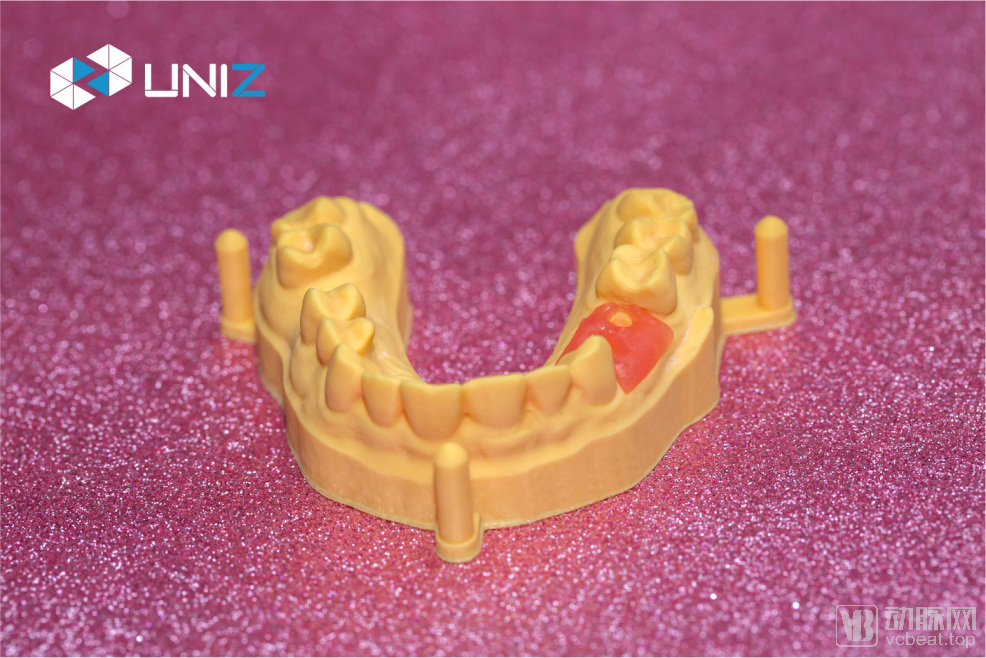
3D-Printed Dental Models (Photo provided by the interviewee)
“Glidewell has risen to become a dental industry giant, with speed being one of its defining characteristics. In the United States, it can deliver complete surgical plans and models to clinics within 72 hours of receiving patient data. To shorten the delivery time for restorations, Glidewell provides digital solutions to dental clinics and hospitals. Furthermore, Glidewell has established processing facilities adjacent to FedEx distribution hubs. Thus, Glidewell’s success is inseparable from its relentless pursuit of speed.”
Within Glidewell’s digital ecosystem, Glidewell Dental Lab leverages artificial intelligence in conjunction with a proprietary restorative database, enabling clinicians to either design and fabricate restorations in-office or digitally submit patient cases to the Glidewell laboratory.
In addition to applying 3D printers in dentistry, UNIZ Technology also collaborates with Medtronic to provide surgical models for physicians in interventional therapy.
UNIZ Technology can create 3D models based on patients' CT or MRI data prior to surgery, and then print these models using 3D printers. The primary purpose of 3D-printed medical models is to allow surgeons to visually assess the three-dimensional structure of the surgical site beforehand, thereby facilitating surgical planning. This is particularly beneficial in complex surgeries, as it helps reduce surgical risks and improve success rates.
Taking aneurysms as an example, if an aneurysm is located in a position that is difficult for surgeons to access, endovascular treatment requires the physician to possess advanced procedural expertise. 3D-printed models can provide preoperative simulation for surgeons, particularly benefiting those with less experience by allowing them to practice on the physical model. In this context, UNIZ Technology’s advantage lies in its ability to rapidly print models that accurately reflect pathological changes, thereby providing clinicians with the most timely feedback.
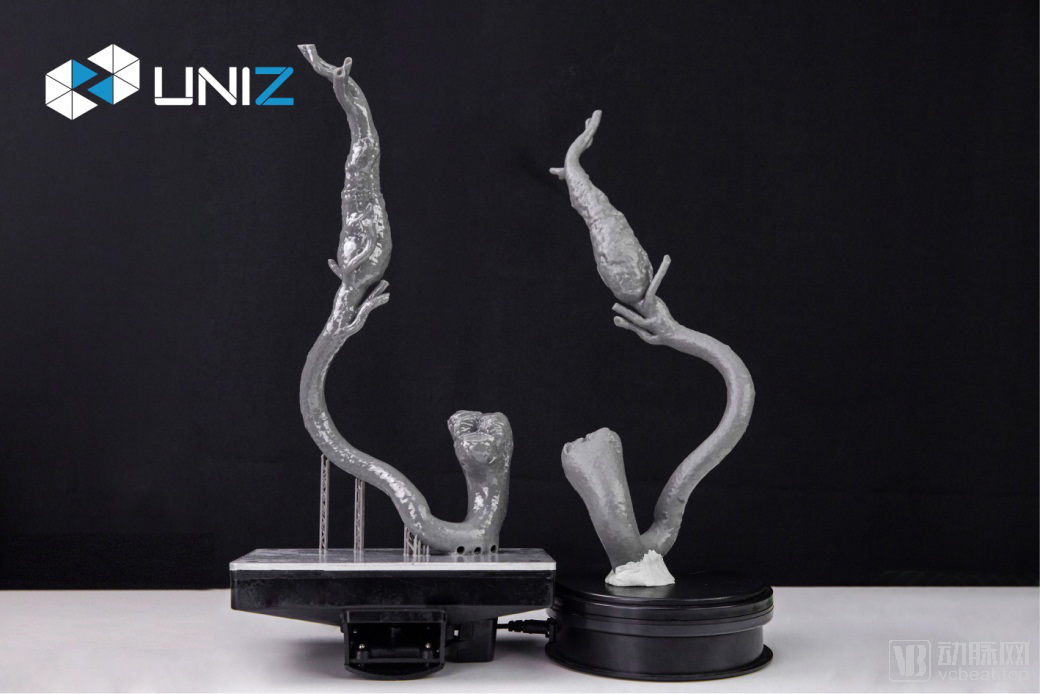
3D-Printed Model of Hemangioma Lesion (Image provided by the interviewee)
UNIZ Technologies has also entered the field of orthopedics, where 3D printing applications are currently widespread. Li Houmin stated, “In orthopedic rehabilitation, our digital splints can replace traditional plaster casts, which often provide a poor user experience. Furthermore, from a rehabilitation perspective, after two weeks of immobilization with a plaster cast, the cast should be removed for a period under conscious supervision to allow the injured area to regain strength. Traditional plaster casts cannot meet this need. In contrast, 3D-printed splints can be designed as removable devices with ventilation gaps, which is more beneficial for patient recovery.”
In orthopedic surgery, UNIZ Technology collaborated with Solingen Municipal Hospital in Germany to assist surgeons in performing an orthopedic procedure by leveraging 3D printing technology and third-party augmented reality (AR) solutions. Prior to the operation, surgeons could examine a 1:1 scale 3D-printed model of the lesion, which offers more intuitive visualization than MRI scans, thereby facilitating the efficient and accurate formulation of surgical plans. During the procedure, the 1:1 model served as a reference for comparison with the actual surgical field, enhancing surgeons’ confidence and improving the success rate of the operation.
Currently, UNIZ Technology’s applications in the orthopedic field are primarily focused on Class I and Class II medical devices. Li Houmin revealed that UNIZ Technology will next explore 3D printing for Class III medical devices, developing metal-printed products for medical use.
Looking back at the achievements UNIZ Technology has made over the past five years, the company has amassed over a thousand clients. Its products are applied across industries including healthcare, automotive, entertainment and animation, and footwear manufacturing. Key partners include Mercedes-Benz, ANTA, Ecco, Glidewell Labs (the largest dental laboratory in the United States), and Medtronic.
UNIZ Technology’s rapid achievements are inseparable from founder Li Houmin’s longstanding passion for and dedication to 3D printing technology. As early as 2001, while pursuing his undergraduate degree in Materials Science and Engineering at Tsinghua University, Li was first exposed to 3D printing—a technology that was still immature at the time.
Subsequently, Li Houmin went to the University of Southern California in the United States, where he earned a master’s degree in Materials Science and Engineering. He then pursued his studies at Auburn University in the United States, obtaining master’s degrees in Electrical and Computer Engineering and Polymer Engineering, as well as a Ph.D. In 2014, one year after the expiration of the key SLA patent, Dr. Li Houmin founded UNIZ Technology.
Today, UNIZ Technology’s core team comprises senior software and hardware development experts as well as marketing and sales professionals, with branch offices established in Beijing, Shenzhen, Guangxi, the United States, and the Netherlands.
Although UNIZ’s products are currently sold primarily to overseas markets, Li Houmin believes that as 3D printing applications become more widespread in China, the domestic market for medical applications of 3D printing will also enter a period of rapid growth.
Li Houmin stated, “Compared to European and American markets, China remains relatively conservative in the adoption of new technologies. In Western environments, ethical review frameworks for innovative technology applications are well-established. Furthermore, there are corresponding insurance systems in place to support the deployment of such innovations. Although development in the Chinese market lags behind that of Europe and the United States, it still holds substantial room for growth.”
In 2017, UNIZ Technology secured a Series A financing round of RMB 45 million, led by Delian Capital. Currently, UNIZ Technology is also undertaking a new round of financing.