

Infervision Launches AI-Powered End-to-End Lung Cancer Solution and Files for IPO

Infervision
Artificial Intelligence Product Developer
On July 5, 2019, the State Council issued the “Opinions on Implementing the Healthy China Action.” The document explicitly states that active cancer prevention should be advocated, and early screening, early diagnosis, and early treatment should be promoted... It sets targets for the overall five-year cancer survival rate to reach no less than 43.3% by 2022 and 46.6% by 2030. To break down this plan, lung cancer, breast cancer, and gastric cancer will undoubtedly become the key focus areas, with lung cancer being the highest priority.
Statistics show that in China alone, the number of new lung cancer cases reached 800,000 in 2018, while the total number of patients approached 13 million. A senior radiologist told VCBeat, “Among individuals aged 40 and above, 30% have pulmonary nodules; of these, 29% are benign nodules and 1% are lung cancer. Furthermore, among the 800,000 diagnosed lung cancer patients, only 20% were detected at an early stage.”
Benign nodules should not cause panic among patients, while lung cancer must not be missed. This requires not only timely early screening by patients but also precise decision-making by physicians.
There are many potential solutions. For instance, some physicians have pointed out that while the Department of Respiratory Medicine has access to patients, it lacks advanced post-processing tools; conversely, the Department of Radiology possesses robust post-processing capabilities and data but has limited patient contact and insufficient clinical knowledge. Therefore, establishing a specialized pulmonary nodule imaging clinic adjacent to the respiratory outpatient department could help improve screening accuracy.
Regardless of the approach, the challenges remain centered on funding and talent, with technology continuously offering support. For instance, artificial intelligence (AI) technologies are accelerating report generation and image interpretation... What else can AI technology help us achieve?
Infervision is more committed to imaging AI than any other company.
Four years have passed since Infervision pioneered the use of AI technology for the automatic detection of pulmonary nodules in medical imaging in China, to now becoming the first in the industry to launch its “Smart Solution for the Full Lifecycle of Lung Cancer.” Recalling the early days, Chen Kuan, Founder and CEO of Infervision, smiled wryly: “When we first unveiled our AI, we were hardly confident enough to look at it ourselves.” Today, however, few in the field are unfamiliar with the name Infervision when it comes to AI-powered medical imaging.
As of June 2019, Infervision’s deployment sites had covered 30 provinces, municipalities, and autonomous regions across China, while also completing its strategic layout in North America, the Asia-Pacific region, and Europe, with a presence in eight countries worldwide. By June 2019, Infervision was assisting physicians in completing over 40,000 clinical diagnoses daily, and the total number of cases processed by Infervision AI servers had exceeded 7 million.
However, Infervision is still striving to refine the functionality and positioning of its AI products. For a long time, we have regarded imaging AI merely as a tool to assist physicians in reading medical images, and all imaging AI companies have focused on this aspect, thereby overlooking the advantages of AI in education, management, and decision-making. Furthermore, the potential needs of hospitals remain to be fully explored.
Therefore, Infervision AI emphasizes the full lifecycle of lung cancer management, empowering the entire chain from early screening and treatment to follow-up. All four key stages—prevention, diagnosis, treatment, and management—are indispensable.
The value of the intelligent full-cycle solution for lung cancer lies in integrating previously isolated AI services, supported by a platform, to unlock the value of disease management.
Chen Kuan stated, “Healthcare involves many stages, but we must address every aspect of the treatment process and integrate all these stages to deliver value to patients. Patients do not derive value from screening alone, nor from diagnosis alone, and they certainly do not undergo surgery without cause. It is only when screening, diagnosis, and subsequent follow-up, observation, surgery, and prognosis are combined that patients can truly appreciate the value brought by AI. This is the core direction of our solution design.”
Specifically, Infervision will build an AI-assisted diagnosis and decision-making system covering the entire lifecycle of “prevention, diagnosis, treatment, and management.” This solution will leverage a research quality control platform to support physicians in AI-driven scientific innovation and clinical implementation, thereby accelerating the rapid development of artificial intelligence applications across the full spectrum of lung cancer care, including screening, diagnosis, treatment decision-making, and prognosis. By establishing “imaging databases” and “clinical databases” as data centers for healthcare institutions, it will achieve unified and standardized data management, enhancing data usability and security. Ultimately, through its AI medical application platform, Infervision will provide comprehensive, standardized, full-lifecycle AI solutions for lung cancer prevention, diagnosis, and treatment.
In fact, Infervision has already validated the feasibility of its “Smart Solution for the Full Lifecycle of Lung Cancer” in collaboration with partners such as the Third Affiliated Hospital of Jinzhou Medical University in Liaoning Province. With the support of Infervision’s AI-powered medical products, the hospital has provided precise early screening services for lung cancer to residents and healthcare institutions within the region, effectively integrating advanced technologies into lung cancer prevention and control, enhancing regional lung cancer screening capabilities, and improving public well-being.
So, how do doctors benefit from artificial intelligence? A doctor presented such a table to VCBeat.
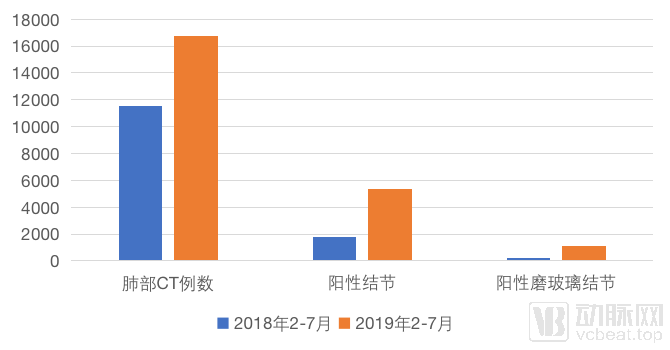
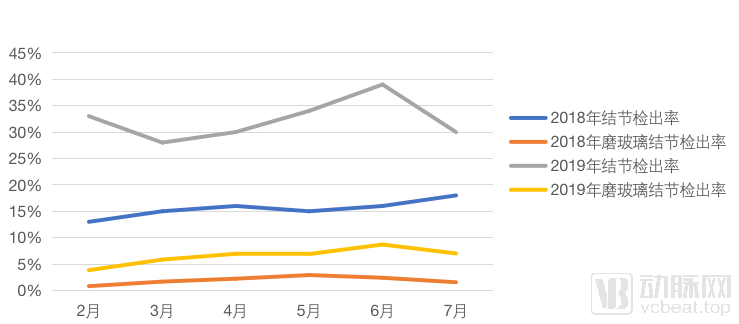
After the application of Infervision AI in 2019, the detection rates for both nodules and ground-glass nodules increased significantly.
This presents the statistical data from a hospital in Shandong Province following the adoption of Infervision’s AI solution for pulmonary nodule detection. Several major trends are evident:
1. In the first five months of 2019, the total number of pulmonary CT scans performed at this hospital increased from 11,525 in 2018 to 16,751, representing a year-on-year growth of 45.3%.
2. The number of detected positive nodules increased significantly, with the average nodule detection rate rising by approximately 17% and the average ground-glass nodule detection rate increasing by about 4.6%.
The increased detection of early-stage positive nodules means that early-stage nodules, which were previously easily overlooked, are now being identified, allowing for earlier diagnosis of lung cancer. It also means that more lung cancer patients can receive early treatment through “one-time payment” models, resulting in a significant reduction in treatment and medication costs compared to those with advanced-stage disease, as well as a substantial decrease in health insurance expenditures.
Regarding the role AI plays in this transformation, the physician stated, “The number of patients is continuously rising, but the number of radiologists has not increased proportionally. With excessive workloads, diagnostic accuracy inevitably declines. Infervision’s AI has significantly reduced the time we spend on image interpretation while ensuring accuracy, which I believe is why its adoption rate continues to rise. At the same time, it provides indirect support for the development of our department.”
Overall, the value contributed by Infervision can be categorized into three aspects.
For physicians and hospitals, the value of medical AI is widely recognized. Medical AI products can serve as super assistants to doctors, alleviating the burden on clinicians, providing better medical tools, reducing repetitive manual labor, maximizing physician efficiency, addressing the shortage of healthcare workforce in China’s medical services, improving diagnostic efficiency, and enabling doctors to refocus on their core professional value.
For patients, AI technology offers new feasibility for early screening, diagnosis, and treatment of cancer, which not only saves lives and reduces treatment costs but also improves the quality of life for patients and their families.
For our society as a whole, AI technology has made it possible to extend high-quality medical resources to the grassroots level, thereby promoting the implementation and improvement of China’s tiered diagnosis and treatment system while reducing health insurance expenditures.
Thanks to the efforts of medical imaging AI companies, the vision of AI-assisted diagnosis has become a reality. Now, Infervision has launched its comprehensive smart solution for the full lifecycle of lung cancer care, reigniting enthusiasm for leveraging AI in prevention, diagnosis, treatment, and management. What lies ahead? Chen Kuan offered an answer with significant potential: “Expanding business models and fostering internal innovation are our two core strategic directions, both centered on advancing and enhancing healthcare services.”