

Sichuan Provincial People's Hospital Robotic Minimally Invasive Center Successfully Completes Complex Tumor Surgery with 3D-Printed Surgical Model
As the concept of smart healthcare gains widespread acceptance, an increasing number of innovative approaches are being applied to clinical practice. In May this year, Sichuan Provincial People’s Hospital, the Chengdu High-Tech Industrial Development Zone Administrative Committee, and Sichuan Huashu Turing Co., Ltd. jointly signed the Strategic Cooperation Agreement on Medical 3D Printing. In July, the National Medical Products Administration and the National Health Commission issued the Announcement on the Provisions for the Supervision and Administration of Custom-Made Medical Devices (Trial) (Announcement No. 53 of 2019). A transformation in surgical practice is underway, quietly yet rapidly.
As a practitioner of surgical innovation, the Robotic Minimally Invasive Surgery Center at Sichuan Provincial People's Hospital deeply integrated 3D printing technology with precision medicine concepts in a surgery performed last week, successfully completing a highly complex tumor resection.
Ms. Wu, who just celebrated her 31st birthday last month, is relatively young but has become a “frequent visitor” to the hospital. Due to an abdominal paraganglioma, she has been hospitalized multiple times and underwent open resection of the paraganglioma more than two years ago. A follow-up examination one month ago revealed a new mass larger than a fist in her right retroperitoneal space. Given her prior surgical history, along with complications such as the tumor encasing the renal pedicle, indistinct boundaries with the inferior vena cava and liver, abundant blood supply, and disruption of surrounding anatomical structures, the feasibility of completing the surgery was reduced to an extremely low level. After being declined for surgery at a well-known local hospital, the patient came to the Robotic Minimally Invasive Surgery Center of Sichuan Provincial People’s Hospital with her last hope.

Figure 1 Director Wang Dong of the Provincial Hospital’s Center for Robotic Minimally Invasive Surgery
Director Wang Dong of the Robotic Minimally Invasive Surgery Center at Sichuan Provincial People’s Hospital is the first physician in Sichuan Province to be globally registered as a da Vinci Surgical System surgeon. He has personally performed over 1,500 da Vinci robotic surgeries and was honored with the highest award, the “Robotics Master” Award, at the Asian Robotics Conference. Taking into account the complexity of the surgical case and recommendations from his team, and considering the efficiency and accuracy of preoperative assessment and communication, it was decided to customize a surgical model of Ms. Wu’s right kidney using 3D color printing technology provided by Sichuan Huashu Turing Additive Manufacturing Technology Co., Ltd., to assist in surgical analysis and planning.
The Sichuan Huashu Turing technical team utilized Ms. Wu’s CT scan data to perform multi-angle, precise 3D reconstruction of relevant anatomical structures, including blood vessels and the tumor. Using 3D printing technology, they fabricated a 1:1 surgical model. The model employs multi-colored materials to accurately and clearly demarcate the boundaries and spatial relationships between different structures—such as intrarenal and perirenal vasculature, the renal pelvis, and the tumor—using distinct colors.
and incorporated this model into preoperative discussions, specifically inviting Mr. Chen Jidong from the Department of Ultrasound at Sichuan Provincial People’s Hospital to conduct a multidisciplinary team (MDT) consultation for this patient, thereby enabling more scientific preoperative planning and formulation of the surgical strategy. Meanwhile, the demonstration of the surgical model also allowed the patient
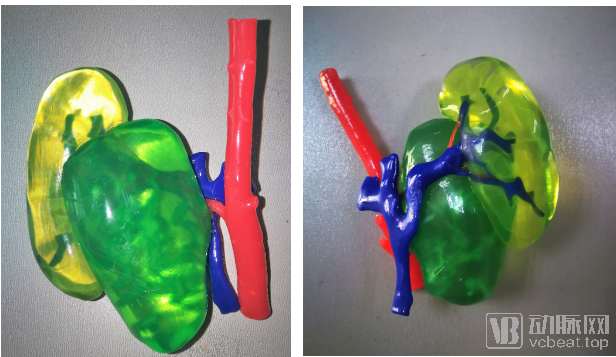
Figure 2 Surgical Model
To gain a more intuitive understanding of the patient’s condition, ensure adequate psychological preparation, facilitate doctor-patient communication, and lay a solid foundation for surgical success. Ultimately, through relentless efforts, the robotic minimally invasive surgery team led by Director Wang Dong overcame various challenges and successfully resected the mass.
With the advancement of technology, the era of smart healthcare and big data has arrived, prompting industries across the board to seek further development. As a bellwether sector for human technological progress, healthcare is also continuously innovating and advancing. Only by embracing, daring, and seeking change can we better welcome the new era.
We look forward to a brand-new era in future healthcare!