

BioMap Advances AI and Life Sciences Integration at the 8th Hong Kong Biophysics Graduate Symposium

BioMap
Developer of Innovative Drug R&D Platform
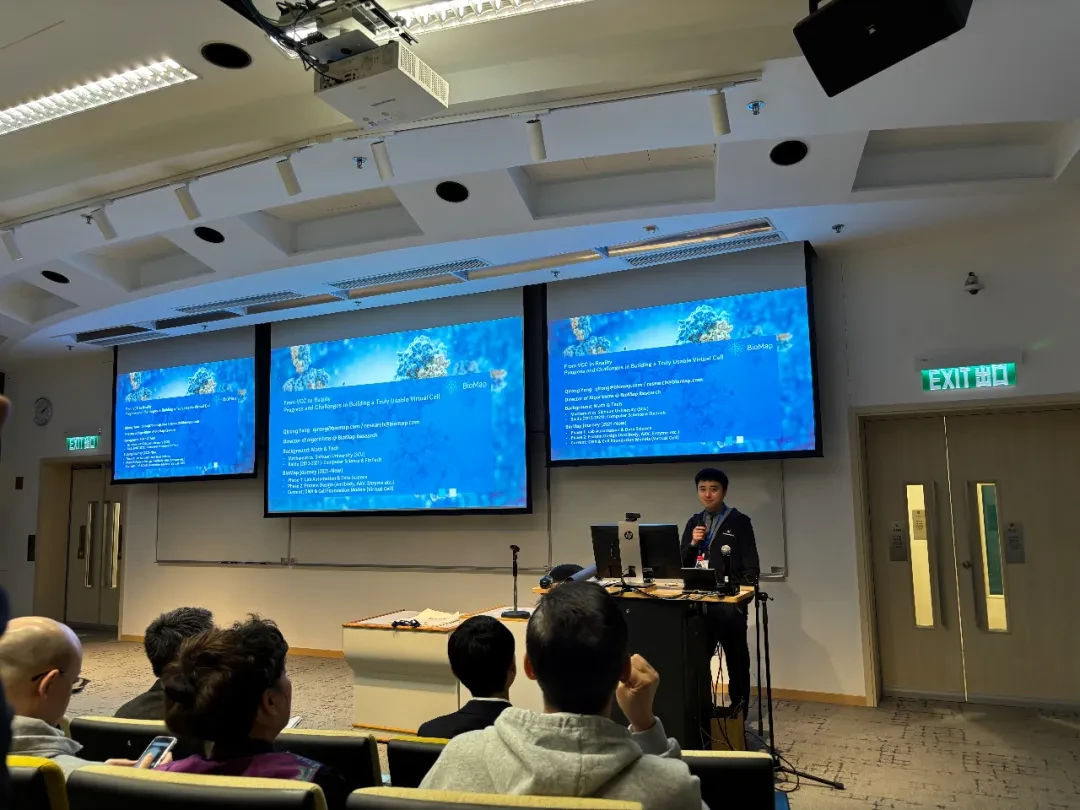
On January 11, 2026, the 8th Hong Kong Biophysical Graduate Student Annual Conference, sponsored by BioMap, was successfully held at the Hong Kong University of Science and Technology. The annual conference brought together graduate students, faculty, and researchers from multidisciplinary backgrounds such as physics, chemistry, and biology, aiming to promote academic exchange, research collaboration, and innovation network building in the field of biophysics. As an important partner of this conference, Yang Qirong, head of AI Cell Algorithms at BioMap and the first-ever Virtual Cell Challenge (VCC) world champion, was invited to attend and delivered a speech titled《From VCC Competition to the Real World: Progress and Challenges in Building "Usable" Virtual Cells》Thematic Speech.
Facing a 90% Failure Rate: Breaking Through Drug Development with "Virtual Cells"
Yang Qirong pointed out at the beginning that the current drug development faces a severe challenge where approximately 90% of candidate drugs fail in clinical trials. The core reason lies in the inability of traditional in vitro experiments to fully replicate the complex responses of cells to drug perturbations. Therefore, building a highly predictive and high-precision "AI Virtual Cell" (AIVC) has become the key to breaking through this industry bottleneck.
"We not only need to understand static biological sequences, but also need to predict dynamic cellular behaviors." Yang Qirong stated. To this end, BioMap has constructed the xTrimo family of models, including the protein language model xTrimoProtein, the bio-inspired DNA model xTrimoDNA, the genomic regulatory mechanism model xTrimoGenome, and the single-cell foundation model scFoundation, systematically enhancing multi-modal and cross-scale reasoning and representation capabilities from the molecular to cellular levels.
Review of VCC Championship Technology: The Breakthrough of scFoundation 2.0
As the highlight of the speech, Yang Qirong made an in-depth review for the first time in a public setting of the technical details behind BioMap's victory in the inaugural Virtual Cell Challenge (VCC). Faced with the challenges of "predicting perturbations in unseen cell types" and "highly noisy and sparse data" in the VCC competition, the team upgraded the base model and introducedscFoundation 2.0。
The three core technological breakthroughs of this model:
Data Denoising Strategy: Innovatively teach the model to distinguish between "biological zeros" (Biological Zeros, i.e., true non-expression) and "technical zeros" (Technical Zeros, i.e., sequencing loss) in gene expression, effectively extracting high signal-to-noise ratio biological signals from massive amounts of low-quality public data.
Cross-modal Architecture: The introduction of xTrimoProteinNext's protein characterization has constructed a unified representation of genes and cell states, significantly enhancing the model's interpretability.
Alignment Training: By using Latent Distribution Alignment technology, the gap between high-quality data from competitions and low-quality publicly available data has been successfully bridged.
From Competition to Reality: BioMap OS Builds a Closed Loop
"Winning the championship is just the starting point; our next step is to build truly usable virtual cells." Yang Qirong presented BioMap's future roadmap at the end of his speech. He emphasized that applying AI virtual cells to real drug discovery must rely on multi-omics integration and Dry-Wet Closed-Loop. Currently, BioMap has launched its discovery system product.BioMap OS, integrating knowledge, prediction and design, intelligent experiments, data, and model training to form a complete R&D closed loop.
Joining Hands with Hong Kong Universities to Build an AI Life Science Ecosystem
Lin Yiwei, Head of BioMap HK InnoHub (BioMap Hong Kong Innovation Center), attended the meeting and stated: "Hong Kong boasts world-class scientific research foundations and talent reserves. We look forward to collaborating more with research institutions and universities in Hong Kong and around the globe through the xTrimo life science foundational large model platform and BioMap OS, jointly exploring the limitless potential of AI in drug design, synthetic biology, and disease mechanism research."
About the 8th Hong Kong Biophysical Graduate Student Academic Annual Conference
Since 2014, the annual meeting has been successfully held for seven sessions, with previous conferences rotating among multiple universities such as The Chinese University of Hong Kong, Hong Kong Baptist University, and City University of Hong Kong. It has become an important academic exchange platform in the local fields of biophysics and computational biotechnology.