

DaWei Medical Files IPO Prospectus: AI-Powered ECG Solution with 99.99% Beat Accuracy Serves Over 100,000 Patients
“Five years ago, a relative of mine passed away suddenly from a heart attack. It was a profound shock to me—how could someone who had always been in such good health just disappear like that?” said Li Feng, founder of Shenzhen Datawe Medical Technology Development Co., Ltd. (hereinafter referred to as “Datawe Medical”).
According to World Health Organization (WHO) statistics, cardiovascular and cerebrovascular diseases claim 15 million lives globally each year, making them the leading cause of death worldwide. Data released by the National Health Commission shows that mortality from cardiovascular and cerebrovascular diseases accounts for more than 40% of all disease-related deaths among Chinese residents. In addition to high mortality, these diseases are also characterized by high rates of disability and prevalence. In China, the number of patients with cardiovascular disease has reached 290 million, making it a severe social issue.
“Heart disease does not occur without warning signs. Studies have shown that 72% of patients experience significant discomfort before cardiac arrest, with 70% of them having symptoms lasting more than 15 minutes. Therefore, real-time electrocardiogram (ECG) monitoring for patients to promptly detect abnormal ECG changes is of great significance in the prevention and treatment of cardiovascular diseases,” said Li Feng. “I previously majored in computer science and have experience in algorithm research. Thus, I hope to enter the field of remote ECG monitoring to contribute to the heart health of people in China.”

Li Feng, Founder of Datawe
He observed that large hospitals had long queues of cardiac patients waiting for examinations and treatment, while primary care facilities were nearly empty. Doctors informed him that scheduling a dynamic electrocardiogram (ECG) at many Grade A tertiary hospitals required a wait of two weeks or even longer. Only these top-tier hospitals possessed the necessary equipment; primary care institutions lacked the capacity to provide ECG monitoring services. After conducting research, he concluded that the efficient processing of ECG data was the core component of solutions for heart disease.
Serial Entrepreneur Li Feng Focuses on the Field of ECG Monitoring
Currently, Datawe focuses on data operation services for the full lifecycle of cardiovascular care, providing intelligent ECG solutions for cardiovascular data preprocessing to healthcare institutions and out-of-hospital users.
In fact, DataWe Medical was not the first company founded by Li Feng. As a serial entrepreneur, Li established a software company after graduation that specialized in the processing and analysis of financial data, thereby accumulating extensive experience in data handling. Later, he focused on the research and development of cardiovascular medical devices, successfully developing remote ECG monitoring equipment. Although this venture failed due to an immature market at the time, he did not give up.
In 2015, inspired by CardioNet, a pioneer in American cardiac health management, Li Feng founded Datawe. When discussing his reasons for choosing the cardiovascular field, he stated:
First, China has a large patient population with cardiovascular diseases and a high frequency of medical visits. Approximately 35 million dynamic electrocardiogram (ECG) tests are performed annually, while static ECG examinations reach 250 million person-times. Additionally, tens of millions of people undergo real-time cardiovascular monitoring each year, and the annual activation volume of wearable devices with heart rate monitoring capabilities also reaches tens of millions. The market for ECG data services is a massive industry valued at hundreds of billions of yuan.
Secondly, ECG data is presented in the form of waveform graphs, which users cannot interpret on their own and require physicians to read and provide guidance. However, China has only over 30,000 physicians with extensive experience in interpreting ECGs, and they are mainly concentrated in central hospitals, resulting in a severe supply-demand imbalance. Meanwhile, reading ECGs consumes a significant amount of physicians' time; processing one dynamic ECG record takes approximately 30 minutes to several hours. Intelligent ECG algorithms can not only assist in interpreting ECGs but also reduce physicians' workload as well as the rates of missed diagnoses and misdiagnoses.
Finally, the field of ECG monitoring has high entry barriers, requiring cross-disciplinary knowledge and experience as well as substantial accumulation of ECG data. Prior to its establishment, DataWe had already amassed extensive experience and resources in the research and development of ECG devices and in electrocardiogram data.
Throughout the entrepreneurial journey, many like-minded partners have gradually joined Datawe. Li Feng introduced, “Our management team possesses extensive experience in corporate governance and startup operations. We also have dedicated teams specializing in algorithm research and medical affairs. In terms of algorithmic R&D, Datawe has established a Joint Laboratory for Cardiac Health Devices and Artificial Intelligence with Southern University of Science and Technology (SUSTech), focusing on AI technology research. The laboratory comprises experts in machine learning, PhDs specializing in mobile internet research, and specialists devoted to sensor studies. On the medical front, our team includes professors and ECG experts from multiple Grade A tertiary hospitals, who provide guidance on cardiovascular clinical data modeling and assist Datawe in developing high-quality algorithms.”
Addressing the industry’s key pain points—namely, the lack of diagnostic equipment and specialized interpreting physicians at primary care hospitals, insufficient physician capacity due to high outpatient volumes at central hospitals, and the absence of medical-grade devices, professional analysis tools, and clinical services outside hospital settings—DataWe has developed an integrated solution. Building on prior R&D efforts and real-world market experience, this solution combines AIPlus.ECG intelligent ECG algorithms, a distributed storage system, collaborative analysis software, and ECG acquisition devices. It provides networked data processing tools for hospitals and internet-based data processing platform services for out-of-hospital users, thereby helping central hospitals improve diagnostic efficiency and treatment quality, enabling primary care hospitals to establish ECG diagnostic capabilities, and connecting patients with physicians to achieve “early screening, early prevention, and early treatment.”
Currently, Datawe primarily offers services in three areas. Li Feng introduced, “In terms of equipment, we provide ECG acquisition devices that integrate dynamic, static, and telemetry functions into a single unit; these devices have obtained CFDA certification. In terms of software, we offer collaborative analysis software and dedicated mobile mini-programs, enabling users to access relevant services anytime and anywhere. Additionally, we provide specialized services such as assisted diagnosis.”
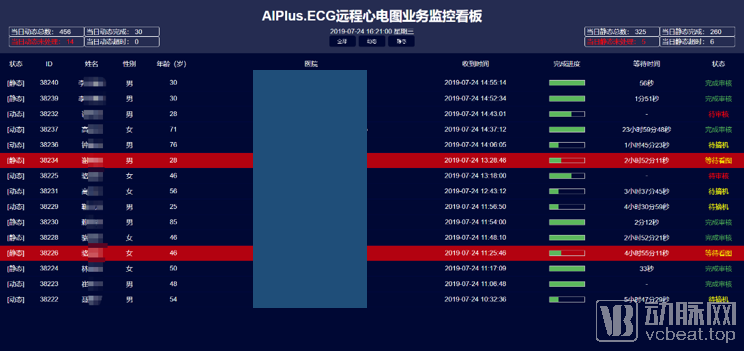
(Dawei Medical AIPlus.ECG Remote ECG Business Monitoring Dashboard)
Expert-level AI algorithm, with 99.99% accuracy in normal heartbeat recognition
“ECG data is the core of cardiac health management and disease treatment, serving as the cornerstone of AI-based ECG algorithms.” Datawe believes that “the essence of cardiac health management is data management.” Therefore, Datawe has developed an intelligent ECG information system that connects primary healthcare institutions with central hospitals, as well as patients with physicians, providing users with high-quality professional data processing services.
Meanwhile, datawe’s intelligent ECG information system, as an open data processing platform, also integrates third-party ECG data acquisition devices, including single-lead wearable devices. Combined with datawe’s AIPlus.ECG intelligent ECG algorithm, the system can identify and diagnose various cardiac diseases, enable multi-scenario applications, and facilitate self-assessment of cardiac health status.
Most notably, datawe’s AIPlus.ECG intelligent ECG algorithm stands out. This algorithm is an industrialized artificial intelligence-based 12-lead electrocardiogram (ECG) diagnostic medical technology developed by datawe. It boasts high accuracy and precision, capable of identifying more than 40 types of cardiac conditions, including arrhythmias, heart rate variability, and myocardial ischemia. It demonstrates particular strength in detecting premature beats, tachycardia, escape beats, conduction blocks, atrial fibrillation, and atrial flutter. Compared with traditional ECG analysis and diagnostic methods, this algorithm offers significant advantages.
AIPlus.ECG’s intelligent ECG algorithm can also identify more than ten critical values, including ventricular flutter, ventricular fibrillation, and frequent premature ventricular contractions, enabling real-time monitoring of patients’ cardiovascular conditions and providing critical alerts.
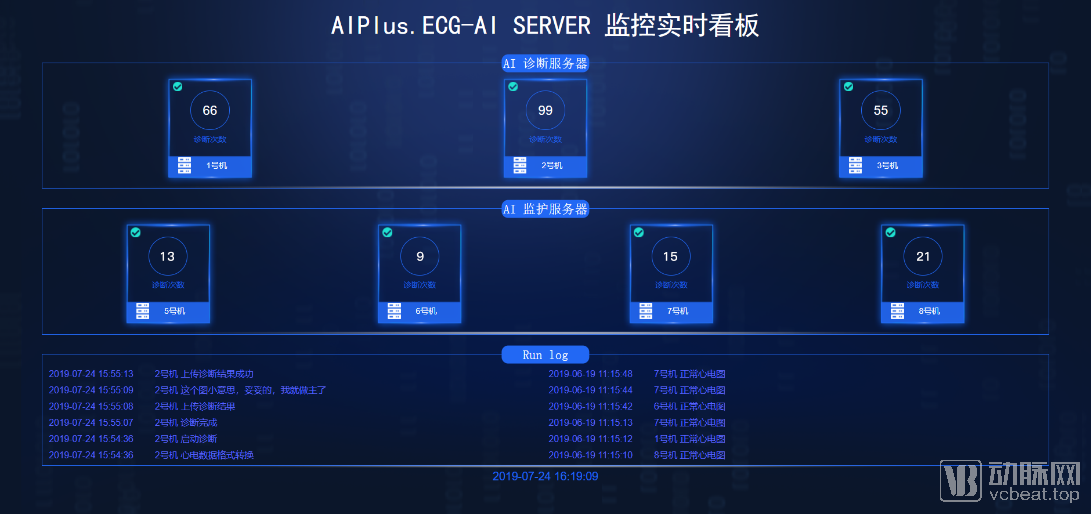
AIPlus.ECG-AL SERVER Monitoring Real-Time Dashboard
AIPlus.ECG’s intelligent ECG algorithm has been validated against the American Heart Association (AHA) database, the MIT-BIH Arrhythmia Database, and the European Common Standards for Quantitative Electrocardiography (CSE) database, achieving a 99.99% accuracy rate in normal beat recognition. Li Feng stated, “This algorithm is based on annotated clinical training data from over 100,000 12-lead ECG records. It is one of the few ECG algorithms globally capable of automated diagnosis stratified by sex and age group, thereby reducing the workload of interpreting physicians by 40–80%.”
The algorithm has also undergone third-party clinical validation. Li Feng stated, “We conducted clinical validation of the algorithm at four Grade A tertiary hospitals. Each hospital selected 300 patient electrocardiograms (ECGs), totaling 1,200 cases. These were first diagnosed by physicians and then by our algorithm. The diagnostic results were evaluated by three chief-level experts, and the findings demonstrated that the AIPlus.ECG intelligent ECG algorithm outperformed manual diagnosis.”
Li Feng stated, “Leveraging technological advantages and business model innovation, Datawe has established a core competitive edge characterized by high cost-effectiveness, reducing equipment and labor costs while enhancing the overall operational efficiency of its systems. In 2018, Datawe’s revenue exceeded RMB 10 million.”
Focusing on the B2B sector, expanding from in-hospital to out-of-hospital settings
Datawe’s growth and expansion have been driven not only by its proprietary algorithms but also by the tiered diagnosis and treatment policy. Li Feng remarked, “We are truly grateful for the healthcare reform policies, particularly the tiered diagnosis and treatment system, which has significantly contributed to Datawe’s development.” On September 8, 2015, the General Office of the State Council issued the Guiding Opinions on Promoting the Establishment of a Tiered Diagnosis and Treatment System, enabling Li Feng to identify opportunities for rapid growth.
Under the tiered diagnosis and treatment policy, Datawe has partnered with Central Hospital to establish a consultation center, leveraging the medical consortium framework to serve primary care hospitals. Specifically, Datawe provides remote testing services to primary healthcare institutions; after testing, ECG data are transmitted to Central Hospital, where highly skilled physicians conduct remote consultations. Currently, Datawe serves more than 400 primary healthcare institutions.
Unlike most ECG monitoring service providers, Datawe primarily serves primary healthcare institutions. By providing ECG monitoring devices and remote medical services to primary healthcare institutions in 13 provinces, Datawe has served over 100,000 patients.
In terms of sales model, Datawe has chosen to collaborate with distributors. Its data preprocessing services connect resources through distributors to provide hospitals with auxiliary diagnosis and other services, while ECG acquisition devices are sold via distributors. Notably, data preprocessing services have become Datawe’s primary source of revenue.
In 2019, with the rapid rise of wearable devices equipped with heart rate and electrocardiogram (ECG) monitoring capabilities, Datawe also began to focus on the out-of-hospital ECG data services market, establishing strategic partnerships with several leading enterprises.
At the end of the interview, Li Feng stated, “Datawe has always been dedicated to the cardiovascular field. In the future, we will continue to provide specialized services centered on data processing across the entire lifecycle of cardiovascular diseases, expanding from in-hospital to out-of-hospital settings, extending our support from clinical devices to wearable devices, and broadening our scope from assisted diagnosis and real-time monitoring to out-of-hospital rehabilitation and disease prevention.”