

Healthy Choice Wellness Corp. Wins ECI Awards Grand Prize with Proprietary nFOPT® Fiber-Optic Physiological Monitoring Technology for Elderly and Infant Care
Recently, the 5th ECI Awards International Digital Business Innovation Forum and Award Ceremony was held in Weihai City, Shandong Province. The ECI Awards International Digital Business Innovation Competition received a total of 907 entries from industries such as AI, VR, new retail, smart medical devices, education, and food & beverage. An expert jury composed of more than 150 specialists will select 21 Gold Awards from nearly one thousand digital innovation cases.
Following the evaluation, the NIKE Try-On Experience Space, Ping An Smart Healthcare, and Huijia Health’s nFOPT® Non-Invasive Fiber-Optic Physiological Monitoring Technology and Smart Care System were awarded the Gold Awards in the Marketing Innovation, Model Innovation, and Product Innovation categories, respectively. In addition, Huijia Health, exhibiting for the first time, not only won the Gold Award for Product Innovation but also secured the sole “Grand Prize” among all innovative products this year.
It is reported that the current valuations of nearly all past Grand Prix-winning entries have exceeded $1 billion. What enabled Huijia Health’s product to stand out among nearly 1,000 competitors? And how did it earn the favor of more than 150 experts? VCBeat spoke with Ms. Yang Shuzhen, founder of Huijia Health, to hear her insights.
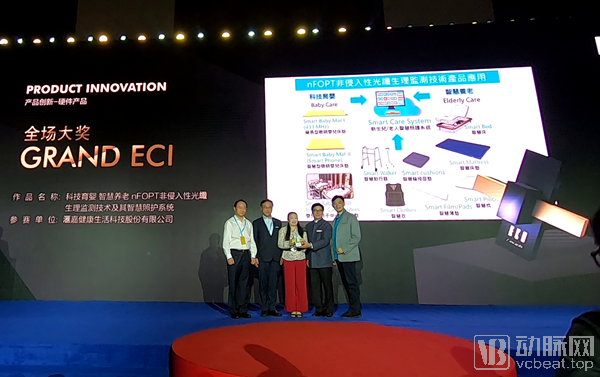
Yang Shuzhen Receives Award (Photo from the Interviewee)
According to the latest data, by the end of 2016, China's population aged 60 and above had reached 230 million. The next 20 to 30 years will witness an accelerated aging process, with the elderly population growing rapidly at an annual rate of 3%. It is projected that by 2030, the elderly will account for approximately 25% of the total population. How to balance value creation with high-efficiency elderly care has become an urgent issue to address. Furthermore, as living standards improve, a contradiction has emerged between the rising demand for neonatal care and the shortage of neonatal caregivers. Yang Shuzhen, founder of Huijia Health, told VCBeat, “Only when the elderly and children are well cared for can the national workforce devote themselves fully to social production.”
Huijia Health, established in 2009, is a high-tech enterprise dedicated to providing technology-enabled care models and alleviating workforce shortages through its proprietary non-invasive fiber-optic physiological monitoring technology. The company’s R&D center is located in the Hsinchu Biomedical Park in Taiwan, China, with offices in Hong Kong, Shenzhen, and Shanghai.
When discussing her original motivation for starting the business, Yang Shuzhen recalled a past incident. To monitor the safety and health status of her premature niece at all times, Yang, who previously worked in fiber-optic technology, decided to develop healthcare technologies that enable intelligent care services for infants and young children. She pioneered the nFOPT® non-invasive fiber-optic physiological monitoring technology.
This technology employs a 0.5 mm optical fiber as a physiological sensor, calculating the subject’s status by monitoring changes in light attenuation caused by fiber deformation or vibration. This approach achieves non-invasive monitoring of various human physiological activities, including respiration and sleep states. “The barrier to entry for fiber-optic technology in Taiwan’s tech industry is high, but most products are used for data transmission,” introduces Yang Shu-zhen. Based on the principle of total internal reflection, fiber optics emit no electromagnetic radiation, posing no harm to the human body, while offering greater sensitivity than electromagnetic waves. Consequently, enterprises leveraging fiber optics to detect vital signs can obtain more subtle physiological parameters.
Unlike conventional wearable smart physiological monitoring devices, Huijia Health has developed a smart mattress capable of gesture recognition and autonomous learning. Built upon high-sensitivity, high-precision fiber-optic physiological sensors and leveraging intelligent methods such as big data analytics, this innovation enables 24-hour non-wearable home-based physiological monitoring for newborns.
In light of the accelerating global population aging, Huijia Health has leveraged its successful experience in infant care to expand into the elderly care market. By standardizing the commercial application of optical sensing technology, Huijia Health has significantly reduced the discomfort associated with traditional physical sensors in eldercare services, alleviated the shortage of caregiving personnel, and enhanced the overall quality of elderly care services.
Since 2017, Huijia Health has successfully developed a series of smart products, including smart mattresses, smart cushions, and smart clothing. These solutions enable safety and health monitoring by unobtrusively capturing health data from toddlers and the elderly.
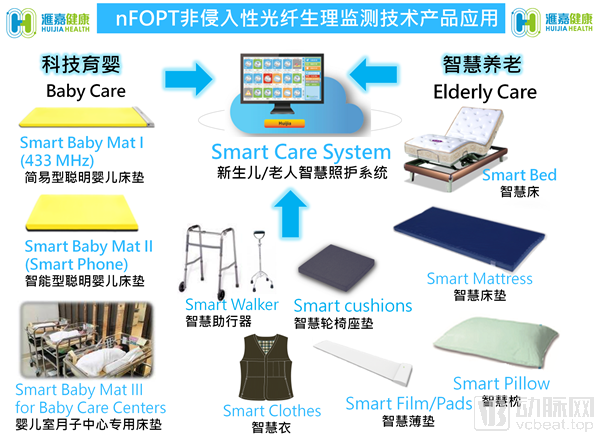
Overview of Huijia Health’s Products (Image provided by the interviewee)
Yang Shuzhen introduced that the various applications of Huijia Health’s proprietary patented core technology, nFOPT®, have gained recognition both domestically and internationally, successively winning the Top 100 Innovation Gold Awards in 2015 and 2017, the Gold Medal at the 16th APICTA (Asia Pacific ICT Alliance Awards), and the 2017 R&D 100 Awards.
As of the end of 2018, Huijia Health’s products had been used by more than 220 maternal and child health hospitals, postpartum care centers, and elderly care centers across China, serving a total of over 50,000 individuals.
“Caring for the elderly and young children is not the ultimate goal of Huijia Health,” Yang Shuzhen told VCBeat. As a next step, Huijia Health will integrate physiological monitoring, the Internet of Things (IoT), and AI-powered robots to realize its vision of smart home-based care.
To address the need for long-term companionship and care for the elderly, Huijia Health has developed an intelligent sleep health management and companion guardian robot, featuring proprietary motion recognition and motion-activated wake-up technology to replace voice activation. This unique motion recognition learning capability allows seniors to make emergency calls simply by nodding, without pressing any buttons. This innovation transforms passive care into proactive care, enabling active health and safety early warnings and enhancing the quality of manual nursing care.
Furthermore, this robot integrates physiological monitoring, the Internet of Things (IoT), and AI robotics to create intelligent nursing systems—such as a neonatal safety and health tracking management system and smart care rooms—as well as household appliances and robots with automatic control based on physiological activities, thereby providing 24-hour automated safety and health patrols. This unique continuous intelligent care system assists caregivers, physicians, and family members in real-time monitoring and analysis of users’ physiological data, and can be widely applied to remote home care, community-based long-term care services, hospital-based home hospice care, and residential care facilities.
After a decade of R&D on nFOPT® technology-based physiological monitoring sensors, Huijia Health now holds dozens of patented technologies. The sensors have evolved from an initial thickness of 7 mm to the latest ultra-thin, portable fiber-optic sensors measuring just 1.5–2 mm, significantly broadening their application scope. Huijia Health has accumulated substantial big data and maintains relatively stable technological sophistication, thereby establishing high barriers to entry in the industry.
Yang Shuzhen told VCBeat that Huijia Health has already focused on more advanced clinical medical validation of medical devices, conducting clinical trials in hospitals to study the correlation between fiber-optic sensing mats and PSG-diagnosed sleep apnea syndrome. The research results were published in July 2019 in the internationally renowned medical engineering journal *Physiological Measurement*.
This study demonstrates, for the first time worldwide, that patients can classify sleep apnea syndrome without the need for wearable external devices. “This research is poised to transform the detection of sleep apnea syndrome in the future, expanding testing capabilities to home settings or any hospital bed.”
Furthermore, Huijia Health is leveraging pulse wave signal processing and blood pressure measurement algorithms to develop key technologies for continuous blood pressure wearable devices, while researching non-invasive continuous blood pressure monitoring devices. It is reported that Huijia Health is launching a new round of financing to support the research and development of new products and the recruitment of professional talent.