

Yuan Yi Herbal Haircare: Bridging Traditional Chinese Medicine and Cosmetics for Global Expansion
Yuan Yi Hair Care: Rooted in Ancient Formulas, Nourishing Beautiful Hair.
“In the Five Elements theory, ‘Yuan’ corresponds to Water, ‘Yi’ to Earth, and hair to Wood. ‘With Water, Earth, and Wood present, it is bound to thrive,’ said Zheng Wei, founder of the Yuan Yi Traditional Chinese Medicine Hair Care chain, proudly over the phone. This reflects the Five Elements philosophy in Traditional Chinese Medicine.”
The correspondence between the Five Elements and the five zang organs forms the foundation of Traditional Chinese Medicine (TCM). According to VCBeat’s 2019 Special Report on TCM, since 2015, as policy support for TCM has intensified, the number of TCM medical institutions and TCM-related enterprises has grown year by year. Against this backdrop, TCM companies are also seeking new business growth points, with consumer-oriented TCM products emerging as a major direction for cross-industry expansion.
By integrating traditional Chinese medicine (TCM) with scalp and hair care, Yuan Yi Hair Care has developed three product series—smooth and shiny, anti-dandruff and oil-control, and anti-hair loss and hair regrowth—through the research and development of ancient formulas and ultra-low temperature cell-wall disruption processing of Chinese herbal medicines. The company has already obtained two TCM invention patents. Since the opening of its first store on July 4 this year, Yuan Yi Hair Care achieved profitability within just one month. It is expected that by the end of this year, the brand will have opened a total of three stores in China’s first-tier cities and expanded internationally by launching a TCM hair care store in South Africa.
How does Yuanyi Herbal Hair Care achieve profitability in one month, compared to the six months it takes for industry peers? Why did Zheng Wei choose the hair care sector? What are the advantages of consumer-oriented traditional Chinese medicine (TCM) products? With these questions in mind, VCBeat conducted exclusive interviews with Zheng Wei and Zhang Yuan, founders of the Yuanyi Herbal Hair Care chain, to hear their insights.
Speaking of Wenling merchants, most people are likely familiar with them. Born in this region in 1986, Zheng Wei was perhaps influenced by the local business atmosphere; while studying medicine and health at Beijing University of Chinese Medicine, he planted the dream of “promoting the internationalization of Traditional Chinese Medicine.”
In Zheng Wei’s view, expertise in medicine and pharmacy alone was insufficient to realize his ambitions. Therefore, after completing his undergraduate studies, he pursued advanced studies in securities law at the Central University of Finance and Economics, studying under Professor Guo Feng, President of the China Securities Law Research Association. In late 2012, Zheng Wei joined Gushengtang, a chain of traditional Chinese medicine clinics, as Board Secretary. As a core team member, he played a key role in facilitating Gushengtang’s strategic transformation, financing, and mergers and acquisitions.
“At that time, we raised capital in U.S. dollars, with the aim of pursuing internationalization,” analyzed Zheng Wei. “However, Gushengtang primarily focuses on internal medicine treatments within Traditional Chinese Medicine (TCM), which traditionally involves patients consulting experienced TCM practitioners who then prescribe herbal decoctions for consumption. Yet abroad, due to a lack of cultural foundation and stringent regulatory approval processes for herbal medicines, it is difficult to gain acceptance among foreign consumers for TCM remedies in the healthcare and pharmaceutical sector.”
Zheng Wei realized that the path of internal treatment in Traditional Chinese Medicine (TCM) would not yield immediate results. In 2015, riding the wave of favorable policies, TCM emerged as a new growth hotspot. After concluding his entrepreneurial journey at Gushengtang, Zheng Wei joined Zhongjing Technology Investment Co., Ltd. to strategically invest from the perspective of the TCM industry chain, with a primary focus on the TCM sector.
Among the projects invested in by Zheng Wei, he has assisted Beijing Qinglai Health, as a shareholder and strategic advisor, in focusing on its chain of Traditional Chinese Medicine (TCM) Day Surgery Centers. According to previous reports by VCBeat, Qinglai Health utilizes the “Huangdi Needle” technique to perform minimally invasive TCM needle-based surgical procedures (known as TCM Needle Repositioning Surgery) for the treatment of cervical and lumbar disc diseases, leveraging Western medical imaging technologies to achieve visualized surgery. Zheng Wei stated, “TCM external therapies have garnered support from international friends; Ban Ki-moon, the eighth Secretary-General of the United Nations, has previously received this type of treatment.”
“Verified, TCM external therapies are acceptable to overseas audiences. However, as they are driven by TCM techniques, the talent training cycle is long, making internationalization difficult. ‘So I was thinking: while external therapies work, replicating practitioners is not feasible; meanwhile, Chinese herbal medicines are not widely accepted and lack FDA recognition. Could we develop them not as pharmaceuticals, but as cosmetics?’ said Zheng Wei. ‘Overseas, cosmetic approval is much easier.’”
Consequently, Zheng Wei began researching the cosmetics market. “The facial and body care segments are already dominated by established brands, leaving little room for new entrants in terms of product categories. Therefore, we opted for the relatively niche field of scalp care.” In his view, the relationship between the scalp and hair is akin to that between soil and vegetation: only when the soil is healthy can the plants thrive; similarly, only with a healthy scalp can hair flourish. Since Unilever and Procter & Gamble entered the Chinese market in the 1990s and began selling shampoos, they have propagated the misconception that “oiliness, dryness, and hair loss are merely hair issues.”
Zheng Wei aims to leverage the power of traditional Chinese medicine to help the public recognize that the root cause of hair problems lies in scalp conditions, which can be improved.
The saying “hair is a woman’s second face” has gone viral online. Compared to men, women tend to pay closer attention to their scalp and hair health. Accordingly, Yuanyang Hair Care targets its customer base with 90% consisting of women aged 25 to 50. This demographic primarily faces four major pain points: dry and frizzy hair, oily scalp and dandruff, hair loss, and premature graying.
Leveraging his professional expertise and the assistance of an elder from a family with a long heritage in Traditional Chinese Medicine (TCM), Zheng Wei began developing classical formulas targeting these four major scalp concerns. By formulating specific combinations and ratios of herbs, he created targeted TCM-based hair care products and established a standardized service protocol for acupoint and meridian therapy on the head, thereby enhancing the scalp’s absorption of the active ingredients in the herbal decoctions.
"To maximize the efficacy of traditional Chinese herbal medicines, Zheng Wei employs ultra-low temperature cell wall disruption. 'While conventional cell wall disruption technologies on the market typically operate at around -10°C, we have achieved a temperature of -196°C. This ensures an exceptionally high cell wall breakage rate, with nutrient release exceeding 95%.'"
To ensure treatment efficacy, all hair care specialists at Yuan Yi Hair Care are required to master scalp acupoint therapy and meridian dredging techniques. Consequently, Yuan Yi Hair Care’s products are exclusively available to in-store clients and are not offered for retail sale.
When asked about hair loss, a concern plaguing many people today, Zheng Wei provided an analysis from the perspective of Traditional Chinese Medicine (TCM). “Many individuals now have irregular daily routines, and factors such as staying up late, stress, anxiety, and the use of inappropriate shampoos can lead to excessive scalp oiliness. Prolonged and severe oiliness can cause hair follicle blockage, resulting in folliculitis. This impedes the delivery of nutrients from the scalp hair follicles to the hair strands, leading to problems such as dryness, frizziness, hair loss, and premature graying. Follicle blockage can also trigger fungal infections, causing folliculitis and the proliferation of Demodex mites.” Therefore, the recommended care regimen begins with a sebum-control treatment, followed by an anti-hair-loss treatment, then a hair-regrowth treatment, and finally a hair-strengthening treatment.
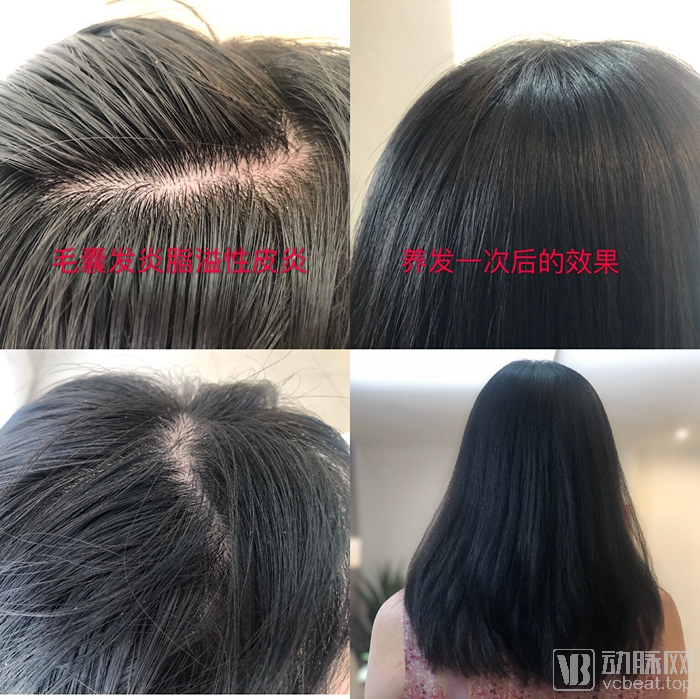
Hair Care Results (Image source: Provided by the company)
Yuan Yi Hair Care has introduced medical-grade scalp detection equipment, allowing for visual assessment of scalp conditions and making the results of each treatment clearly visible. Zheng Wei provided an example to reporters: a customer presented with an oily scalp, pale yellow discoloration, uneven hair shaft diameter, and severe follicular occlusion due to excess sebum, leading to atrophic alopecia. Following Yuan Yi’s scalp care regimen, which deeply breaks down scalp sebum and impurities, the scalp appeared bluish-white, elastic, and resilient; the follicular openings were free of obstructions and exhibited a vortex-like pattern.
Zheng Yuan also excitedly told the reporter, “The treatment yields even better results in Westerners than in Chinese people.” Further investigation revealed that the hair cuticles of Western women are thinner—only a fraction of the thickness of those in Asian women—allowing for easier absorption of the nutrients present in the traditional Chinese medicine decoction.
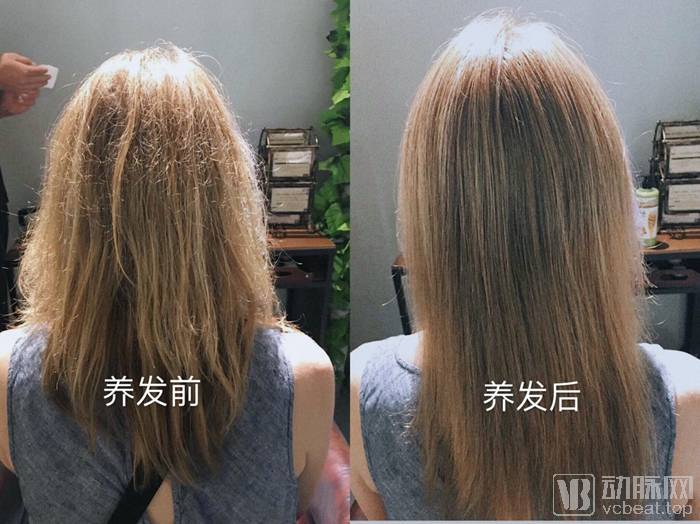
Before-and-After Hair Care Results for Caucasian Individuals (Image source: Provided by the company)
The efficacy of topical application of traditional Chinese medicine (TCM) decoctions for hair care has been validated, and hair care practitioners can become proficient within one to two weeks. Both the products and the business model can be rapidly replicated through chain expansion domestically and overseas. Zheng Wei breathed a sigh of relief, saying, “I finally see hope for realizing my dream of internationalizing traditional Chinese medicine.”
For businesses serving the consumer market, service experience is a critical component of core competitiveness, alongside products and technology.
At Yuanyiyangfa, co-founder Zhang Yuan is specifically responsible for the standardization of services. Zhang Yuan was the runner-up in the Huizhou L'Oréal Fashion Styling Competition, formerly a senior stylist at Dongtian Styling Group, and has provided scalp and hair care services to celebrity Ms. Zhang Yuqi and business magnate Mr. Pan Shiyi.
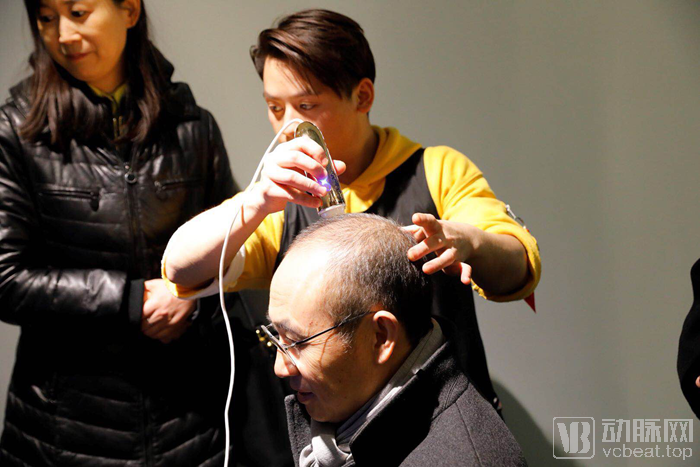
Zhang Yuan, Co-Founder of Yuanyi Traditional Chinese Medicine Hair Care Chain, Conducts Scalp Examination for Mr. Pan Shiyi, Chairman of SOHO China (Image source: Provided by the company)
Drawing on his existing service experience, Zhang Yuan developed a standardized service protocol comprising: scalp problem detection and diagnosis, meridian-based hair combing and washing, traditional Chinese medicine (TCM) scalp acupoint therapy, rinsing, a second round of meridian-based scalp combing, blow-drying and styling, and professional knowledge training. Upon completion of this service sequence, the outcome achieved was that “nine out of ten customers fell asleep.”
In addition to manual techniques and herbal compresses, Yuan Yi Hair Care has introduced two medical-grade hair care devices that enable scalp analysis, microcurrent massage, spray application of treatments, anti-inflammatory and sterilizing functions, vibrational therapy, ultrasonic infusion, ultrasonic atomization, SPA aromatherapy, SPA shampooing, and scalp physiotherapy.
It is worth noting that Yuanyiyangfa achieved profitability within just one month of opening its store in Hangzhou. When asked for details, Zheng Wei summarized three key reasons:
First, the product delivers excellent results. Within the first month of operation, Yuanyang Hair Care served nearly 400 customers, all of whom provided highly positive feedback on its efficacy.
Second, service comfort. All hair care specialists are trained in meridian and acupoint massage and combing techniques, enabling clients to achieve comprehensive physical and mental relaxation through massage; nine out of ten clients fall asleep during the service.
Third, a high-quality marketing strategy. Currently, the Hangzhou hair care store has ranked first on the Hangzhou Hair Care List on Meituan and Dianping within one month of opening, without spending a single penny.
Regarding future plans, in addition to deepening its presence in China’s first-tier cities, Yuan Yi Hair Care will expand its stores to South Africa by the end of this year. Zheng Wei further explained the rationale behind choosing this location. On one hand, it is driven by a sense of cultural sentiment; he hopes to emulate Zheng He’s historic voyages to the Western Seas by using traditional Chinese medicine (TCM) hair care stores as vessels to deliver authentic TCM herbal decoctions abroad, fostering global appreciation for TCM. This endeavor relies heavily on the strong support of the motherland.
In addition, the Yuanyiyang Hair Care Program has established a strategic research collaboration with Beijing University of Chinese Medicine to deepen R&D efforts and build core competitiveness, optimizing traditional Chinese medicine granules for enhanced absorption by scalp hair follicles.
It is reported that the Yuanyi Traditional Chinese Medicine Hair Care Project recently secured first place in the Hangzhou division of the Cultural and Creative Competition hosted by People's Daily Online, successfully advancing to the national finals.