

Metagenomic Pathogen Detection Gains Traction: Insights from Industry Pioneers

Legend Capital
Early-stage venture capital and growth-stage private equity investment institutions
In 2019, metagenomic pathogen detection surged in popularity.
Earlier, proponents of next-generation sequencing (NGS) technology painstakingly carved out a clinical market, gradually transforming non-invasive prenatal testing (NIPT) into a highly lucrative product and establishing a formidable market landscape. Subsequently, oncology genetic testing products urgently sought to replicate NIPT’s success, but instead left behind a chaotic scene that has led to investor fatigue.
Today, the emergence of metagenomic pathogen detection appears to have opened a door to the future. It rigorously adopts the complete workflow for clinical application of next-generation sequencing (NGS), eliminating the need to validate the feasibility of the underlying technology. Meanwhile, it addresses the technical limitation of traditionally low positivity rates in microbial testing, capitalizing on the vast market potential under antibiotic stewardship regulations.
BGI Genomics, the first company in China to launch this service, reported in its 2018 semi-annual financial statement that the year-on-year revenue growth of its infection prevention and control business ranked among the top three across all major business segments. Jinshi Medicine, an emerging star enterprise, attracted significant capital investment despite market headwinds earlier this year, with multiple investment institutions noting their close monitoring of the company’s development. Genetic testing companies are increasingly aligning their product portfolios with metagenomic pathogen detection in their marketing efforts, all touting the rising prominence of metagenomic pathogen testing.
However, when we let the data speak, it becomes evident that although more than 30,000 units of metagenomic pathogen detection products have been sold cumulatively, their conversion rate in clinical microbiology testing remains very low. In other words, very few metagenomic pathogen detection products have been truly implemented in clinical practice.
In this article, VCBeat interviewed Professor Wang Guiqiang, Director of the Department of Infectious Diseases at Peking University First Hospital; Dr. Jiang Zhi, CEO of Jinshi Medical; Dr. Qi Fei from Legend Capital; and other industry practitioners. By gathering perspectives from renowned physicians, leading entrepreneurs, and investors who have already entered this sector, we aim to identify the technical bottlenecks hindering product commercialization amid the stark contrast between the conceptual hype and market reality of metagenomic pathogen detection, and to explore its true future application prospects.
Metagenomic sequencing is a highly mature technology in scientific research services and is frequently employed in soil microbiome analysis. It was not until 2014, when British scientists successfully diagnosed and treated a 14-year-old boy presenting with unexplained recurrent fever, epilepsy, and hydrocephalus using metagenomic-assisted detection, that global exploration into the clinical application of metagenomics began. In China, BGI Genomics pioneered the introduction of this technology for clinical pathogen diagnosis and completed the world’s first detection of neurobrucellosis (NB) infection in 2016, bringing domestic and international clinical progress in metagenomic pathogen detection to near parity.
Metagenomic pathogen detection involves direct high-throughput sequencing of infectious specimens, followed by alignment against specialized pathogen databases to identify the species of suspected pathogens. It provides analytical reports that guide clinical treatment, offering a basis for rapid and precise diagnosis of complex and critical infections.
Microorganisms encompass a broad group of organisms, including bacteria, fungi, certain small protozoa, and microscopic algae, as well as viruses, covering numerous beneficial and harmful species. The scope of clinical microbiology includes microbial diagnostics and etiologic identification in clinical samples to guide the management and treatment strategies for patients with infectious diseases, as well as public health microbiology and the oversight and surveillance of reporting community-acquired infectious diseases.
Based on the type of nucleic acid extracted, metagenomic pathogen detection is categorized into DNA-based and RNA-based workflows. The DNA-based workflow is suitable for detecting intracellular bacteria, such as *Mycobacterium tuberculosis*, and fungi with thick cell walls, such as *Cryptococcus*. The RNA-based workflow is applicable to the detection of RNA viruses, including influenza virus, respiratory syncytial virus (RSV), and coronaviruses. In cases of suspected RNA viral infection, the RNA-based workflow should be selected.
In clinical practice, metagenomic pathogen detection involves several steps, including sample collection from the infection site, nucleic acid extraction, high-throughput sequencing, bioinformatics analysis, generation of test results, and interpretation of reports. The specific workflow is illustrated in the figure below:
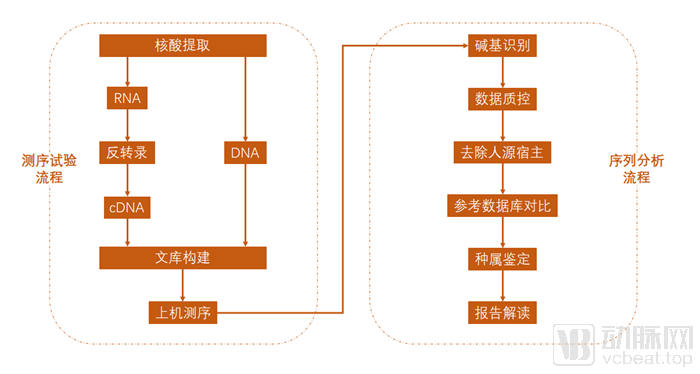
Workflow for Metagenomic Pathogen Detection
According to Dr. Jiang Zhi, sample processing, database construction, and bioinformatics analysis are critical steps in metagenomic pathogen detection.
Among these steps, sample processing is the most critical and challenging, requiring assurance of nucleic acid integrity and appropriate storage conditions. For research services, a nucleic acid extraction completeness of 80% is generally acceptable, whereas clinical applications demand extraction rates as close to 100% as possible. “The likelihood of detecting a pathogen often lies within the nucleic acids that fail to be extracted.” Therefore, optimizing nucleic acid extraction protocols and storage conditions represents a key challenge that metagenomic pathogen detection companies must overcome.
The critical factor constraining the commercialization of metagenomic pathogen detection is the construction of reference databases. Due to the absence of public databases that fully meet operational needs, companies in this sector must build their own proprietary databases by curating data from public sources and leveraging their accumulated case records. While the technical complexity of constructing these reference databases is not particularly high, the workload is staggering. The mere collection and processing of relevant literature and sequencing data equate to at least one year’s work for a team of ten PhD-level researchers.
Unlike scientific research services, which only need to provide data reports, metagenomic pathogen diagnosis requires the provision of test results that are understandable to clinicians. The accuracy of these results depends, to a certain extent, on the reliability and appropriateness of the reference database.
Dr. Jiang Zhi, founder of Jinshi Medicine, believes that having reliable workflows and databases for metagenomic pathogen detection is merely the basic prerequisite for launching this business. Product refinement cannot proceed without the involvement of clinical experts, and the accumulation of clinical research plays a crucial role in establishing rules for report interpretation. “Companies specializing in metagenomic pathogen detection should strengthen collaboration with clinical experts to jointly refine their products through the accumulation of real-world cases.”
Indeed, a sufficient volume of samples must be accumulated to establish accurate thresholds for determining pathogen positivity, thereby reducing the gray zone. At present, test results are typically interpreted based on the empirical experience of metagenomic pathogen detection companies. Dr. Jiang Zhi believes that this situation arises partly from insufficient sample accumulation and partly from inadequate clinical engagement. He emphasizes the need to collaborate with clinical experts to conduct a sufficient number of high-quality clinical trials, thereby enhancing the utility of the results and establishing clinical concordance as the most critical metric for product evaluation.
VCBeat’s investigation reveals that many companies originally engaged in gut microbiota testing are currently offering metagenomic pathogen detection services. However, there are significant differences between gut microbiota testing and metagenomic pathogen detection. The former focuses on research services and healthy populations, delivering data reports, whereas the latter is used for clinical diagnosis and requires the issuance of rigorous diagnostic reports. Furthermore, while samples collected for gut microbiota testing contain small amounts of shed human cells, the extracted nucleic acids are predominantly microbial. In contrast, samples for pathogenic microorganism detection contain a higher background of human nucleic acids, making sample processing and library construction more challenging.
This represents the consensus among several industry experts interviewed by VCBeat regarding the current market size of metagenomic pathogen detection. After comparing the advantages and disadvantages of metagenomic pathogen detection with traditional pathogen detection methods, we identified one of the key reasons hindering the practical implementation of metagenomic pathogen detection products.
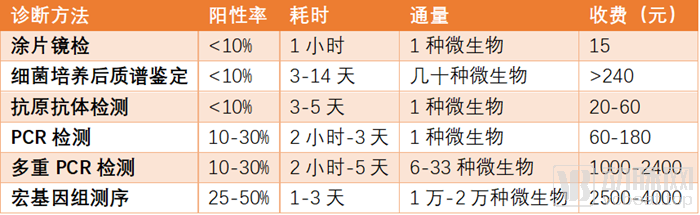
Comparison of Different Diagnostic Methods (Compiled by VCBeat from Public Sources)
A simple analysis reveals that the greatest advantage of metagenomic pathogen detection lies in its throughput. Unlike conventional testing methods, which can only target specific single or multiple microorganisms in a single test, metagenomic pathogen detection leverages the high-throughput capabilities of its underlying technology to detect nearly all types of pathogenic microorganisms in a sample at once, depending on the size of the reference database used by the specific product. Meanwhile, the pre-processing steps for metagenomic pathogen detection involve only nucleic acid extraction and library construction, eliminating the time lag associated with culture-based methods, thereby better meeting the diagnostic needs for pathogens in critical care situations.
The high cost of metagenomic pathogen detection, often running into thousands of yuan, offers no advantage in simple outpatient pathogen diagnosis, which clearly hinders the promotion of metagenomic pathogen detection products in the clinical market.
Furthermore, although metagenomic pathogen detection products have achieved a positive pathogen detection rate of 50%–60% in relatively mature fields such as central nervous system infections, the positive rate for mainstream clinical metagenomic products in bloodstream infections is only around 30%. The latter accounts for 70%–80% of severe infections. The variability in pathogen detection capability across different types of infections is undoubtedly a significant factor currently hindering the clinical adoption of metagenomic pathogen detection products.
The third-level reason lies in the fact that pathogen diagnosis is a relatively niche service within hospitals. On one hand, compared to the concentrated allocation of clinical resources for the treatment of viral hepatitis, which has an extremely high incidence rate, bacterial and fungal diagnosis and treatment do not constitute mainstream areas within infectious disease departments. On the other hand, bacterial and fungal diagnostic procedures are complex and cumbersome, with low success rates, resulting in very low enthusiasm among physicians to adopt them.
“Based on existing diagnostic methods, such as blood culture and PCR, matching can only be performed among nearly 3,000 bacterial species with clear clinical value. The average positive rate for pathogen detection in submitted samples is less than 20%, which falls far short of meeting the needs of clinical treatment. Improving the pathogen diagnosis rate is currently the breakthrough point in the clinical management of infectious diseases,” pointed out Professor Wang Guiqiang, Director of the Department of Infectious Diseases at Peking University First Hospital.
In China, over 1 billion cases of infection occur annually, with the vast majority of common infections being manageable through empirical treatment and routine diagnostic methods. Statistics indicate that approximately 20 million people suffer from complex and critical infections each year. These cases represent a diagnostic gap, which is precisely the domain addressed by metagenomic pathogen detection.
In fact, in recent years, the Chinese government has attached great importance to enhancing the diagnostic capabilities for bacteria and fungi to ensure the rational use of antimicrobial agents. In August 2016, 14 departments, including the National Health and Family Planning Commission and the National Development and Reform Commission, jointly issued the National Action Plan to Contain Antimicrobial Resistance (2016–2020). The plan emphasizes improving the diagnostic and treatment capabilities for bacterial and fungal infections in hospitals at Level II and above, and promoting a multidisciplinary approach to antimicrobial stewardship, with the aim of introducing specialized and advanced diagnostic and therapeutic methods to address the current issue of antibiotic misuse.
Professor Wang Guiqiang told VCBeat that there is a substantial demand among hospitals to enhance their pathogen diagnostic capabilities, with a very high level of acceptance for advanced technologies such as metagenomic pathogen diagnosis. Professor Wang himself is also closely monitoring the clinical implementation of multiple cutting-edge technologies, including rapid pathogen diagnostics and metagenomic pathogen diagnosis.
Bacterial culture has long been insufficient to meet clinical demands, creating an urgent need for the clinical translation of new technologies, including next-generation sequencing (NGS), third-generation sequencing, and rapid diagnostics. We have applied rapid pathogen diagnosis and metagenomic pathogen detection to address pressing clinical challenges in infections of the digestive system, central nervous system, respiratory tract, and bloodstream. Professor Wang Guiqiang stated that promoting the clinical translation and implementation of cutting-edge pathogen diagnostic projects has been a key focus of his work over the past two years.
Having analyzed the optimal implementation strategies for metagenomic pathogen detection and the obstacles to its clinical adoption, we believe that, with optimized workflows and reduced costs, this technology will gradually move from a niche, high-end application to become a routine diagnostic tool in the pathogen testing market, which serves billions of patients annually.
Essentially, metagenomic pathogen detection requires high throughput and high sensitivity to identify trace amounts of pathogenic sequences against a massive background signal.
On the one hand, current mNGS-based pathogen detection primarily relies on short-read sequencing platforms. There is a clinical demand and future trend toward long-read sequencing results, PCR-free library preparation, real-time long-read sequencing, and compressed sequencing turnaround times to meet the high timeliness requirements for diagnosing critical infections. However, the clinical application of third-generation sequencing is unlikely to be realized within the next 2–3 years.
On the other hand, although the cost of human genome sequencing dropped from millions to thousands between 2008 and 2014, it is expected to continue declining as sequencing throughput increases and more players enter the market.
As testing workflows and costs continue to be optimized, mNGS is poised to gradually replace certain routine diagnostic tests. By leveraging longer-read genomic sequence data, it enables more accurate assessments of drug resistance, virulence, and strain typing. Furthermore, with ongoing miniaturization of instruments, mNGS has the potential to become a point-of-care tool in the future.
Anti-infective drugs constitute one of the largest pharmaceutical markets globally, covering the broadest patient population and featuring the highest frequency of use. However, due to differences in treatment practices, the adoption rate of pathogenic microorganism diagnostic products in China is significantly lower than that in foreign countries. Dr. Qi Fei from Legend Capital believes that the emergence of metagenomic pathogen detection products, which offer higher positivity rates, can provide solutions for severe infections of unknown etiology—such as encephalitis, meningitis, and sepsis—thereby enhancing the precision of anti-infective drug usage in clinical practice.
Regarding the estimated timeline for the maturation of the metagenomic pathogen detection industry, Dr. Qi Fei believes it will take at least three to five years. Although there is genuine market demand for metagenomic pathogen detection, and national regulations restricting antibiotic abuse will further promote industry development, this approach will not be immediately integrated into clinical practice within China’s current landscape of anti-infective and antimicrobial drug usage. It still requires product refinement and market education. “Market maturity demands time and joint efforts from industry practitioners.”
“The metagenomic pathogen detection industry is unlikely to witness the same rush of entrants seen in the tumor genetic testing sector.” In the past, capital influx might have “forced growth” and prematurely matured an industry to some extent. However, metagenomic pathogen detection products require further advancements in both technical optimization and bioinformatics services. Addressing unmet clinical needs remains the core mission for enterprises in this field. As such, the industry lacks the characteristics that allow for rapid maturation driven by capital; instead, it must gradually expand its market share through the accumulation of real-world clinical cases and effective market education.
Dr. Qi Fei also noted that metagenomic pathogen detection has accumulated tens of thousands of clinical applications across numerous hospitals and enterprises. Clinicians are increasingly recognizing the value of this technology. Coupled with the continuous efforts by industry practitioners in the early stages to build reference databases and conduct market education, the maturity of the industry is largely a matter of time.
VCBeat will continue to monitor the development of the metagenomic pathogen detection industry. If you are a practitioner in this field, please contact us.