

Ruitong Bio Prepares IPO: Leading China's Personalized Lingual Orthodontics Market with eBrace
Wang Hongwei, CEO and founder of Riton Bio, told VCBeat that the company’s expansion into the dental sector stemmed from a 3D printing project. “In 2000, we founded Guangzhou Riton Laser Technology Co., Ltd., focusing on the research, development, and production of laser processing equipment.” Through his years of experience in the equipment industry, he was exposed to emerging technologies within the field. At that time, 3D printing technology was just beginning to take off in developed countries such as those in Europe and the United States, with companies like 3D Systems in the U.S. and EOS in Germany successively launching commercial resin and metal 3D printers. 3D printing technology was gradually maturing in the international market.
“In 2007, we jointly undertook the project ‘Research on Selective Laser Melting Rapid Prototyping Equipment and Processes’ with South China University of Technology, funded by the Guangdong Provincial Department of Science and Technology—a project now widely known as ‘metal laser 3D printing,’” recalled Wang Hongwei. “After the successful development of the equipment, during its promotion and application, we discovered that 3D printing technology could be effectively applied to the healthcare market to meet customers’ personalized needs. Consequently, we entered the field of dentistry and began researching and manufacturing customized lingual orthodontic appliances.” In 2010, Guangzhou Riton Biomaterial Co., Ltd. was established, dedicated to the promotion and application of digital dental technologies.
In recent years, with the improvement of people's living standards, the number of individuals opting for orthodontic treatment has grown rapidly. According to the oral health report by the Chinese Stomatological Association and Ping An Securities, more than 2 million people in China underwent orthodontic treatment in 2017, with an annual growth rate of 20–30%. The compound annual growth rate for personalized lingual orthodontics and clear aligner therapy without brackets exceeded 50%.
Since its establishment, Riton Biomaterial has gradually developed a product portfolio centered on the production and sales of customized lingual braces, supplemented by clear aligners without brackets and 3D printing product lines. The company’s R&D team comprises specialists in orthodontic treatment technology, 3D printing technology, and a clinical medical team composed of orthodontic experts. After several years of independent research and development, the team’s customized lingual brace system, eBrace, obtained the National Class II Medical Device Registration Certificate in 2011.
Traditional braces are tools that require doctors to spend a significant amount of time on technical operations, in addition to diagnosis and treatment planning. This results in prolonged chairside treatment times. Moreover, bonding accuracy and archwire precision are prone to human error, which can adversely affect treatment outcomes and efficiency. Furthermore, traditional labial appliances, with brackets and archwires installed on the labial surfaces of teeth, compromise aesthetics.
Riton Biomaterial’s personalized lingual braces feature digitally customized brackets, archwires, and bonding trays, thereby eliminating extensive laboratory work for clinicians, reducing chairside treatment time, and enhancing precision and treatment efficiency. “Compared with traditional labial orthodontics, our lingual orthodontic system can shorten treatment duration by approximately six months, improving overall treatment efficiency,” stated Wang Hongwei.
Since the brackets and archwires used in lingual orthodontics are installed on the lingual (back) surfaces of the teeth, this approach is more aesthetically pleasing than labial orthodontics, where brackets and archwires are attached to the facial (front) surfaces. Furthermore, lingual orthodontics can reduce the incidence of dental caries, lower the likelihood of post-treatment relapse, and prevent lip injuries caused by labial appliances during physical activities. In addition, because lingual orthodontic techniques enhance posterior anchorage, they allow for more effective control of tooth movement.
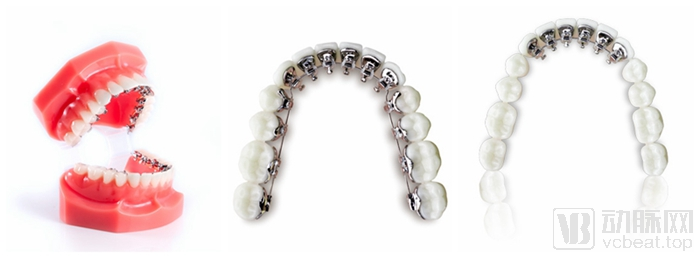
ebrace Lingual Braces
Lingual orthodontic treatment has gained significant popularity in the international orthodontic market in recent years. Since 3M launched its customized lingual appliance, Incognito, in the United States in 2004, more than 100,000 patients had received customized lingual orthodontic treatment by 2013. “Currently, customized lingual orthodontic technology is not yet widely adopted in China, with only a few thousand cases reported in 2018. However, as training and promotion efforts intensify and clinical advantages become more evident, the proportion of lingual orthodontic cases is expected to exceed 1% within the next three to five years. The annual number of eBrace customized lingual cases is projected to reach 20,000,” said Wang Hongwei.
With nearly a decade of technological accumulation, Riton Biomaterial has built a database of personalized lingual orthodontic treatment plans for tens of thousands of cases and mastered the core technologies for the mass production of customized lingual appliances. According to Wang Hongwei, Riton Biomaterial’s eBrace lingual appliance has been granted more than ten invention patents and twenty utility model patents, and has been included in graduate-level textbooks on orthodontics at numerous universities worldwide. The company holds over 60% of the domestic market share for personalized lingual orthodontic services.
Leveraging its technological expertise with eBrace, Riton Biomaterials has also developed digitally customized clear aligners and digital labial bonding positioners. Both product categories have obtained medical device registration certificates and have been launched on the market. Patients can choose the orthodontic solution best suited to their needs based on factors such as price and user experience across labial, lingual, and clear aligner options.
Furthermore, Riton Biomaterial has entered the dental prosthesis market by independently developing, manufacturing, and selling metal 3D printers specifically designed for dentures. The company’s metal 3D printers are intelligent devices tailored for the dental prosthetics industry to replace manual labor, thereby enhancing the production efficiency of metal crowns and bridges and improving the quality of the resulting prostheses. By bundling the sale of metal 3D printing materials with agency sales of scanners, zirconia blocks, resin materials, and other products, Riton Biomaterial leverages its technological and channel advantages to establish a presence across the entire industrial chain of dental prosthesis production.
“Although lingual orthodontics has not yet been widely adopted on a large scale in China, we have promoted its application in specialized dental hospitals, large chain dental clinics, and major medical aesthetic and plastic surgery hospitals through academic outreach and training programs. As a result, a substantial community of clinicians proficient in lingual orthodontic treatment has emerged. Our medical team is categorizing and optimizing treatment protocols based on clinical cases to streamline clinical procedures, enabling more young dentists to rapidly master lingual orthodontic techniques,” added Wang Hongwei. “Since last year, the company has leveraged new media operations to educate and engage direct-to-consumer (C-end) users, thereby referring patients to dentists.”
Through strategic partnerships, the establishment of clinical bases, and direct sales, Riton Biomaterial’s lingual orthodontic appliances have been adopted by more than 40 public stomatological hospitals and over 50 large dental clinic chains across China. These include prestigious specialized institutions such as Peking University School of Stomatology, West China School of Stomatology, Shanghai Ninth People’s Hospital, and The Fourth Military Medical University, as well as major dental chain clinics including Bybo Dental, Arrail Dental, Malo Clinic, Meowee Dental, Side Sunshine Dental, and Delun Dental.
Since its establishment, Riton Biomaterial has completed three rounds of financing. The angel round was completed in 2012, and the Series A round was completed in 2015, led by Anxin Demo Dental Fund. Zheng Lixin, Chairman of Demo Capital, stated: “Orthodontics and dental implants will become the leading segments within the future dental industry landscape. Our survey of over a thousand enterprises in the oral care sector reveals that Riton Biomaterial’s personalized lingual orthodontic technology is at the industry forefront both in China and globally. Furthermore, Riton Biomaterial is the only company in China capable of providing integrated orthodontic solutions combining labial, lingual, and clear aligner therapies. We believe that under the leadership of CEO Wang Hongwei, Riton Biomaterial will continue to deepen its expertise in the field of orthodontics, deliver diversified products to patients, enhance orthodontic outcomes, and better meet patient needs.”
In 2017, Riton Biomaterial completed its Series B financing round, led by Yanghe Investment. Xia Yu from Yanghe Investment stated, “The orthodontics market offers substantial growth potential and is one of the key sectors focused on by Yanghe Investment. Personalized clear aligner technology based on 3D printing has sparked a trend combining healthcare with consumption upgrades both domestically and internationally. We are optimistic about Riton Biomaterial’s founding team, innovative products, and market potential. Riton Biomaterial is among the earliest companies in China to industrialize 3D printing applications, and its founding team possesses profound technical expertise across multidisciplinary fields, including 3D printing, CAD/CAM, clinical medicine, and biomechanics.”
Currently, Riton Bio is undergoing a new round of financing to pursue better and faster development.