

Top 10 Biotech Funding Rounds of 2019: Pfizer, Novartis, Bayer Among Investors; Largest Single Round Reaches $2.1 Billion

Century Therapeutics
Developer of Transformative Allogeneic Cell Therapies
SpringWorks Therapeutics
Disease Treatment Drug Developer

ADC Therapeutics
Clinical Oncology Drug Developer
According to statistics from the renowned global investment firm Jefferies, there have been 18 financing deals exceeding $100 million in the biotechnology sector so far in 2019.
Based on the VCBeat (WeChat ID: vcbeat) database, the Dongguan Special Report Pro is launched.“Top 10 Biotech Financing Deals of 2019”, this article is compiled based on the special topic. The "Pro" series will continue to track investment and financing data in the biotechnology sector for 2019, dynamically updating real-time changes to this ranking.
>> Click to enter the Pro topic <<


Whether startups or leading enterprises, the oncology field has always been the primary focus of biotechnology companies.
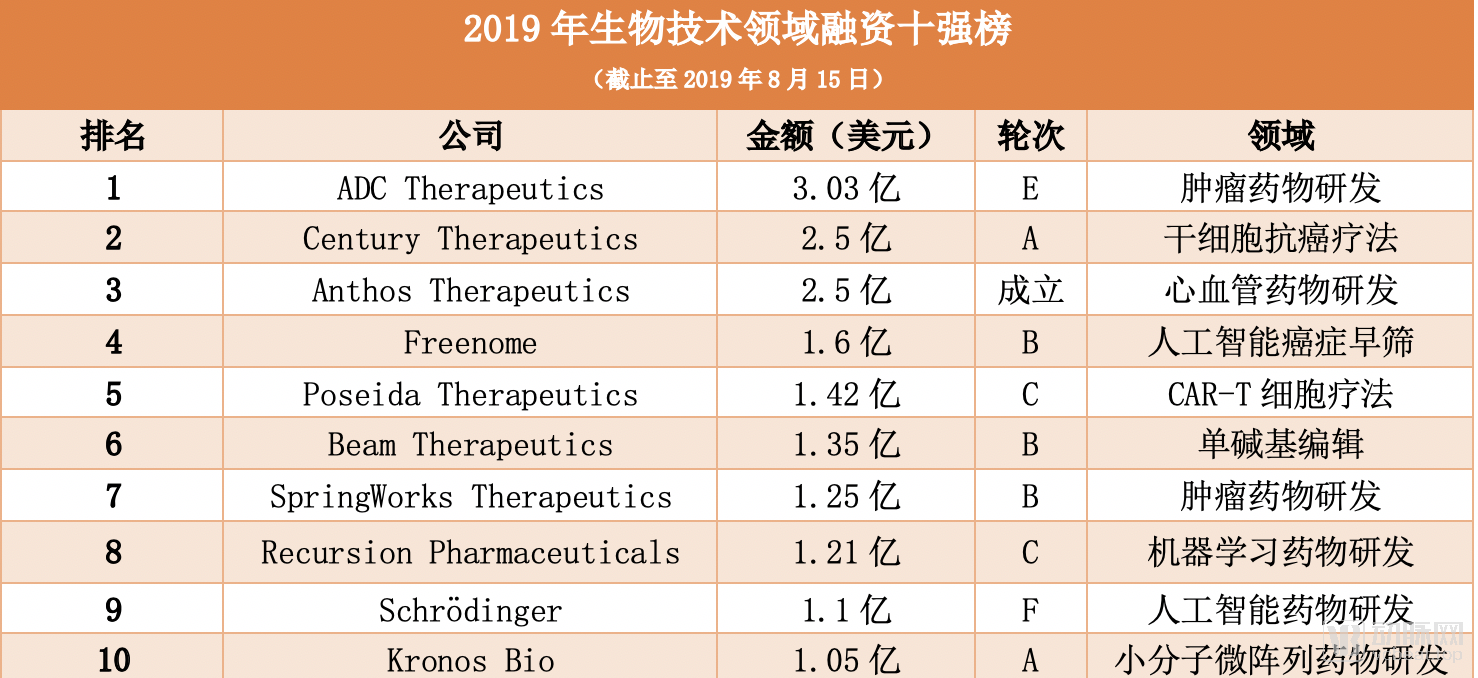
Among the top 10 biotechnology startups with the highest financing amounts, companies in oncology-related fields account for half of the list. These include two oncology drug development companies, ADC Therapeutics and SpringWorks Therapeutics; CAR-T cell therapy anticancer company Poseida Therapeutics; stem cell therapy company Century Therapeutics; and Freenome, which uses AI genomics for early cancer screening.
According to the latest top 10 pharmaceutical companies list recently released by VCBeat, oncology is a key therapeutic area of focus for all ten companies. In particular, Merck & Co. and Bristol Myers Squibb (BMS) have made significant efforts to expand the indications for Keytruda and Opdivo, respectively.
Regarding specific indications, the five most highly watched indications are all oncology-related. Diseases that large pharmaceutical companies focus on are basically tumors and chronic diseases. The former represents an essential need for patients, while the latter boasts excellent market prospects. Rare diseases are generally underrepresented in clinical trials conducted by large pharmaceutical companies, with “major diseases” remaining their core focus.
Among the top 10 biotechnology companies that raised the most funding in 2019, three were AI-driven biotech firms with teams predominantly composed of members with computer science backgrounds.
They are Freenome, which uses AI Genomics for early cancer screening; Recursion Pharmaceuticals, which leverages machine automation and visual processing technologies for drug development; and Schrödinger, which employs deep learning technologies for drug discovery.
In application areas, cost savings are a major reason for the increasingly frequent integration of artificial intelligence and biotechnology.
Persistent pain points have long plagued the traditional drug development landscape. First, the R&D cycle is protracted, with new drug development taking an average of approximately 10 years. Second, costs are exorbitant, with the development expense for each new drug reaching around $1.5 billion. Third, the success rate is low; among roughly 5,000 synthesized compounds, only one advances to Phase II clinical trials. The integration of artificial intelligence with drug discovery can significantly enhance R&D efficiency and reduce corporate costs.
The same holds true in the field of gene editing. The human genome consists of 20,000 genes and more than three billion base pairs of these genetic "letters." Genome sequencing is a critical first step toward understanding it. One of the most exciting prospects of genetic technology is the development of precision or personalized medicine. This field enables interventions tailored to individual patients or groups with similar genetic profiles, and its market size is projected to reach $87 billion by 2023.
Historically, costs have limited the implementation of personalized medicine supported by genetic technologies, but machine learning techniques help overcome these barriers. Machines assist in identifying patterns within genetic datasets, enabling computer models to predict an individual’s likelihood of developing a disease or responding to interventions, thereby improving healthcare efficiency.
With continuous breakthroughs in the two key technologies of artificial intelligence and biotechnology, their integration will become increasingly tight, enabling the resolution of more complex medical challenges.
Among the top ten fundraising deals, VCBeat found that many biopharmaceutical giants were active on the investor lists.
SpringWorks Therapeutics, an oncology drug development company, was spun off from Pfizer and received joint investment from GlaxoSmithKline and Pfizer;
Anthos Therapeutics was jointly established by Blackstone and Novartis, and has received licensing rights for Novartis’s targeted therapies;
Poseida Therapeutics, which is dedicated to researching CAR-T cell therapy for cancer treatment, was also led by the pharmaceutical giant Novartis in its investment round;
The investment in stem cell therapy company Century Therapeutics marks the eighth investment under Bayer’s “Leap” program and is part of Bayer’s strategic commitment to addressing major challenges facing society today. Prior investments under the “Leap” program in potentially breakthrough technologies have included: Casebia Therapeutics (using CRISPR/Cas technology to treat severe genetic diseases), BlueRock Therapeutics (employing induced pluripotent stem cell technology to treat cardiovascular and central nervous system disorders), Joyn Bio (developing probiotics for plants to enable agriculture without chemical fertilizers), and Khloris (leveraging iPSCs as cancer vaccine formulations to explore possibilities for treating or preventing cancer).
There are two reasons for this phenomenon:
On the one hand, large pharmaceutical companies are spinning off mature, innovative entities with late-stage R&D pipelines—a rising trend in recent years aimed at alleviating the R&D burden on major pharmaceutical firms and accelerating new drug development.
On the other hand, biopharmaceutical giants may face the challenge of being “too large to pivot” in R&D. While striving to protect their market position from disruption by small and mid-sized innovative companies and engaging in fierce competition with other industry leaders, their investments in emerging firms take on even greater strategic significance.
In 2019, ADC Therapeutics, an oncology drug development company, ranked first in financing amount within the biotechnology sector. On July 6, ADC Therapeutics announced the closing of a $103 million expansion of its Series E financing, bringing the total amount raised in the Series E round to $303 million. Investors in this round included Auven Therapeutics and AstraZeneca, among others.
ADC Therapeutics, founded in 2011 and headquartered in the Canton of Vaud, Switzerland, is dedicated to developing proprietary antibody-drug conjugates (ADCs) for hematologic malignancies and solid tumors. Its ADC products consist of monoclonal antibodies targeting specific antigens linked to pyrrolobenzodiazepine (PBD) dimers via Spirogen Limited’s PBD technology. The company has multiple PBD-based ADC candidates in ongoing clinical trials, with clinical research laboratories located across the United States and Europe.
ADC Therapeutics has four R&D pipelines: ADCT-402, ADCT-301, ADCT-602, and ADCT-601. The company’s lead candidate, ADCT-402 (loncastuximab tesirine), is undergoing Phase 2 studies for relapsed or refractory diffuse large B-cell lymphoma (DLBCL), with plans to submit a Biologics License Application (BLA) to the FDA in the second half of 2020 as a monotherapy for this specific blood cancer.
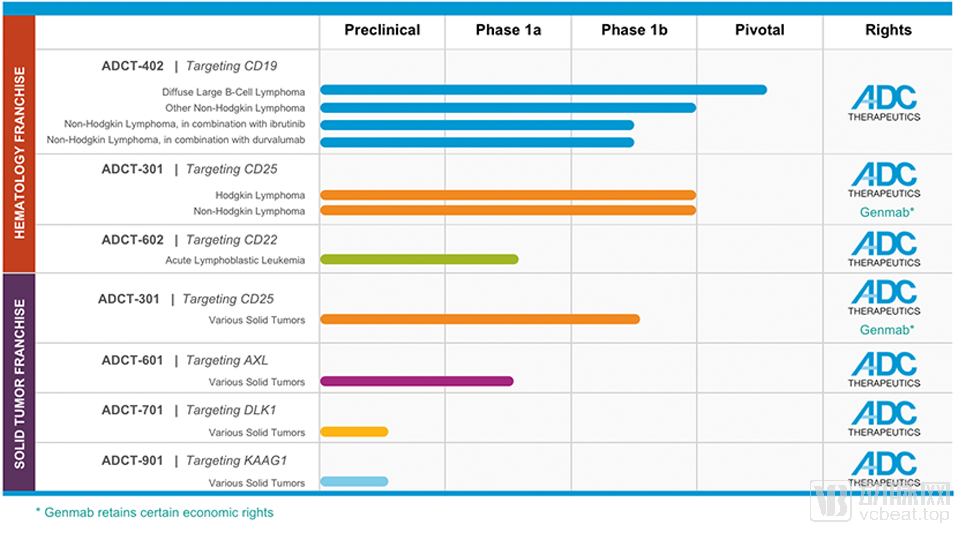
ADC Therapeutics’ R&D Pipeline (Image source: company website)
Century Therapeutics Emerges from Stealth Mode, Securing Up to $250 Million in Funding from Bayer, Versant, and Fujifilm Cellular Dynamics Inc. (FCDI)
Founded by Versant Ventures, the company is engaged in the research and development of allogeneic or off-the-shelf immune cell therapies for cancer treatment. This transaction will advance Century Therapeutics’ multiple research programs in hematologic malignancies and malignant solid tumors into the clinical stage.
Century Therapeutics’ foundational technology is built upon induced pluripotent stem cell (iPSC) technology, which possesses unlimited self-renewal capacity. This technology enables multi-round cell engineering to generate a master cell bank of modified cells, which can be expanded and differentiated into immune effector cells, thereby providing a substantial supply of allogeneic, off-the-shelf therapeutic products.
With this technological support, Century Therapeutics has distinguished itself from numerous competitors engaged in cell therapy development using non-renewable donor cells.
In March 2019, asset management firm Blackstone and pharmaceutical giant Novartis collaborated to establish a biopharmaceutical company, Anthos Therapeutics (hereinafter referred to as “Anthos”). Blackstone invested $250 million in Anthos and retained control over product development rights, while Novartis acquired a minority equity stake.
Anthos is a biopharmaceutical company based in Massachusetts, USA, dedicated to developing next-generation targeted therapies for patients with cardiovascular diseases.
Novartis has licensed the targeted drug MAA868 to Anthos, which will continue its development. MAA868 is an antibody-based therapeutic designed to treat thrombotic disorders by targeting two coagulation proteins, Factor XI and Factor XIa.
Meanwhile, research has found that MAA868 has the ability to prevent a range of cardiovascular diseases and can provide a longer-lasting treatment than anticoagulant therapy. Anthos stated that MAA868 will change the standard of care for patients with cardiovascular disease.
On July 24, Freenome, a prominent company in the field of early cancer screening in the United States, announced the completion of a $160 million Series B financing round. Investors included RA Capital, Polaris Partners, and China Renaissance Capital, among others.
Freenome is a biotechnology company that pioneered the most comprehensive multi-omics platform for early cancer detection. By combining deep expertise in molecular biology with advanced computational biology and machine learning techniques, it identifies disease-associated patterns from billions of circulating cell-free biomarkers.
Freenome is developing simple and accurate blood-based tests for early cancer detection and plans to integrate this actionable approach into healthcare systems to enable a feedback loop between machine learning in medicine and computational science.
Freenome’s core expertise lies in AI Genomics. Although the term may sound cumbersome, it simply refers to the use of deep learning techniques in artificial intelligence to analyze patterns within the human genome. By detecting hidden correlations that conventional medical methods cannot identify, this approach aims to predict diseases, diagnose conditions, and even pinpoint the specific anatomical sites of disease onset. Leveraging AI to analyze large volumes of blood samples and employing deep learning algorithms, Freenome establishes correlations between specific signals within the complex landscape of immune system markers and particular types of cancer as well as their primary sites of origin.
Therefore, by analyzing patients' blood samples, Freenome's AI can filter out signals directly related to cancer from those emitted by the immune system, and leverage deep learning expertise to determine whether an individual has cancer and identify the tumor's location.
In April 2019, Poseida Therapeutics completed a $142 million Series C financing round, led by Novartis.
The company completed a $30.5 million Series B financing round in April 2018 and filed for an IPO on the Nasdaq earlier this year, aiming to raise $115 million. Ultimately, however, the company abandoned its IPO plans and instead secured a Series C funding round led by Novartis, a pivot that carries significant strategic implications.
Poseida’s investigational products are designed to address the limitations of other CAR-T therapies, including duration of response, ability to treat solid tumors, and safety concerns. The company’s lead candidate, P-BCMA-101, is an autologous CAR-T product targeting B-cell maturation antigen (BCMA) and is currently enrolling patients with relapsed/refractory multiple myeloma in a Phase 2 trial. Poseida is recruiting patients with multiple prior treatment failures into this Phase 2 trial, where follow-up will be conducted on an outpatient basis rather than requiring hospitalization for treatment.
On March 6, 2019, U.S.-based Beam Therapeutics completed a $135 million Series B financing round. New investors in this round included Redmile Group, LLC, Cormorant Asset Management, and GV. The proceeds from this financing will be used to develop next-generation gene-editing technologies and expand its pipeline of gene-editing programs.
Beam Therapeutics is a Massachusetts-based biotechnology company founded in 2017 by Feng Zhang, a scientist in the field of gene editing. Beam Therapeutics is dedicated to leveraging gene-editing technologies to precisely edit single base pairs in DNA and RNA for the treatment of genetic diseases.
Beam Therapeutics was co-founded by three luminaries in the CRISPR field—MIT Professor Feng Zhang, Harvard University Professor David Liu, and J. Keith Joung—and is the first innovative company to leverage single-base editing technology to develop precision gene therapies.
Beam’s core technology stems from the scientific breakthroughs of Professor Feng Zhang and Professor David Liu, enabling precise editing of single bases on DNA or RNA. This technology comprises two key components: first, a CRISPR enzyme capable of specifically targeting any locus in the genome, which can be directed to either DNA or RNA by employing different enzymes; second, a class of enzymes that modify bases. Unlike classical CRISPR gene-editing techniques, these enzymes primarily facilitate chemical modification of bases without cleaving DNA or RNA, thereby offering theoretically enhanced safety.
On April 1, 2019, SpringWorks Therapeutics announced the completion of a $125 million Series B financing round. Investors included GlaxoSmithKline, Pfizer, and Bain Capital.
SpringWorks was spun off from Pfizer at the end of 2017 and obtained licenses for four R&D pipelines from Pfizer. These four pipelines constitute the company’s current core product portfolio, namely PD-0325901 for the treatment of neurofibromatosis (NF), PF-05416266 for the treatment of hereditary xanthocytosis (HX), PF-03084014 for the treatment of desmoid tumors, and PF-0445784 for the treatment of post-traumatic stress disorder (PTSD).
This round of financing will be used to advance the company’s R&D programs for two cancer drugs: PF-03084014 (Nirogacestat) for the treatment of desmoid tumors, and PD-0325901 for the treatment of neurofibromas.

(SpringWorks Therapeutics’ R&D Pipeline; image sourced from the company’s official website)
On July 15, 2019, biotechnology company Recursion Pharmaceuticals completed a $121 million Series C financing round. Investors included Scottish Mortgage Investment Trust and Intermountain Ventures, among others.
This round of funding will support Recursion in further expanding its machine learning-enabled drug discovery platform, as well as introducing new capabilities designed to fundamentally accelerate the development of novel chemical entities and predictive safety pharmacology.
Recursion Pharmaceuticals is a clinical-stage biotechnology company that integrates artificial intelligence, experimental biology, and automation, primarily engaged in large-scale drug discovery and development. By combining experimental biology and automation with artificial intelligence within a massively parallel system, it effectively identifies potential drug candidates for various indications, including genetic disorders, inflammatory conditions, immunological diseases, and infectious diseases.
Furthermore, Recursion will continue to advance its growing portfolio of preclinical and clinical assets, including clinical-stage programs for cerebral cavernous malformations and neurofibromatosis type 2.
On May 19, 2019, Schrödinger announced the completion of a $110 million Series F financing round. Investors included Bill Gates, David E. Shaw, GV, and others.
This round of financing will be used to further advance the development of Schrödinger’s computational platform, expand its therapeutic pipeline, and strengthen its collaborations with global biopharmaceutical companies.
Schrödinger’s drug discovery platform integrates physics-based molecular simulation technologies with machine learning techniques. Compared to traditional drug development approaches, molecular simulation accelerates the drug development process. The platform includes suites for small-molecule drug discovery, biologics, and materials science, among others. Currently, many of Schrödinger’s investigational new drugs have advanced to clinical stages. Two novel oncology drugs co-developed by the company with its partners have received FDA approval.
On July 18, 2019, drug development company Kronos Bio announced the completion of a $105 million Series A financing round, with investors including Vida Ventures and Omega Funds.
The current round of financing will be used to advance the establishment of the company’s Small Molecule Microarray (SMM) platform and to hire additional staff in Boston and San Francisco.
Kronos Bio is dedicated to translating scientific achievements into a high-throughput screening strategy for chemical modulators of transcription factors and other elusive targets in oncology. The company leverages its Small Molecule Microarray (SMM) platform and biological assay technologies to develop novel therapeutics that address some of the most challenging problems in cancer research.
Small Molecule Microarray (SMM) technology was invented in the 1990s by Schreiber, an expert in chemical biology. Angela Koehler, a professor at MIT and the founding technologist of Kronos, was one of Schreiber’s students who participated in this project. SMM is highly suitable for the rapid discovery of novel modulators or degraders. Kronos has demonstrated that SMM possesses the potential to identify compounds that either bind directly to target proteins or interfere with protein activity with nanomolar potency. SMM can discover hits that act through diverse mechanisms, including those that indirectly modulate target protein activity by binding to cofactors or other members of protein complexes.
More unicorn rankings, more investment and financing news, more in-depth analyses of leading companies’ businesses, and more comprehensive industry consulting insights—all available in VCBeat Special Pro!