

Oncologie and MSD Announce Global Strategic Collaboration to Evaluate Bavituximab plus Keytruda Combination Therapy for Advanced Gastric Cancer
Recently, the field of PD-1-based combination immunotherapy has witnessed another major development. Dinghang Medicine (Oncologie), an industry leader focused on combination cancer immunotherapies, announced that it has entered into a global clinical strategic collaboration agreement with Merck & Co. The two parties will jointly evaluate the efficacy of combining Bavituximab, Dinghang’s investigational novel anti-phosphatidylserine (PS) monoclonal antibody, with Merck’s flagship anti-PD-1 drug Keytruda for the treatment of patients with advanced gastric or gastroesophageal cancers.
This marks another major research collaboration between the two parties, following their work in liver cancer, to explore the combination of Bavituximab and Keytruda for the treatment of multiple and refractory cancers, underscoring both companies’ optimism about the clinical prospects of this combination therapy.
According to reports, Dinghang Pharmaceuticals will conduct a single-arm, open-label, Phase II multicenter clinical study in the United States, the United Kingdom, South Korea, and the Taiwan region of China. The study aims to evaluate the efficacy and safety of this combination therapy in patients with advanced gastric cancer and gastroesophageal junction cancer who have previously experienced failure with at least one line of targeted first-line treatment. The study is expected to launch in the second half of 2019 and plans to enroll approximately 80 patients.
“Reversing Immunosuppression”: A Highly Promising Novel PS Target
Bavituximab is an innovative chimeric monoclonal antibody drug that targets phosphatidylserine (PS). By reversing PS-mediated immunosuppression, it stimulates immune activation and anti-tumor immune responses, enabling other cancer therapies to attack tumors more effectively and without restriction. Bavituximab has demonstrated a favorable safety and tolerability profile in previous clinical trials, making it an excellent candidate for combination cancer therapies.
Phosphatidylserine (PS) is a phospholipid exposed on the surface of stressed cells within tumors and their stroma. As an innovative chimeric monoclonal antibody drug targeting PS, Bavituximab blocks the binding of PS to various immune cell receptors (including TIM and TAM families), thereby reversing PS-mediated immunosuppression. Studies have shown that antibodies targeting PS can activate intratumoral immune cells, triggering systemic immune activation and anti-tumor immune responses. By reversing immunosuppression, PS-targeting antibodies hold promise for enhancing the efficacy of other cancer therapies, enabling more effective and unrestricted tumor attack. Notably, Bavituximab has demonstrated favorable safety and tolerability profiles in multiple clinical trials completed to date, making it an excellent candidate for combination cancer therapies.
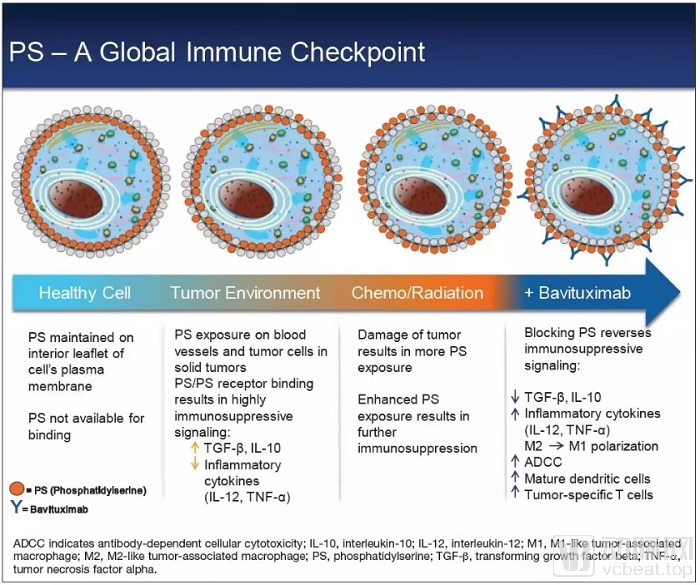
Cell-surface PS is an immune checkpoint.
(Image source: Bavituximab: a Novel, Investigational Immunotherapy Agent Targeting Phosphatidylserine in the Vasculature of the Tumor Microenvironment.)
“Gastric cancer is a malignant tumor prevalent in many regions worldwide and represents an urgent unmet medical need. Through this research collaboration, we aim to evaluate the clinical efficacy of combining Bavituximab and Keytruda in addressing this refractory cancer,” said Dr. Laura Benjamin, Co-founder and Chief Executive Officer of Dinghang Pharma. “This collaboration also reflects our shared commitment to enhancing and improving the lives of cancer patients.”
Keytruda Monotherapy Setback in First-Line Gastric Cancer Treatment Raises Hopes for “B+K” Combination Therapy
Keytruda is Merck & Co.’s flagship PD-1 inhibitor, which has brought breakthrough progress to global cancer treatment. By successfully expanding its use as a first-line therapy for indications such as lung cancer, Keytruda has established a strong market advantage. According to Merck’s 2018 financial report, Keytruda’s annual sales reached $7.171 billion. Gastric cancer is an important indication targeted by Keytruda. Global cancer statistics from 2018 show that gastric cancer ranks fifth in incidence and third in mortality worldwide. If the cancer metastasizes or spreads, the five-year survival rate is only around 5%. However, global PD-(L)1 monoclonal antibodies, including Keytruda, have made limited progress in treating gastric/gastroesophageal cancers. To date, only Keytruda, Opdivo, and similar agents have been approved for gastric/gastroesophageal cancers, and all are designated as third-line therapies.
As a humanized monoclonal antibody developed by Merck & Co. that blocks the PD-1 receptor molecule, Keytruda inhibits the binding of the PD-1 receptor on the surface of T cells to its ligands, thereby activating T cells to attack tumors. As the most prominent star in the era of immunotherapy, Keytruda has brought breakthrough progress to cancer treatment. With the successful expansion of first-line therapies for indications such as lung cancer, Keytruda has established a strong market advantage. According to Merck’s 2018 financial report, Keytruda’s annual sales reached $7.171 billion.
As a highly malignant tumor, gastric cancer is also a key indication for Keytruda. According to 2018 global cancer statistics, gastric cancer ranks fifth in incidence and third in mortality worldwide. If the cancer metastasizes or spreads, the five-year survival rate is only around 5%.
However, global PD-(L)1 monoclonal antibodies, including Keytruda, have made limited progress in the treatment of gastric cancer/gastroesophageal junction (GEJ) cancer. To date, only Keytruda and Opdivo have been approved for gastric cancer/GEJ cancer, and both are indicated as third-line therapies. According to clinical updates released by Merck & Co. in April this year, Keytruda’s pivotal Phase 3 trial, KEYNOTE-062, which aimed to secure approval for first-line treatment of gastric cancer, has failed once again following the setback of KEYNOTE-061. Neither Keytruda monotherapy nor its combination with chemotherapy demonstrated desirable outcomes in patients with advanced gastric or GEJ adenocarcinoma.
In fact, not only in gastric cancer but also in the vast majority of unselected solid tumor indications, the objective response rate to PD-1 inhibitor monotherapy remains modest, typically ranging from 10% to 30%. Enhancing the therapeutic efficacy of PD-(L)1 inhibitors and further expanding the eligible patient population have become focal points for the entire industry in the post-PD-1 era. In particular, PD-1 combination therapies, especially immuno-combination regimens, are garnering increasing attention from both international and Chinese pharmaceutical companies developing PD-1 inhibitors, including Merck & Co., Bristol Myers Squibb (BMS), Junshi Biosciences, BeiGene, Hengrui Medicine, and Innovent Biologics. These companies have successively launched clinical trials investigating their respective PD-1 products in combination with other agents.
As a leading company focused on combination immuno-oncology therapies, Dinghang Pharma has announced its collaboration with Merck & Co.
The expansion of the clinical collaboration between the two parties on the combination therapy of Bavituximab and Keytruda into the field of gastric cancer has attracted widespread attention in the industry. Building on its favorable safety and tolerability profile, Bavituximab—a monoclonal antibody targeting phosphatidylserine (PS)—features a unique “immune suppression reversal” mechanism. Its combination with Keytruda, a star PD-1 inhibitor, is expected to deliver synergistic efficacy through an “immune-plus-immune” therapeutic approach. Dinghang Pharma stated that if the current global Phase 2 clinical study collaboration proceeds smoothly, larger-scale, multicenter Phase 3 clinical trials will be initiated in China and the United States at the appropriate time.
Earlier in June, Dinghang Pharma announced the completion of an $80 million Series B financing round (approximately RMB 560 million), led by DF Capital and Nan Fung Life Sciences. The round also saw participation from Panacea Venture, Hualing Capital, Zheshang Industry-Finance Integration, Jiuyou Capital, Volcanic Rock Capital, as well as prominent Korean funds Korea Investment Partners and KB Investment, among others. This transaction ranked among the largest biopharmaceutical financing deals in China during the first half of the year. Currently, Dinghang Pharma is undertaking a Series B2 financing round to accelerate global clinical studies of its existing product pipeline and the development of corresponding novel biomarkers.