

MetHealth: Building an Integrated Digital Platform for Cardio-Cerebrovascular Rehabilitation at Home
After leaving Chunyu Doctor, Wang Kai had been contemplating what path to pursue. “In the vast healthcare market, there are significant gaps between different disease areas, akin to crossing industry boundaries. As a newly formed small team, we firmly decided from the outset to focus on specific vertical disease indications.”
“At that time, several of my friends and relatives passed away due to sudden myocardial infarction.” Wang Kai sighed. “Although cases of myocardial infarction and sudden cardiac death are frequently reported by the media and attract public attention, having worked in the healthcare industry for 12 years, I am acutely aware that behind these highly publicized individual cases lies a much larger population of cardiovascular and cerebrovascular disease survivors who face long-term disability, along with the enduring burden imposed on their families.”
Therefore, Wang Kai’s team has shifted its business focus to meeting the rehabilitation needs of patients with cardiovascular and cerebrovascular diseases. “Our primary consideration is how to enable more patients with cardiovascular and cerebrovascular diseases to live dignified, high-quality lives after onset, rather than merely surviving.”
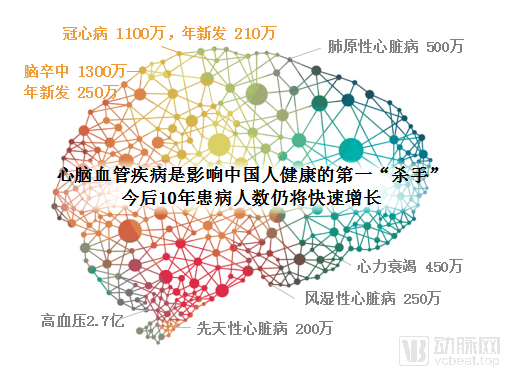
Data on Cardiovascular and Cerebrovascular Diseases (Source: Provided by the Company)
After 70 years of development, the mortality rate of acute myocardial infarction has decreased from 45% to 10%; the same-day mortality rate for stroke has dropped to 7.8%, with over 90% of patients surviving. However, among stroke survivors, 70%-80% lose their ability to perform daily activities independently due to sequelae such as hemiplegia and loss of speech and swallowing functions.
“Up to 10 million stroke survivors live with a loss of self-care ability,” Wang Kai told reporters. “Stroke rehabilitation is the most effective method proven by evidence-based medicine to reduce disability rates. Studies have demonstrated that adhering to standardized rehabilitation treatment guidelines can significantly improve the outcomes and quality of rehabilitation for stroke patients.”
Taking Japan as an example, nearly 50% of stroke patients aged 65 and older resume normal daily living, while more than 60% of those under 65 years of age do so.
“In China, only 11.5% of stroke patients receive rehabilitation therapy within one week, while 50% of patients do not receive any rehabilitation treatment at all after the onset of the disease,” explained Wang Kai. “The current standard of care involves physicians referring patients to a rehabilitation facility. However, most such facilities have waiting lists for beds, and many are located far from patients’ homes. Given that waiting for an available bed requires significant human and material resources, patients ultimately opt to return home for self-guided rehabilitation or forego treatment altogether.”
Against this backdrop, Wang Kai founded Beijing Yujian Future Technology Co., Ltd. (hereinafter referred to as “Yujian Future”), which is dedicated to facilitating home-based rehabilitation for patients with cardiovascular and cerebrovascular diseases.
In fact, rehabilitation in the field of cardiovascular and cerebrovascular diseases hinges on two core elements: first, leveraging the resources of major hospitals and experts; and second, productization within the rehabilitation sector.
In terms of hospitals and experts, YuJian Future has partnered with Xuanwu Hospital of Capital Medical University. “Xuanwu Hospital has extensive expertise in the field of cerebrovascular diseases and serves a large patient population. We decided to start with Xuanwu as a pilot site,” said Wang Kai.
In terms of productizing rehabilitation solutions, Yujian Weilai has adopted a “hardware + services” model by launching Walnut Health, a home-based intelligent rehabilitation platform that leverages internet, big data, and artificial intelligence technologies to connect physicians, devices, and patients.
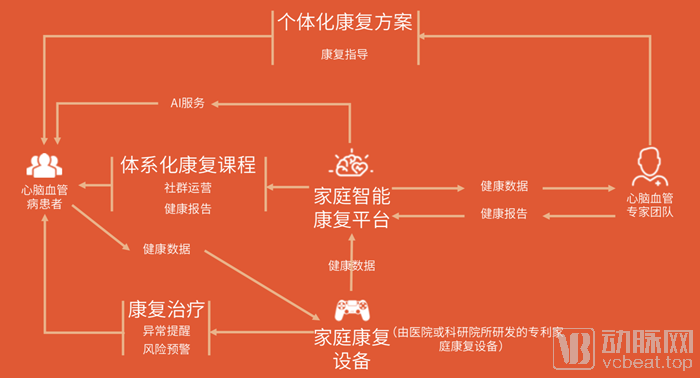
Yu Jian Future Service Model (Source: Provided by the enterprise)
Leveraging the platform as a connector, content as the core, and an expert team as support to comprehensively enter the field of cardiovascular and cerebrovascular rehabilitation is the primary strategy of Yujian Future. In terms of content, Yujian Future has developed a comprehensive, systematic suite of materials and courses. Similar to how KEEP provides differentiated content for beginners, intermediate, and advanced fitness enthusiasts, Yujian Future has established detailed staging for patients with cardiovascular and cerebrovascular diseases. Addressing specific symptoms such as unilateral hand stiffness, facial droop, and unilateral leg stiffness, the company provides tailored rehabilitation guidance, dietary recommendations, psychological support, and key precautions.
Since its official launch in April 2018, the platform has accumulated nearly 3,000 users to date. “Yu Jian Wei Lai” has further refined its user persona to target stroke patients aged 45 to 65.
Patients’ recovery is inseparable from home rehabilitation equipment. In addition to its software platform, YuJian Future provides patients with rehabilitation devices through the patented scientific research product of Professor Ji Xunming’s team—Chief Physician and Deputy Director of the Department of Neurosurgery at Xuanwu Hospital, Capital Medical University—namely, the “XuanYiTong” Portable Rehabilitation Device. This device offers preventive, therapeutic, and rehabilitative (anti-recurrence) benefits for individuals with cardiovascular and cerebrovascular diseases; it also helps high-altitude tourists prevent altitude sickness in advance. Furthermore, it can improve sleep quality.
In the field of cardiovascular and cerebrovascular health, the XuanYiTong Portable Rehabilitation Device employs endogenous physical therapy based on ischemic preconditioning. By delivering repeated, intermittent, and regulated ischemic-hypoxic stimuli to non-vital organs or tissues, such as both upper limbs, the device stimulates and induces the human body to produce endogenous protective substances. This enhances the tolerance of distant vital organs, including the heart and brain, to ischemic-hypoxic injury, thereby preventing potentially fatal ischemic-hypoxic events in these critical organs.
Wang Kai further stated that while using the Xuan Yitong portable rehabilitation device, it was found to have room for development; however, due to insufficient cloud-based data capabilities within the hospital, iterative upgrades were difficult to implement. In contrast, Yu Jian Future has accumulated extensive resources in the cardiovascular and cerebrovascular fields and has established close partnerships with relevant pharmaceutical companies and major enterprises such as Huawei. By leveraging its cloud-based data capabilities, Yu Jian Future can iterate on the product, offering enhanced functionalities and expanded device ecosystems.
In terms of future planning, Yujian Weilai is developing a mini-program and upgrading its hardware. By adopting a dual-drive B2B+B2C model, the company aims to further empower health and elderly care institutions.
It is understood that Yu Jian Wei Lai is currently raising funds to enhance its technological capabilities and build a sales team.