

Hainan's First TCM Internet Hospital with Over 300,000 Doctors Files IPO Prospectus, Aiming to Be the 'Meituan-Dianping' of Traditional Chinese Medicine Services

Beijing Universe In Nutshell Technology
Provider of Online Learning Service Platform for Traditional Chinese Medicine
The Development of Traditional Chinese Medicine Faces Numerous ChallengesThe development of Traditional Chinese Medicine (TCM) is currently confronted with many challenges. In terms of heritage transmission, senior TCM masters are struggling to find suitable successors, putting their valuable clinical experience at risk of being lost. In clinical practice, there is a significant gap between academic curricula and actual clinical needs, resulting in weak practical skills among graduates; consequently, TCM practitioners are increasingly focusing on scientific research. At the primary care level, grassroots clinicians lack sufficient experience and standardized methodologies, failing to establish systematic logical frameworks. This series of issues has become a critical bottleneck hindering the inheritance and development of TCM.
Fortunately, in recent years, with the improvement of the overall economic environment and changes in dietary patterns, the advantages of Traditional Chinese Medicine (TCM) in managing chronic diseases have gradually become apparent. The promulgation of the TCM Law has also further fueled the revival of TCM.
The Law of the People's Republic of China on Traditional Chinese Medicine, which officially came into effect on July 1, 2017, is primarily dedicated to the protection, support, and development of Traditional Chinese Medicine (TCM). Focusing on the inheritance and promotion of TCM, it strengthens policy support and safeguards, adheres to equal emphasis on standardization and扶持, and prioritizes innovation in systems, mechanisms, and institutions. To a significant extent, it has addressed key and challenging issues that have constrained the development of TCM, thereby facilitating its inheritance and growth while helping to maintain China’s leading position among major traditional medicine nations in the global development of traditional medicine.
This not only marks the advent of the first “dedicated” national law for traditional Chinese medicine (TCM), but also signals comprehensive tailwinds for the TCM industry, which boasts a market capitalization in the trillions.
Efficacy is the lifeblood of Traditional Chinese Medicine (TCM). However, the most fundamental pain point in the TCM industry today remains an insufficient supply of high-quality services. In short, there is a severe shortage of competent TCM practitioners, and appointments with renowned TCM experts are extremely difficult to secure.
Take Professor Chai Songyan, a National Medical Master at the Beijing Hospital of Traditional Chinese Medicine who specializes in treating infertility, as an example. Many patients are unable to conceive due to issues related to hormones, ketone bodies, or follicles; however, after treatment by Professor Chai, the majority are able to give birth to healthy infants. Nevertheless, securing an appointment with Professor Chai typically requires booking six months in advance.
“Dedicated to physician education, Beijing Universe In Nutshell Technology is ‘extracting the academic thoughts and clinical experiences of these National Medical Masters and renowned senior TCM practitioners, recording them into videos for intergenerational inheritance,’ Ma Wei, President of Beijing Universe In Nutshell Technology, told VCBeat. The company’s core business strategy is to establish a ‘wall-less’ lifelong university for TCM professionals.”
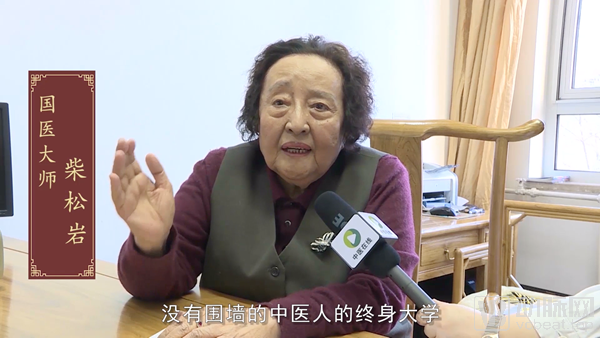
National Medical Master Chai Songyan (Photo provided by the interviewee)
Internet “Jingyi University”: Training TCM Practitioners Capable of Providing Effective Care for the General Public
“If the Medical Sage Zhang Zhongjing had left behind a set of detailed video recordings rather than just the 48,000-character Treatise on Cold Damage and Miscellaneous Diseases, today’s TCM practitioners might all be highly skilled masters,” Ma Wei told VCBeat. She explained that Beijing Universe In Nutshell Technology established “Jingyi University” to enable more grassroots TCM practitioners to access clinical expertise from national TCM masters and specialists, ensuring that their clinical experience endures and is passed down to future generations.
On May 7, 2018, “Jingyi University” was established through a joint initiative signed by dozens of National Medical Masters, over one hundred nationally renowned senior TCM practitioners, and nearly 30,000 TCM professionals across China. “Jingyi University” is an online TCM education platform under Beijing Universe In Nutshell Technology. It carefully selects National Medical Masters, renowned senior TCM practitioners, and influential and highly competent TCM experts to provide immediately effective clinical improvement courses for junior TCM physicians.
In accordance with university regulations, Jingyi University has established a set of compulsory courses based on the efficient learning pathways summarized by Beijing Universe In Nutshell Technology and renowned senior TCM practitioners across China. More than ten thousand additional courses are categorized as elective options, allowing learners to select content tailored to their individual needs. Ma Wei noted that previously, the content provided by Beijing Universe In Nutshell Technology consisted of fragmented courseware. Without proper guidance, users engaged in unsystematic study, failing to construct a structured framework in their minds, which limited their potential for improvement.
Ma Wei told VCBeat that Professor Chai Songyan, a National Medical Master, stated when proposing the establishment of Jingyi University: “The experience I have summarized over five years can be taught to them in five minutes, thereby gaining them an additional five years.” Guided by this philosophy, Jingyi University integrates the expertise of outstanding experts from the Beijing Universe In Nutshell Technology online platform with obscure and difficult-to-understand traditional Chinese medicine (TCM) classics, combining them into structured courses that are easy to comprehend. The curriculum ranges from introductory TCM classic courses focused on Six-Channel Pattern Differentiation using classical formulas, to later-stage clinical experience in specialized diseases, and finally to mentorship and guidance by renowned masters, aiming to “enable grassroots TCM practitioners to become skilled practitioners within one year and renowned local doctors within three years.”
Online Cloud Pharmacy: Enabling Primary Care Clinics to Access Authentic Herbal Medicines
“A simple needle, a stick of moxa, and a bowl of herbal decoction can regenerate flesh on withered bones. ‘TCM Online aims not only to enhance physicians’ clinical skills but also to improve therapeutic outcomes for patients.’”
Enhancing therapeutic efficacy hinges on the undeniable importance of Traditional Chinese Medicine (TCM) herbal products. However, concerns persist amid widespread claims that “TCM is being undermined by its herbal medicines.” Frequent issues such as adulteration and questionable medicinal value have raised alarms about the current state and development of TCM herbs. Ma Wei pointed out that quality problems are particularly pronounced in primary care clinics in third- and fourth-tier cities. On one hand, these small clinics place limited purchase orders, resulting in high procurement costs; on the other hand, adulteration and counterfeiting of drugs are rampant. Even with accurate prescriptions, patients struggle to achieve desired therapeutic outcomes without access to high-quality herbal medicines.
In response to the current state of traditional Chinese medicine (TCM), Beijing Universe In Nutshell Technology has established the Jingyi Society, a high-quality TCM decoction piece mutual aid platform, enabling scattered clinics to form a powerful purchasing consortium. By partnering with upstream TCM decoction piece manufacturers known for their strong reputation and premium raw materials, Beijing Universe In Nutshell Technology leverages centralized procurement to reduce purchasing costs for grassroots clinics while strictly controlling drug quality. Processed high-quality decoction pieces are delivered directly to various grassroots clinics, while complex preparations such as pills, powders, ointments, and elixirs are managed through a “Cloud Pharmacy” model: prescriptions are issued by clinics, processed by large-scale enterprises, and then delivered directly to patients’ homes.
Currently, Beijing Universe In Nutshell Technology has partnered with multiple pharmaceutical manufacturers, including Tongrentang, Kangmei Pharmaceutical, China Resources Sanjiu, and Tongjuntang, completing the distribution layout of its national dispensing centers.
Internet Hospital to Launch by Year-End, Becoming the “Meituan-Dianping” of Traditional Chinese Medicine Services
The online “Cloud Pharmacy” has been established, with the “Internet Hospital” following closely behind. On August 20, Beijing Universe In Nutshell Technology obtained an Internet Hospital license, becoming the only internet hospital in Hainan with traditional Chinese medicine (TCM) characteristics and nationwide practice qualifications. The establishment of the Internet Hospital platform has attracted numerous large hospitals and small clinics, previously engaged in educational collaborations, to join the network, forming a closed-loop supply-and-demand system that ranges from empowering hospital physicians to providing high-quality TCM services to the public.
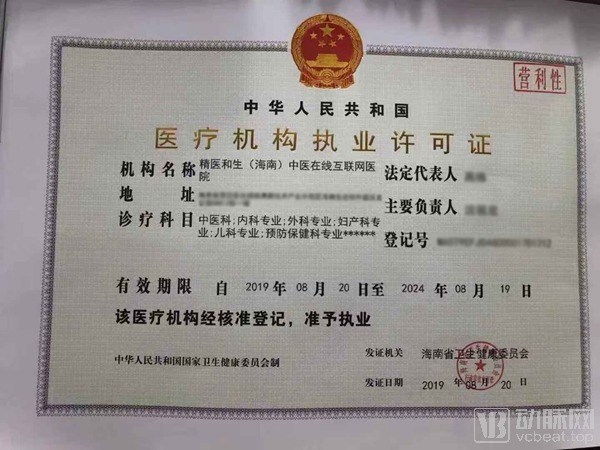
Photo of TCM Online Hainan Internet Hospital (Image provided by the interviewee)
Ma Wei stated that since its establishment in 2015, Beijing Universe In Nutshell Technology has accumulated over 300,000 physician users, with 50,000 primary-care physicians having enrolled in Jingyi University’s educational programs and nearly 3,000 clinics joining the Jingyi Society mutual assistance network.
In addition, the public version of “TCM Online,” dubbed the “Meituan-Dianping for medical and pharmaceutical services,” is scheduled to be officially launched by the end of 2019. Ma Wei told VCBeat that TCM Online aims not only to cultivate competent TCM practitioners but also to help the public identify and access them.