

Ruihua Cardiac Rehabilitation: Bridging the Gap in China's Post-Cardiac Care Market
According to the "Report on Cardiovascular Diseases in China 2018" released by the National Center for Cardiovascular Diseases, the incidence of cardiovascular diseases in China continues to rise, with approximately 290 million people currently affected. Furthermore, cardiovascular diseases account for more than 40% of all disease-related deaths among residents, a rate significantly higher than that of other diseases.
However, clinicians tend to focus more on emergency rescue and pharmacological treatment during the acute phase of heart disease, while post-acute cardiac rehabilitation is often overlooked. Nevertheless, substantial evidence-based medical data have demonstrated that cardiac rehabilitation yields significant benefits for patients, reducing the incidence of cardiovascular diseases by 58%, myocardial infarction by 30%, and cerebrovascular events by 60%. Consequently, developed countries such as those in Europe and the United States, as well as Japan, attach great importance to cardiac rehabilitation.
Professor Matthew Bartel, an internationally renowned authority in the field of rehabilitation medicine, stated, “In the United States, since the 1980s, cardiac rehabilitation has been mandatory for both post-operative coronary artery bypass grafting (CABG) patients and those with heart failure. Undergoing cardiac rehabilitation can significantly improve post-operative quality of life.”
Cardiac rehabilitation provides comprehensive treatment and health management for patients with heart disease, enabling them to maximize their recovery of social function. The target population for cardiac rehabilitation includes patients with myocardial infarction, angina pectoris, and heart failure, as well as those who have undergone coronary artery bypass grafting (CABG), percutaneous coronary intervention (PCI), or heart or lung transplantation.
In China, the development of cardiac rehabilitation started later than that of other fields such as neurological rehabilitation and orthopedic rehabilitation. The inception of cardiac rehabilitation in China dates back to 1991, when the Professional Committee on Cardiovascular Diseases of the Chinese Association of Cardiac Rehabilitation was established, with Professor Liu Jiangsheng elected as its chairman. Over the years, the committee has cultivated a group of experts and scholars dedicated to the cause of cardiac rehabilitation, laying the foundation for the development of cardiac rehabilitation in China.
Since 2012, the number of cardiac rehabilitation institutions in China has been steadily increasing, growing from just a few initially to nearly 700 by 2017, with projections exceeding 1,000 by 2019. Driven by expert advocacy and surging patient demand, China’s cardiac rehabilitation industry has emerged from scratch and achieved rapid development.
Meng Xiaoping, Director of the Central Laboratory of the Department of Cardiovascular Medicine at the Second Hospital of Jilin University, once stated that there are currently three models for carrying out cardiac rehabilitation work in China:
I. An integrated model of the Department of Cardiovascular Medicine and the Cardiac Rehabilitation Center;
II. The comprehensive rehabilitation model includes cardiac rehabilitation;
III. Standalone Cardiac Rehabilitation Model.
Meng Xiaoping believes that the integrated model of cardiology departments and cardiac rehabilitation centers has promoted the development of China’s cardiac rehabilitation industry. As cardiac rehabilitation in China is still in its developmental stage and has not yet been widely adopted, public awareness remains low. Consequently, the likelihood of cardiovascular patients seeking care at a cardiac rehabilitation center as their first choice is very low, leading to insufficient patient volume for standalone cardiac rehabilitation centers.
The integrated model of the Department of Cardiovascular Medicine and the Cardiac Rehabilitation Center offers the following advantages:
1. Maintain a continuous patient pipeline and secure the initiative to facilitate the development of cardiac rehabilitation.
2. Coexistence of economic benefits and social impact.
3. Ensure the safety of cardiac rehabilitation.
4. Achieved integrated, end-to-end management encompassing prevention, treatment, and rehabilitation.
Compared with China, the cardiac rehabilitation industries in countries such as the United Kingdom, Germany, Japan, and the United States have entered a mature stage. The UK adopts a cardiac rehabilitation model combining rehabilitation centers with community-based care; Japan employs a model driven by outpatient rehabilitation services that extend to home care; and the US follows a market-led model with partial government support.
In the United Kingdom, rehabilitation is implemented under the supervision of professional societies, with patients referred to community settings for rehabilitation after treatment at tertiary hospitals. Cardiac rehabilitation clubs are widely utilized in the UK, providing a platform for patients to discuss and exchange experiences, and health insurance covers the cost of one to three months of community-based rehabilitation.
Germany boasts a comprehensive cardiac rehabilitation system and workflow, with its disease management information system integrated throughout the entire process and a highly developed referral system. In Germany, physicians are required to recommend cardiac rehabilitation for patients with cardiovascular diseases; failure to do so may trigger an investigation by the medical board, adversely affecting their professional careers. Regarding payment,Medical insurance reimbursement mechanisms encourage or even mandate patients to undergo cardiac rehabilitation.
Rehabilitation funding is primarily sourced from pension insurance (based on years of service) and medical insurance. Medical insurance covers the full cost of cardiac rehabilitation following the first cardiovascular event; if a patient does not undergo cardiac rehabilitation, the insurance reimbursement rate will decrease in the event of a subsequent cardiac incident.
In Japan, patients in Stage 1–2 of rehabilitation are admitted. These patients demonstrate high health literacy, adhere strictly to medical advice, exhibit high levels of active participation, and show good compliance. Regarding health insurance coverage, six months of cardiac rehabilitation expenses are covered.
In the United States, Phase I in-hospital rehabilitation is covered by health insurance, facilitating a smoother implementation of cardiac rehabilitation during this stage. The American Association of Cardiovascular and Pulmonary Rehabilitation (AACVPR) has proposed outpatient performance measures that require discharge orders to specify mandatory referral of discharged patients to outpatient cardiac rehabilitation programs; such recommendations from healthcare providers increase the likelihood of patient participation in cardiac rehabilitation. According to data, 30% of cardiac patients in the United States participate in cardiac rehabilitation.
With socioeconomic development, lifestyle changes, and an aging population, the risk factors for cardiovascular diseases in China are continuously increasing, leading to a growing number of individuals affected by cardiovascular and cerebrovascular diseases. It is therefore imperative to establish a cardiac rehabilitation model tailored to China’s national conditions and to implement health management for this population.
Although China’s cardiac rehabilitation industry is developing rapidly, it still faces challenges such as insufficient attention, lack of industry standards, and a shortage of qualified professionals. Therefore, the field of cardiac rehabilitation in China remains in its early stages.
Drawing on the development of the cardiac rehabilitation industry abroad, China’s cardiac rehabilitation sector currently needs to address challenges such as insufficient health insurance policy support, a shortage of qualified professionals, an incomplete range of equipment, limited hospital space, a scarcity of cardiac rehabilitation centers, and inadequate patient education.
There is no unified standard system at the national level:The cardiac rehabilitation industry expects the state to take the lead in organizing experts to establish industry construction standards, assessment standards, and other guidelines tailored to China’s national conditions.
Insufficient Support from Medical Insurance:Currently, China has included 29 rehabilitation items in its national medical insurance catalog; however, there is limited coverage for cardiac rehabilitation-related services. In contrast, developed countries have fully integrated cardiac rehabilitation into their medical insurance systems, with continuously expanding coverage driven by ongoing innovation.
Lack of hardware facilities:Tertiary hospitals face limited space and a shortage of beds, while primary care hospitals suffer from insufficient talent and equipment.
Insufficient Public Awareness of Rehabilitation:Patients are concerned about the risks associated with cardiac rehabilitation. In contrast to the traditional belief that postoperative rest is essential, many individuals perceive cardiac rehabilitation as risky, while a subset of patients remains unaware of the concept altogether. Hu Dayi’s team previously published survey data involving 28,227 members of the public from diverse age groups and occupational backgrounds. The results revealed that only 17.7% of respondents had a good understanding of cardiac rehabilitation, and there was a strong public desire for access to more professional rehabilitative treatments and expert guidance on cardiac rehabilitation.
Absence of a Training System for Cardiac Rehabilitation Professionals:In the field of cardiac rehabilitation, there is a gap in the talent training system. Most cardiac rehabilitation specialists in China are former cardiologists or rehabilitation physicians who have transitioned into this role. Additionally, current cardiac rehabilitation training in China mostly takes the form of short-term courses, whereas abroad, cardiac rehabilitation training programs last at least six months. The shorter duration makes it difficult to cultivate qualified cardiac rehabilitation professionals.
In December 2018, the Chinese Alliance for Cardiovascular Health released the first list of institutions designated for the establishment of Cardiac Rehabilitation Centers, comprising a total of 134 facilities. The Chinese Alliance for Cardiovascular Health has put forward specific requirements for the development of these Cardiac Rehabilitation Centers:
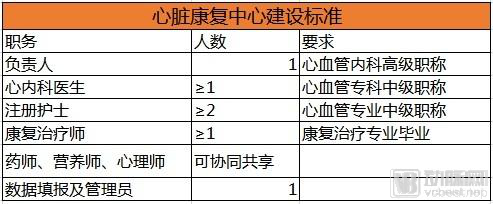
The requirements stipulate that a cardiac rehabilitation center must have one person in charge, at least one cardiologist, at least two registered nurses, and at least one rehabilitation therapist. Pharmacists, dietitians, and psychologists may be shared with other departments. Additionally, the center requires one data entry and administrative staff member. However, among the more than 170 institutions that applied in the first batch, only 134 were accredited.
Among various disease rehabilitation fields, cardiac rehabilitation is one of the highest-risk and most complex. Its five core components—exercise prescription, nutritional prescription, psychological intervention, medication management, and lifestyle modification—require multidisciplinary collaboration among cardiologists, cardiac surgeons, cardiac rehabilitation specialists, rehabilitation nurses, dietitians, psychologists, and clinical pharmacists. Therefore, establishing a qualified cardiac rehabilitation center is no easy task, and there is a significant demand for skilled professionals in this field.
During the development of cardiac rehabilitation in China, private cardiac rehabilitation centers have been a force that cannot be ignored. They have actively collaborated with top-tier international cardiac rehabilitation institutions to carry out talent training, introduce technical standards, and conduct cardiac rehabilitation research. Among them, Reihuaxinkang is highly representative, having received investments from Legend Capital, KaiXuan Capital, and Huimei Healthcare Investment.
Reihuaxinkang is preparing to launch a new round of financing, aiming to raise tens of millions of yuan to build flagship stores, cultivate talent, and establish industry standards. Let’s examine why Reihuaxinkang has attracted the favor of capital and how it proposes its own solutions to address the aforementioned challenges.
Reihuaxinkang pioneered the “pre-treatment, post-rehabilitation” model for cardiac rehabilitation, establishing cardiac rehabilitation centers adjacent to tertiary hospitals. It provides a service system centered on cardiac rehabilitation and secondary prevention, covering end-to-end solutions for cardiac rehabilitation. As a professional cardiac rehabilitation center, Reihuaxinkang has been certified as the first overseas member of Japan’s JHC, and has received accreditation from the Chinese Society of Cardiology of the Chinese Medical Association, the Cardiovascular Prevention and Rehabilitation Committee of the Chinese Association of Rehabilitation Medicine, and the Cardiovascular Disease Prevention and Rehabilitation Committee of the Chinese Heart Union.
Currently, Reihuaxinkang has built and is operating its first cardiac rehabilitation center adjacent to Beijing Anzhen Hospital, with additional centers near Fuwai Hospital and China-Japan Friendship Hospital currently under development. Lu Ji’en, founder of Reihuaxinkang, stated, “Beijing Anzhen Hospital and Fuwai Hospital each perform more than 10,000 cardiac medical and surgical procedures annually, providing a substantial patient base for the cardiac rehabilitation centers.”
In terms of national policies and standards, Reihuaxinkang is preparing clinical data, collaborating with experts and relevant professional associations in the United States, Japan, and China to build a comprehensive data system, draft industry reports, and actively promote policy support at the national level. Lu Jien introduced, “Our ‘Research Center’ introduces and assimilates advanced international concepts and medical technologies. By integrating China’s specific national conditions and ethnic characteristics, we research and develop cardiac rehabilitation medical technologies tailored for the Chinese population, and establish China’s own cardiac rehabilitation standards based on data analysis.”
Regarding insurance policies, Lu Ji’en stated: “China’s insurance system and insurance products have made rapid progress in all aspects, but there is limited coverage in the field of cardiac rehabilitation.”We hope that commercial insurance will focus on new areas, particularly postoperative care. Cardiac rehabilitation insurance should be modeled after auto insurance, making it mandatory for all surgical patients. This approach would effectively reduce postoperative recurrence and related complications, while actively enhancing patients’ awareness of cardiac health, thereby lowering insurance expenditures. Germany offers valuable lessons in cardiac rehabilitation insurance, which have significantly promoted the development of cardiac rehabilitation. Furthermore, this would reduce the waste of medical resources and alleviate the financial burden on the national basic medical insurance system.
Addressing hardware infrastructure issues, Lu Ji’en stated, “Currently, there is a significant gap between China and developed countries in cardiac rehabilitation medical equipment and management systems. Domestically produced equipment remains relatively crude in terms of precision and therapeutic appropriateness. Furthermore, existing management systems often fail to align with actual clinical needs. We have entered into strategic partnerships with Donghua Software and Lenovo Group to jointly develop cardiac rehabilitation health management systems, as well as home-based cardiac rehabilitation training and management devices, thereby enabling comprehensive, full-process management for patients across Phase I, II, and III cardiac rehabilitation. In addition, top-tier tertiary hospitals such as Fuwai Hospital and Anzhen Hospital face constraints in physical space and bed capacity, creating a clear need for patient triage and diversion. If specialized institutions can assume responsibility for pre- and post-operative rehabilitation services, thereby reducing hospital stays at tertiary hospitals, this would not only enhance patients’ rehabilitation outcomes and reduce costs but also improve the utilization efficiency of medical resources in tertiary hospitals.”
Regarding public awareness of rehabilitation, Lu Ji’en stated: “Reihuaxinkang has primarily undertaken four initiatives in this area. First, we frequently conduct direct education for patients and their families at tertiary hospitals, informing them about the importance of cardiac rehabilitation and related knowledge. Second, we organize educational lectures and collaborate with media outlets to promote awareness of cardiac rehabilitation. Third, we publish content related to cardiac rehabilitation on self-media platforms. Fourth, we hold free clinic consultations in communities and partner healthcare institutions to disseminate information on cardiac rehabilitation. Meanwhile, Reihuaxinkang actively responds to the national ‘Health for All’ policy recently proposed by the government, advocating that health education should begin in childhood, particularly with regard to cardiovascular and cerebrovascular diseases and emergency first aid.”
Regarding talent development, Lu Ji’en told VCBeat, “This is our top priority. We have drawn on industry training materials from the United States and Japan to establish our own training system for cardiac rehabilitation physicians, nurses, and therapists, and have jointly designed examination and certification standards with the American and Japanese associations of cardiac rehabilitation. In addition, we collaborate with the Mayo Clinic across academia, research, and clinical practice—specifically through remote consultations, personnel exchanges, and joint research initiatives—to advance technical standards in the field.” Lu Ji’en also expressed hope that health and medical knowledge would be incorporated into China’s compulsory education curriculum, as this would greatly help foster early interest in medical careers and promote public health literacy.
Regarding future plans, Lu Ji’en stated, “We will adopt a development model combining self-built facilities with regional collaborations to cover cardiac surgery hospitals across China. After obtaining regional patient volume data, we will establish small-scale and lightweight rehabilitation centers based on patient needs. In the field of internet-based cardiac rehabilitation, we have signed a strategic cooperation agreement with Lenovo Group to establish an Internet Cardiac Rehabilitation Center, serving patients nationwide to meet their needs.”
In summary, Reihuaxinkang’s numerous initiatives in the field of cardiac rehabilitation have not only promoted the development of the industry but also achieved a win-win outcome in terms of both economic and social benefits. It is hoped that the case of Reihuaxinkang will inspire further reflection within the market.