

BoneRegen Biotech's 'Bio-Ink' Enables Autologous Bone Regrowth: Revolutionizing Orthopedic Implants with 3D-Printed, Biodegradable Scaffolds
In the medical market for artificial bone, metal materials and polymer materials remain the preferred choices for most applications. However, when implanted into patients, these materials exhibit numerous inherent and unavoidable drawbacks. For instance, they fail to achieve organic integration with autologous bone, ultimately leading to "stress concentration and stress shielding." This results in bone resorption around the artificial bone implant, causing localized osteoporosis, which may lead to loosening of the implant or fractures in the adjacent bone.
Furthermore, metallic artificial bones may exhibit a "delamination phenomenon," wherein metal ions leach from the surface of the implant into the human body, causing secondary injury. Excessive release of metal ions increases the risk of Alzheimer’s disease. Factors such as bone morphology and bone growth rate vary among individuals of different age groups. Therefore, using standardized metallic or polymeric artificial bones to accommodate personalized autologous bone structures is inherently challenging and cannot adequately address individual variations.
So, which material is most suitable for artificial bone implants in the human body? The pursuit of avoiding stress shielding while achieving personalized adaptation to the patient’s own bone environment is not merely an empty promise; rather, it is the answer that stakeholders in the artificial bone medical market have been diligently seeking.
From Research to the Founding of Born Biotech: Academic Research Attracts Investor Interest

“How do different implants develop after being implanted in the body?” This question constituted the core focus of a research project titled “Permeability Evaluation,” conducted by Born Biomedical’s scientific research team at Northwestern Polytechnical University. Led by Wang Yan’en, along with his junior colleague Zhang Chi, both students of Professor Wei Shengmin, the team specialized in evaluating the in vivo development of implants during their academic tenure and carried out detailed investigations on implants made from various materials.
From 2005 to 2008, Wang Yan’en’s team devoted themselves entirely to research on “permeability evaluation.” His mentor, Professor Wei Shengmin, suggested translating their research achievements into tangible equipment, which would constitute a highly valuable product. Due to his mother’s health condition, Wang had long aspired to develop an artificial bone product. Furthermore, given the team’s ongoing research focused on implant permeability, they had already identified pure bio-grade bioactive materials most suitable for fabricating artificial bones.
By the end of 2008, the team began to explore how to translate bioactive materials into artificial bones that would truly benefit patients. Although no one initially believed in the feasibility of this endeavor, the team persisted in seeking a viable path to commercialization. Ultimately, in 2012, they developed the first piece of equipment for manufacturing bioactive materials, which subsequently led to the production of the first artificial bone.
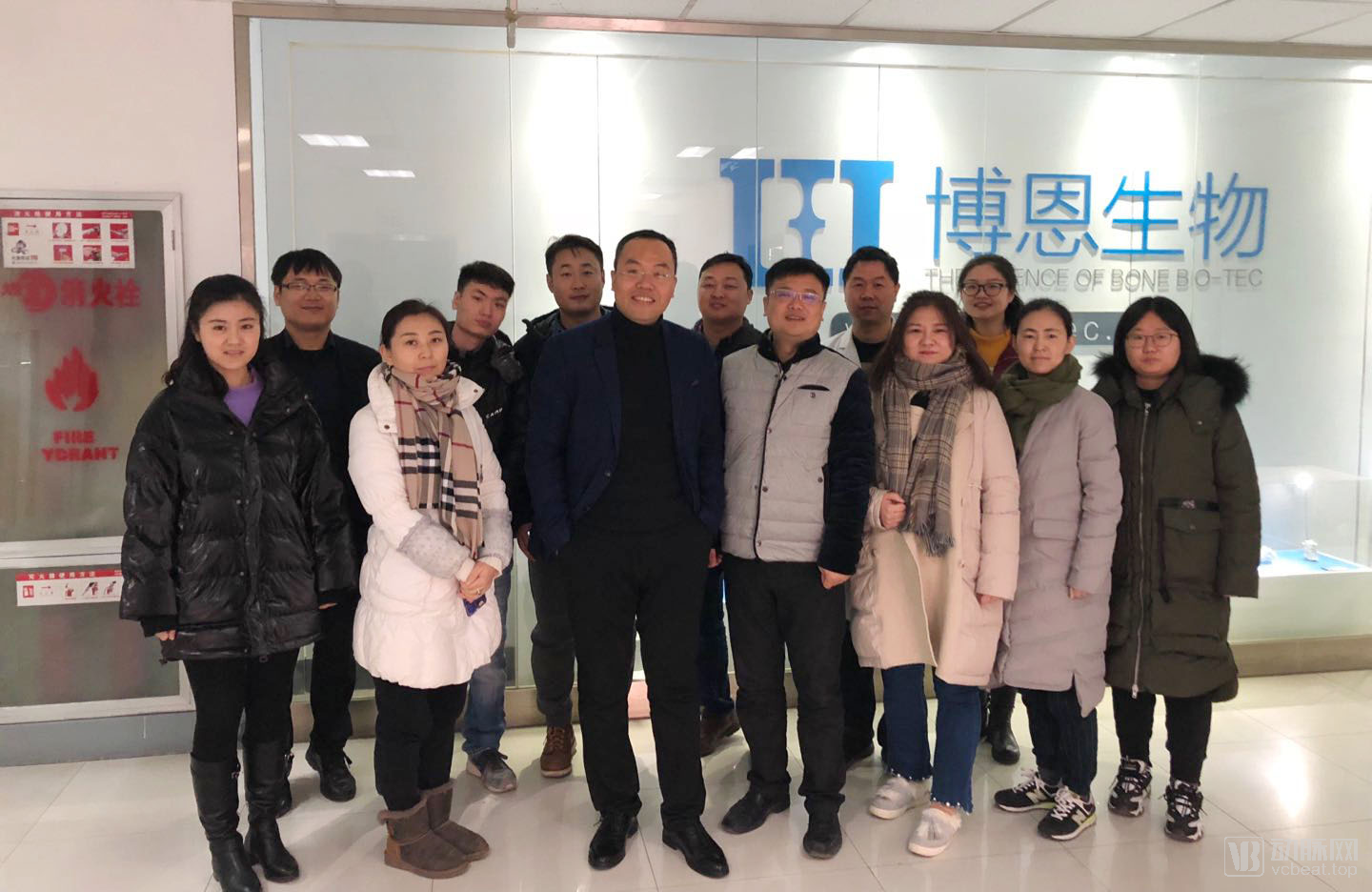
Born Bio Team (Image provided by the company)
The team subsequently presented their scientific achievements at an innovation competition, where they received high recognition from CAS Star, a venture capital arm under the Chinese Academy of Sciences (CAS). Zhang Chi told VCBeat, “Our team was purely focused on scientific research. We felt that starting a business would be overly cumbersome, so when investors first expressed interest in our project, we declined outright. However, the investors repeatedly approached us to explain the numerous advantages of commercializing our product and the social value it would generate. Thanks to their persistence and encouragement, we ultimately established the company.”
In 2015, the research team secured its first seed funding round of RMB 4 million from CAS Star, an affiliate of the Chinese Academy of Sciences, and established Xi’an Born Biotechnology Co., Ltd. (hereinafter referred to as “Born Biotech”).
Hydroxyapatite Combined with “Bioink”: Boen Bio’s Self-Developed 3D Printing Equipment
This bioactive material, which garnered investor interest immediately upon its development, is hydroxyapatite (HA). After years of scientific research, Wang Yan’en’s team ultimately identified hydroxyapatite as the most suitable material for artificial bone. Hydroxyapatite is the most abundant component in human teeth and accounts for 75% of the inorganic salt composition in human bone. It is a natural material possessing both osteoconductivity and osteoinductivity, and can be extracted from natural sources, such as seashells, through physical or chemical methods. However, naturally extracted hydroxyapatite is in powder form, making it extremely difficult to shape. Given that human bones have complex, irregular curved surfaces, achieving proper forming of the raw material presents a significant challenge.
After evaluating various fabrication methods, Wang Yan’en’s team ultimately decided to use 3D printing to manufacture hydroxyapatite into human bone substitutes. However, the lack of commercially available biocompatible-grade 3D printers meant that they would need to develop their own 3D printing equipment to produce hydroxyapatite-based artificial bones. Zhang Chi stated, “Developing our own equipment was an extremely challenging task. There are multiple 3D printing technologies, such as FDM, SLA, and 3DP, and it was initially unclear which method would be suitable for fabricating bone structures. Through extensive exploration and experimentation in the early stages, we ultimately discovered that only a combination of 3DP and bioprinting could effectively address the challenges of printing bone tissues.”
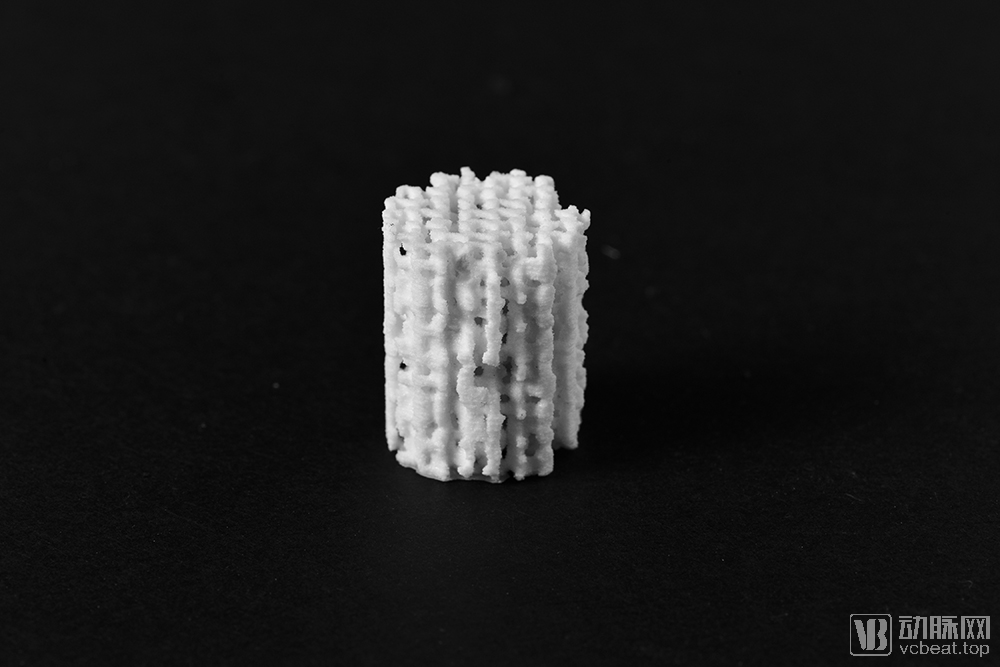
Schematic Diagram of Born Biomedical’s Synthetic Bone Spine (Image Provided by the Company)
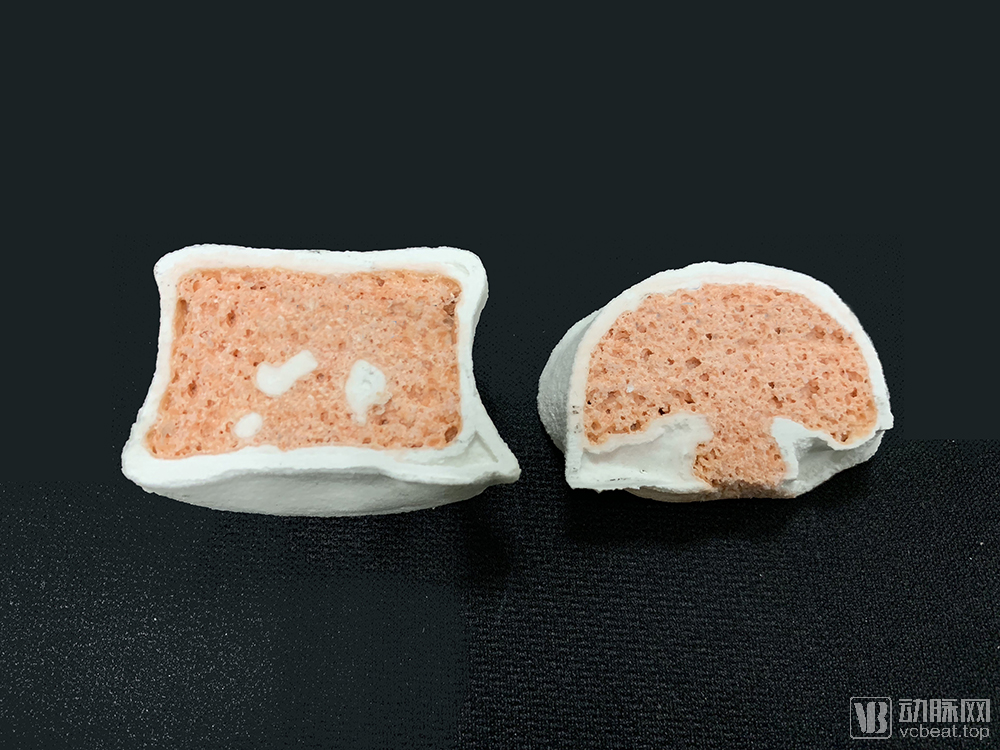
Schematic Cross-Section of Bone Biotech’s Synthetic Spinal Implant (Image Provided by the Company)
Currently, Born Biotech is pursuing artificial bone printing using a “3DP + bioprinting” approach. Zhang Chi added that the challenges of fabricating artificial bones from hydroxyapatite extend far beyond the mere absence of 3D printing equipment; the process of printing irregularly curved bone structures is highly complex. Born Biotech formulates its raw material using 96% hydroxyapatite combined with 4% bioactive factors and “bioink.” This material behaves as a non-Newtonian fluid, causing droplet size variability and “agglomeration” during 3D spray printing, which severely compromises the fabrication of artificial bones. The Born team ultimately resolved this issue by employing precise atomized spraying to accurately control each deposition site of the raw material.
Notably, this “bio-ink,” with a content of less than 4%, is an adhesive independently developed by Bone Biologics that can perfectly fix and shape hydroxyapatite. In contrast, while there are large medical companies abroad that also use hydroxyapatite as the raw material for manufacturing artificial bone, their products contain only 30% hydroxyapatite, with the remaining 70% consisting entirely of polylactic acid (PLA) “glue.” Although PLA degrades within the human body, its degradation creates a slightly acidic microenvironment around the bone, causing damage to the human body.
Personalized Customization of Growable and Developable Bone; Degradation of Artificial Bone Promotes Autogenous Bone Growth
The most remarkable innovation by Born Biotech is their final 3D-printed “grow-and-develop bone.” As is well known, artificial bones made from metal or polymer materials remain permanently in the human body; even after the patient’s death, these metallic or polymeric implants do not degrade. In contrast, the artificial bone produced by Born Biotech gradually degrades after being implanted into the patient, stimulating the development of the patient’s own autologous bone and ultimately enabling the restoration of the patient’s native bone tissue.
Bone development rates vary across different age groups. Born Biotech personalizes the formulation of synthetic bone raw materials based on each patient’s skeletal development rate, then 3D-prints a corresponding synthetic bone graft using the patient’s own autologous bone sample for subsequent implantation. In the defect area between the two fractured bone ends, osteoblasts and osteoclasts are continuously generated; through their ongoing differentiation, the site ultimately undergoes calcification to form new bone tissue. This process is known as the “creeping substitution mechanism.”
The creeping substitution mechanism can be vividly understood as a process in which osteoblasts and osteoclasts on the two fractured bone ends continuously migrate toward each other, forming a “bridge” that eventually meets to facilitate bone healing. Implants made of metallic or polymeric materials are recognized by cells as “foreign bodies,” failing to trigger the creeping substitution mechanism between the fractured bone segments. In contrast, artificial bone fabricated from natural hydroxyapatite is recognized by cells as “self,” thereby initiating the creeping substitution mechanism. Over time, the artificial bone gradually degrades, creating space for the development of autologous bone. By the time the artificial bone is completely degraded, only autologous bone remains.
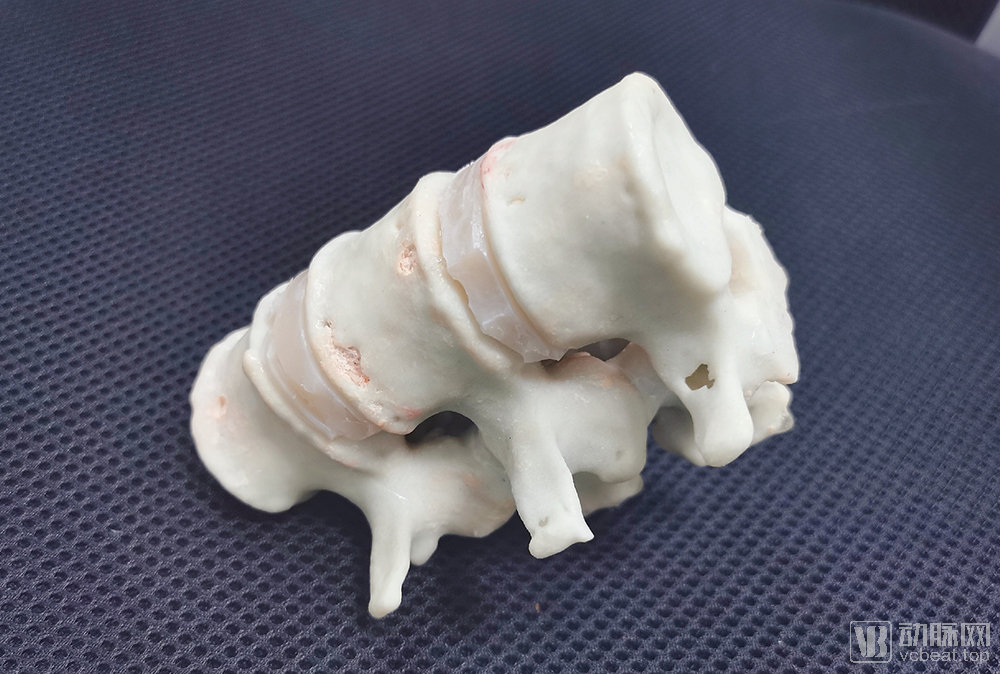
Schematic Diagram of Born Biomedical’s Synthetic Bone (Image provided by the company)
“The rate at which synthetic bone degrades in the body varies depending on the extent of bone damage and the patient’s age,” said Zhang Chi. “If a large segment of bone is extensively damaged, it may take the patient 5 to 10 years for the synthetic bone to degrade. Regardless, the synthetic bone will eventually be fully resorbed over time, leaving only the patient’s own natural bone.”
In terms of clinical trials, Born Biotech has conducted five batches of relevant in vivo studies on animals such as mice, rabbits, pigs, and dogs, with the radius—the bone with the greatest clinical demand—serving as the primary experimental site. Physicians first created 3D models of the animals’ radii, then resected the native radius and implanted 3D-printed synthetic bone grafts. The development of bone regeneration was assessed over a three-month observation period. Zhang Chi stated, “There is an ‘interface’ between the synthetic bone and the autologous bone. If this interface becomes increasingly indistinct after three months, it indicates that a ‘bridge’ has formed between the synthetic and autologous bone, signifying successful integration; otherwise, it suggests failed osseointegration. At the conclusion of the experiments, electron microscopy examination of the injured bone sites revealed the formation of well-structured trabecular and cortical bone.”
Following the completion of six batches of animal studies, Born Biotech will proceed to apply for human clinical trials and ultimately seek Class III medical device certification.
Currently, Bone Biotech operates four medical-grade 3D printing devices, capable of meeting the bone graft needs of eight patients per day. Artificial bone is not the ultimate goal for Bone Biotech. Zhang Chi told VCBeat, “The future will see humans extending their lifespans through integration with machines. Bone Biotech will start with skeletal structures and address issues such as organ deficiency through more advanced artificial means. Artificial organs are the ultimate objective of Bone Biotech, and the company has already made relevant preparations in these areas.”