

From Call Center to YiChengTong App: How Sunshine Kangzhong Became Guangzhou's First Online Medical Payment Platform Integrated with Health Insurance
“Love to tinker,” “thrive on challenges”—Fang Zhihua, founder of Sunshine Health, jokingly refers to these traits as his “flaws.” Transitioning from a real estate elite to the founder of an internet healthcare company, perhaps only the word “tinkering” adequately describes Fang Zhihua’s choice.
During his academic years, Fang Zhihua studied a range of specialized courses, including informatization and investment economics. After graduating in 1992, he entered the real estate industry, where he remained for 16 years, advancing from a sales representative to Vice Chairman and Vice President. Fang Zhihua stated, “I have spent too long in this industry, which no longer presents significant challenges for me. Real estate requires minimal operational effort, with success largely dependent on factors such as location. I am seeking an industry that places greater emphasis on operations, in order to take on new challenges.”

Fang Zhihua, Founder of Sunshine Health
Such thinking may be difficult for the average person to comprehend, yet Fang Zhihua is precisely the kind of individual who thrives on challenges. In 2008, the financial crisis prompted Fang Zhihua to leave the real estate industry in search of a sector resilient to economic cycles. Ultimately, he chose a completely unfamiliar field: healthcare. This decision was the result of careful deliberation. The healthcare industry is truly “counter-cyclical” and “operation-intensive”—it is closely tied to people, involves deep interactions, and offers abundant operational opportunities.
Although Fang Zhihua lacks an academic background in medicine, his strong interest in the field of information technology laid a solid foundation from the early stages of his studies. When deciding to launch a venture in the healthcare sector, Fang Zhihua had already determined his strategic direction: to enter the medical field through the niche segment of “healthcare IT + operations.”
At the end of 2008, Fang Zhihua conducted extensive research and began preparing to establish a new company. In January 2009, Guangdong Sunshine Health Investment Co., Ltd. (hereinafter referred to as “Sunshine Health”) was officially established.
From the Pseudo-Demand of Appointment Registration to Timely Transformation, Ultimately Achieving Full Internetization of Medical Scenarios
Upon entering the healthcare industry, Fang Zhihua’s initial assessment was that hospitals would remain the central setting for future medical care. In China, public healthcare institutions at Level II and above account for less than 5% of all medical facilities, yet they handle nearly 40% of outpatient visits, resulting in a highly unsatisfactory patient experience. Addressing this significant pain point stemming from the concentrated demand on public hospitals, Fang Zhihua sought to leverage information technology to optimize hospital workflows.
In 2009, the customer service model centered on call centers was still prevalent in the market, while mobile internet was in its infancy. Fang Zhihua enlisted a friend who had previously worked at China Unicom’s call center to launch a telephone-based appointment registration service centered on call center operations. Fang recalled, “I remember it clearly: the first hospital to partner with us was Guangzhou Women and Children’s Medical Center. They entrusted Sunshine Health with their SMS notification service for ‘parents to return to the hospital regularly for their children’s injections.’ The company got its start from there.”
This continued for another five years. By 2013, Sunshine Health had become the largest appointment registration platform in Guangzhou at that time, with its call center operating more than 70 agent seats at its peak and serving as the company’s core revenue-generating department. However, in 2014, Fang Zhihua decided to completely eliminate the call center, leaving not a single seat remaining.
This move carried high risks and directly led to a sharp decline in the company’s revenue. Fang Zhihua explained that he had already sensed the trend of the mobile internet era in 2013. In 2014, he made the tough decision to eliminate the traditional call center and fully transition to the mobile internet platform. This strategic shift faced considerable skepticism from shareholders at the time, as few had the courage to pay the price for an uncertain future.
In retrospect, this decision proved to be both timely and prudent. In 2015, Sunshine Health Investment underwent a transformation, subsequently achieving a qualitative leap by capitalizing on the government’s “Internet Plus” initiative.
Leveraging its existing hospital partnerships, Sunshine Health’s transformation challenges primarily centered on product development and the restructuring of its technical team. Fang Zhihua stated, “At that time, mobile technology talent was extremely ‘expensive,’ while the company’s revenue plummeted, which inadvertently heightened the difficulty of its transformation.” It was reported that Sunshine Health’s first angel financing round also took place during this transformation period, alleviating some of the company’s financial pressure at the time.
“From the call center to a brand-new mobile service,” Fang Zhihua added, “In my view, telephone-based appointment registration was a pseudo-demand. We were positioned opposite hospitals: users would book appointments if there were renowned specialists available, and would not if there were not. This resulted in low user stickiness, and the call center failed to truly optimize hospital workflows. This is one of the reasons behind my transition.”
Currently, the smart healthcare platform under Guangdong Sunshine Health Investment Co., Ltd. offers services across various medical scenarios, including online appointment registration, outpatient payment, report inquiries, and inpatient deposit management. This has significantly reduced patients’ time spent seeking medical care and enhanced their overall healthcare experience.
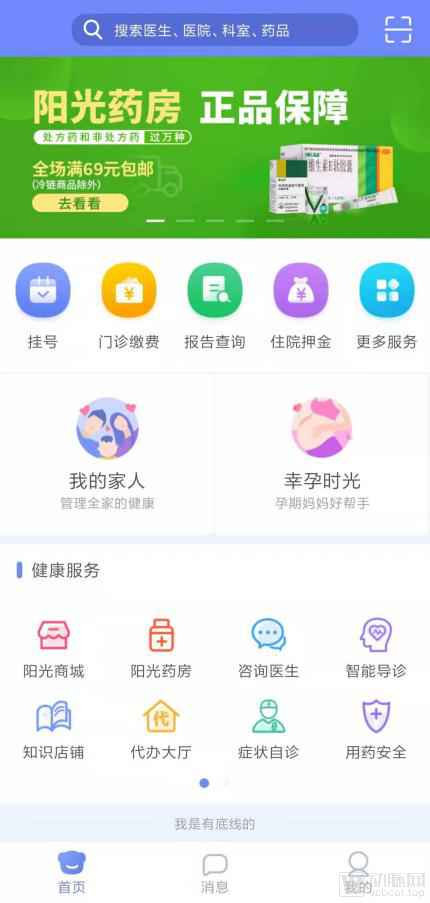
Schematic Diagram of Selected Features of the Smart Healthcare Platform (Yichengtong)
Connected to 1,800 hospitals and serving 9 million platform users, the flagship product, Yichengtong APP, supports online medical insurance payments.
“I have always believed that healthcare is a localized product,” Fang Zhihua illustrated. “Objectively speaking, residents of Chongqing do not book appointments with doctors in Guangzhou when seeking medical care. For an intelligent healthcare platform targeting users in Chongqing, its value is realized as long as it achieves sufficient coverage within the city.”
Sunshine Health’s current flagship product, the Yichengtong app, primarily serves residents in Guangzhou and surrounding areas. In 2017, in partnership with Guangdong UnionPay, it integrated medical insurance payment functions, becoming Guangzhou’s first smart healthcare app to support online medical insurance payments. Sunshine Health has collaborated with more than 30 major hospitals in Guangzhou, enabling users to perform various tasks directly through the Yichengtong app, including appointment registration, deposit payments, hospitalization procedures, and medication purchases. Currently, the Yichengtong app has amassed over 2 million users in the Guangzhou region, with more than 300,000 monthly active users and over 20,000 daily users completing appointment registrations and payments on the platform.
Sunshine Health has established a strong presence in Guangdong and is now expanding its reach across China. In 2017, at the request of the Hainan Provincial Health and Family Planning Commission to build an official smart healthcare platform, and with the support of the Hainan Provincial Government, Sunshine Health developed “Smart Hainan,” a smart healthcare platform serving the people of Hainan Province, in collaboration with more than 70 public hospitals at the secondary level or above in the region. In 2019, the company built another smart healthcare platform, “Handheld Health Ningxia,” for the Ningxia Hui Autonomous Region, the nation’s first pilot demonstration zone for “Internet + Healthcare.”
In light of characteristics such as multiple access points and diverse regional contexts, Sunshine Health (Yangguang Kangzhong) has adopted the unified “Sunshine Cloud Platform” to manage and support various smart healthcare entry points. Currently, the number of users on the Sunshine Cloud Platform has exceeded 9 million.
Notably, in 2018, Sunshine Kangzhong became a Top Partner (TP) for the core construction and operation of China UnionPay’s Smart Healthcare Platform, which has been launched within the “Smart Healthcare” section of the Cloud QuickPass app. Users of Cloud QuickPass can access the Smart Healthcare Platform through this unified entry point regardless of their location, enabling them to perform tasks such as online registration, specialist appointment scheduling, and rapid consultations. Currently, the China UnionPay Smart Healthcare Platform is connected with more than 1,800 hospitals across China, including 798 Grade A tertiary hospitals.
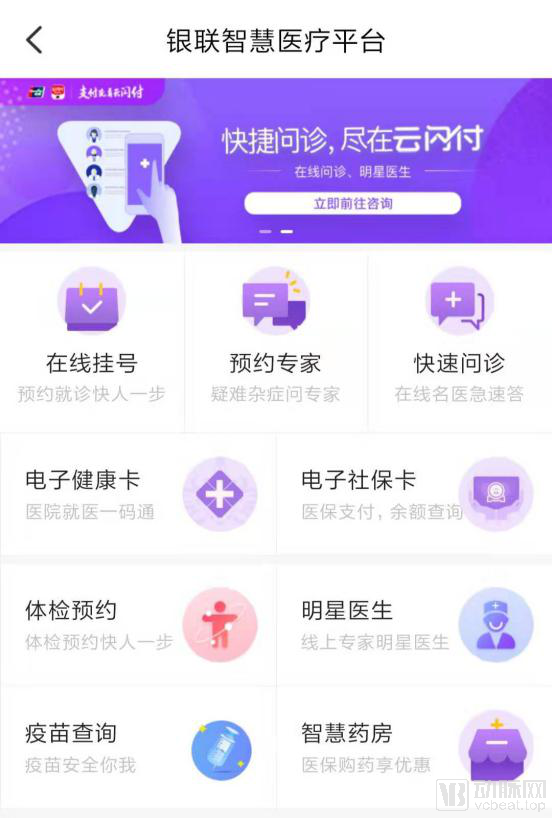
Diagram of the Cloud QuickPass Smart Healthcare Section
Regarding the future of Sunshine Health, Fang Zhihua stated, “We will firmly seize smart healthcare scenarios to drive our development and operations. Sunshine Health will continue to collaborate with hospitals and regional health commissions to help them conduct in-depth user-centric operations. Furthermore, as a technology partner (TP) for China UnionPay’s smart healthcare platform, we will work alongside China UnionPay to establish smart healthcare as a core scenario within its livelihood services sector.”
Currently, Sunshine Health has completed its Pre-A and Series A financing rounds. Against the backdrop of surging demand for smart healthcare infrastructure in China, Sunshine Health plans to launch a new round of financing to accelerate market expansion.