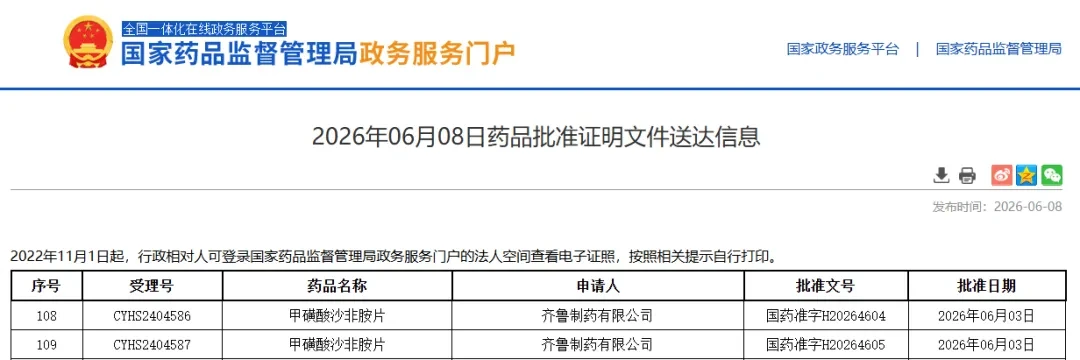
Recently, Qilu Pharmaceutical’s Safinamide Mesylate Tablets were approved for market launch by the NMPA, making it the second domestic generic manufacturer to obtain approval for this product, following Kelun Pharmaceutical.Safinamide Mesylate TabletsInitially developed through a collaboration between Italy’s Zambon and Newron PharmaceuticalsDeveloped primarily for the treatment of Parkinson’s disease, it was approved for marketing in the European Union in 2015, received approval from the U.S. FDA in 2017, and entered the Chinese market in December 2024.Since the original drug was approved in China, this product has rapidly become a hotly contested arena for generic drug manufacturers.As of now, more than 20 companies have submitted listing applications, including well-known pharmaceutical enterprises such as Kelun Pharmaceutical, Chia Tai Tianqing, Singhwa Pharmaceutical, and Shijiazhuang No.4 Pharmaceutical. Finally, on May 21, 2026, Kelun Pharmaceutical successfully secured the first generic approval.However, Kelun’s status as the first generic manufacturer lasted less than twenty days before Qilu Pharmaceutical successfully followed suit.Why Is There a Rush to Genericize This Anti-Parkinson’s Drug? Multiple Perspectives Can Be Considered.
First,Safinamide Mesylate Tablets exhibit the typical characteristics of a “high-quality generic drug.” As the only new molecular entity for anti-Parkinson’s disease marketed in China in recent years, with the originator product already available in the Chinese market, generic development requires only the completion of bioequivalence (BE) studies, and there are no patent restrictions.
This is evident from the rapidly assembled army of generic drugs.The originator drug, Zambon, was approved on December 1, 2024. Twenty days later, the marketing applications for the generics from Kelun and Shijiazhuang Pharmaceutical Group were simultaneously accepted by the CDE; prior to the originator's market launch, a previous Class 3 manufacturing application had failed to gain approval.Nanjing Chia Tai Tianqing, after the launch of the original research drugalso rapidly adjusted its strategy, andDecember 21Resubmitted for marketing approval as a Class 4 drug; on December 27, Qilu Pharmaceutical’s marketing application was also accepted.
In other words, these companies have long completed their bioequivalence (BE) studies and are simply awaiting the market launch of the originator product.
On the other hand, the MAO-B inhibitor segment, to which safinamide belongs, is itself a core component of the Parkinson’s disease treatment landscape. For companies seeking to build a portfolio of neurological products, such agents are virtually indispensable strategic assets.Current Pharmacological Treatment of Parkinson's DiseaseIt should consist of three major categories: levodopa combination preparations, MAO-B inhibitors, and dopamine receptor agonists.Levodopa is the “gold standard” for the treatment of Parkinson’s disease, but when used aloneLevodopa is rapidly metabolized peripherally; therefore, combination formulations are almost exclusively used in clinical practice, including levodopa + benserazide (levodopa/benserazide);. Levodopa + Carbidopa (Carbidopa-Levodopa); Levodopa + Carbidopa+ Entacapone (Entacapone/Levodopa/Carbidopa), etc. In this field, both Qilu Pharmaceutical and Kelun Pharmaceutical have launched Entacapone/Levodopa/Carbidopa tablets.
In the field of MAO-B inhibitors, rasagiline mesylate tablets and safinamide mesylate tablets represent second-generation and third-generation products, respectively. Qilu Pharmaceutical currently holds both rasagiline and safinamide in its portfolio, while Kelun Pharmaceutical has completed its safinamide layout.
In the field of dopamine receptor agonists, Qilu Pharmaceutical possesses pramipexole hydrochloride tablets and extended-release tablets; Kelun has deployed rotigotine transdermal patches. Notably, rotigotineThe patch remains the only transdermal delivery system approved globally for the treatment of Parkinson’s disease.
Finally, from the perspective of market potential, it is not difficult to understand why companies are flocking to enter this space. Parkinson’s disease is the second most common neurodegenerative disorder after Alzheimer’s disease. With the accelerating aging of the population, the patient population continues to grow.Relevant studies project that the global number of Parkinson’s disease patients will increase from approximately 7 million in 2015 to 13 million by 2040, with China accounting for nearly half of the global total. Data shows that in 2024, the number of Parkinson’s disease patients in ChinaThe drug market size has reached RMB 40 billion, with a year-on-year growth of 14%, and is still in a phase of continuous expansion.However, a large market size does not necessarily guarantee that companies will be profitable.The most significant reality in the current landscape of Parkinson’s disease treatment is that the vast majority of medications remain confined to symptomatic control, with truly disease-modifying therapies capable of slowing progression being extremely scarce. Meanwhile, most core drugs were launched many years ago and have expired patents, leading the market to gradually enter a phase of generic competition.
The levodopa segment, characterized by the most intense competition, serves as a typical case in point. Levodopa and Benserazide Tablets, which hold the largest market size, have been included in the 11th National Centralized Drug Procurement program, leading to a restructuring of the pricing system. Five manufacturers have already obtained approval for Pramipexole Hydrochloride Tablets. Meanwhile, Safinamide Mesylate Tablets, where competition has just begun, are likely to see a rapid increase in the number of approved manufacturers in the future, given the current pace of regulatory submissions.
For generic drug manufacturers, this means that even with steady growth in market demand, it is difficult to escape the competitive logic of “trading price for volume.”
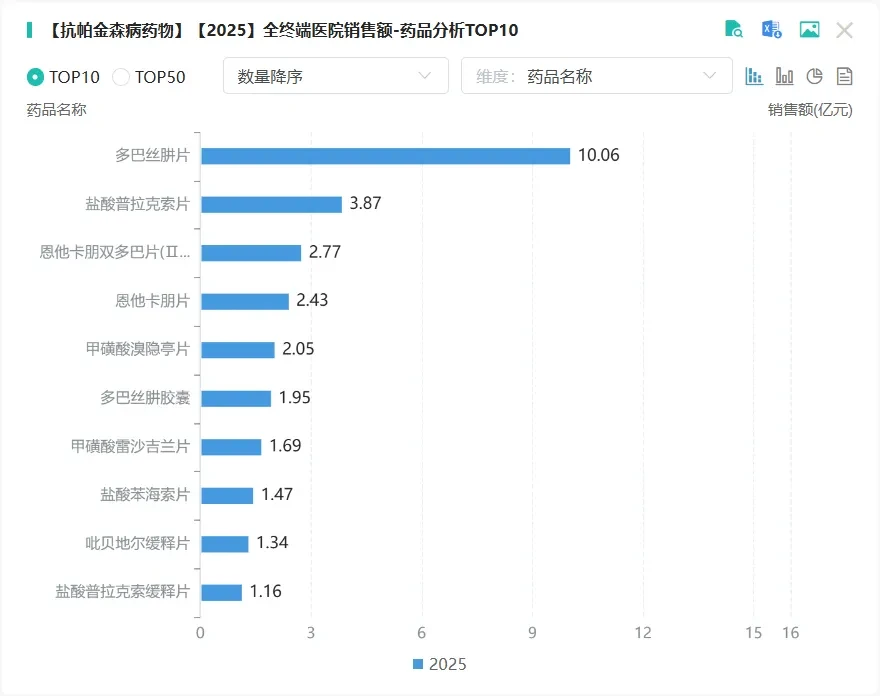
Image source: Moshang Pharmaceutical
In fact, what truly plagues the entire industry is not competition from generics, but the long-term absence of innovative breakthroughs.Over the past decade, the development of novel mechanisms for Parkinson’s disease has been one of the most formidable challenges in the field of innovative drug discovery. Due to the complex pathogenesis of the disease and the prolonged timelines required for clinical endpoint validation, a significant number of programs have failed during clinical development. Multinational pharmaceutical companies such as Sanofi and Roche previously invested in related projects, but ultimately terminated their research efforts after clinical data failed to meet expectations.A review of new products approved in China in recent years shows that, aside from safinamide mesylate tablets, the only other representative innovative product is the rotigotine microspheres from Shandong Luye Pharmaceutical.This product utilizes long-acting sustained-release technology, enabling once-weekly intramuscular injection, which offers significant adherence advantages over daily dosing. However, as it has not yet been included in the National Reimbursement Drug List, its market volume remains relatively limited.Compared to traditional small-molecule drugs, the industry is placing greater hope on novel therapeutic approaches such as disease-modifying therapies (DMTs) and cell therapy.For example, prasinezumab, developed by Roche, is a humanized monoclonal antibody targeting α-synuclein, aiming to slow neurodegenerative progression at the level of disease pathogenesis. Its positioning is analogous to that of Aβ monoclonal antibodies in the field of Alzheimer’s disease. This product is currently undergoing Phase III clinical trials in China.Meanwhile, domestic companies have also begun to explore the field of cell therapy. A typical representative is NouvNeu001 injection, independently developed by Ruijian Yilian Pharmaceutical. This product is based on iPSC-derived dopaminergic neural precursor cell technology, aiming to fundamentally intervene in the core pathological mechanisms of Parkinson’s disease by replenishing missing dopaminergic neurons.In August 2023, NouvNeu001 received NMPA clinicalapproval for clinical trials, becoming the first chemically induced iPSC-derived therapeutic product in China to enter the clinical stage; in June 2024, it also received FDA clinical trial approval, achieving dual IND approvals in both China and the United States.From the perspective of industry development, the wave of generic drug development triggered by safinamide mesylate tablets essentially reflects the contradiction between insufficient innovative supply and continuously growing market demand in the field of Parkinson’s disease.
In the short term, market competition will continue to center on existing products such as levodopa, MAO-B inhibitors, and dopamine receptor agonists; however, in the long run, it may not be another generic drug that truly reshapes the industry landscape, but rather disease-modifying therapies capable of slowing or even reversing disease progression.
And such products may not be as far from the market as imagined.
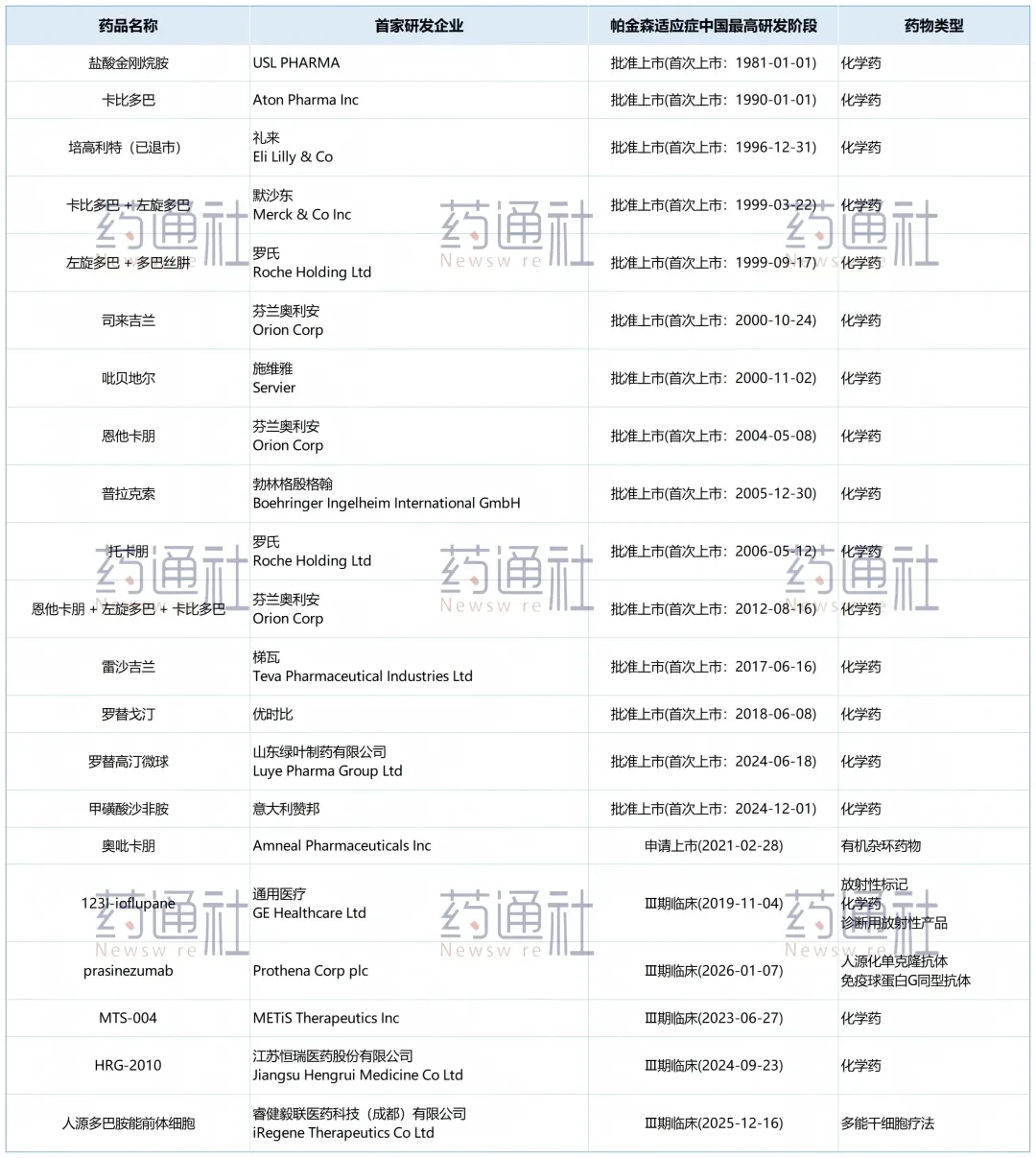
Figure: List of Anti-Parkinson’s Drugs in China, for Reference Only
↓⭐Follow YaoTongShe to Gain Insights into Industry Trends↓