

Nine Innovative Medical Projects Showcase at Chongqing Roadshow, Bridging the Gap from Lab to Market
The rising tide of import substitution in recent years has propelled the research, development, and manufacturing of domestic medical devices into a blue-ocean market. Innovative technological achievements, once shelved in patent repositories, are now reaching the market in diverse product forms with the support of commercialization platforms, becoming an increasingly mainstream trend.
On the afternoon of August 22, 2019, the promotional roadshow for the Western Regional Chongqing Division of the First Bairuike Guojian Cup “Direct to Cleveland” International Medical Innovation and Entrepreneurship Competition was held at Huayi Building in Yuzhong District. The event featured presentations by contestants who had advanced to the next round, showcasing nine projects. The panel of judges included Li Jian’an, International Fellow of the American Academy of Medicine; Chen Li, Chief Medical Officer of Guojian Medical Technology Co., Ltd.; Liu Hui, Deputy Director of the Sinopharm Medical Device Research Institute; Qiao Wei, Director of the Chongqing Huayi Big Health Industry Scientific and Technological Achievement Transformation Center; Xu Hui, Chairman of Chongqing Science and Technology Venture Capital Co., Ltd.; and Meng Wei, Managing Director of Healthcare Investments at Guojian Capital. The judges posed questions regarding the projects’ technical pathways, patent applications, clinical data accumulation, and application prospects.
As a key component of the competition’s supporting activities, the project roadshow aims to provide an effective platform for collaboration and exchange among enterprises, investment institutions, and local governments, enabling participating companies or projects to secure funding, resources, and technical support, thereby facilitating their rapid implementation.
VCBeat followed the entire project route and brings readers first-hand reporting.
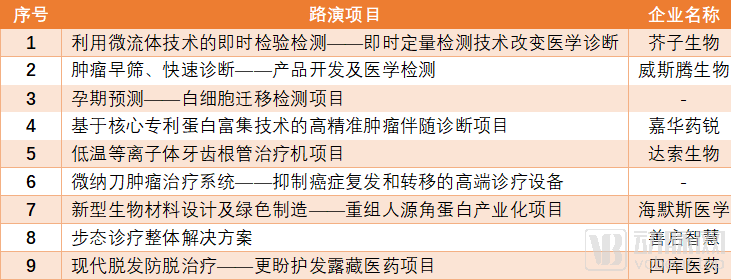
List of Roadshow Projects
Nine roadshow projects, sourced from both enterprises and universities, were presented in full, including those from the technology transfer platforms of Chongqing University and Chongqing Medical University. The applications span various specialized fields such as medical diagnostics, early cancer screening, companion diagnostics, cancer therapy, maternal and child healthcare, health management, novel drug development, and dental treatment. These projects innovatively apply cutting-edge technologies—including microfluidics, fluorescence in situ hybridization (FISH), leukocyte migration assays, protein enrichment, nanoknives, and keratin-based solutions—to clinical diagnosis and treatment as well as daily healthcare.
Following the roadshow, VCBeat conducted an exclusive interview with Mr. Meng Wei, one of the judges, who described the day’s projects as “unexpected.” He noted, “The quality of the projects was consistently high. Each team approached the challenge from a different angle, seeking breakthroughs in bridging the gap between R&D and the market.” Mr. Meng pointed out that there has long been a disconnect in China’s innovative medical device market: R&D teams have tended to focus on technical feasibility when designing and innovating products, often overlooking genuine market needs. Encouragingly, all nine projects showcased during the event made varying degrees of productization efforts aligned with market demands.
All nine roadshow projects adopted a product development pathway that integrates local medical resources to jointly conduct clinical research. Collaborating institutions include renowned domestic medical organizations such as Peking Union Medical College Hospital, the First Affiliated Hospital of Chongqing Medical University, and Chongqing University Cancer Hospital. Among them, the project presentations by Mustard Seed Bio, Shanqi Intelligence, and Westen Bio left a deep impression on reporters.
Mustard Bio’s microfluidic point-of-care testing project enables quantitative detection for medical diagnosis. Microfluidics refers to the technology for controlling, manipulating, and detecting complex fluids at the microscale. Due to high costs and challenges in industrialization, it was initially applied in the fields of microelectronics and micromechanics. In recent years, with advancements in bioengineering and nanotechnology, microfluidic technology has begun to be adopted in the biological and medical fields.
Jiezi Biotechnology, established in March 2017 and headquartered in the High-Tech Industrial Development Zone of Yantai City, specializes in the development and application of point-of-care testing (POCT) products within the field of in vitro diagnostics based on microfluidics technology. As a national-level small and medium-sized scientific and technological enterprise led by microfluidics experts, its product pipeline under development includes POCT biochemical and immunological assays. Notably, its metabolomics platform holds one invention patent, while its immunology platform holds one invention patent and one utility model patent.
Mustard Bio’s biochemical testing products feature China’s first patented invention for solid-phase reagents, breaking through traditional lyophilization processes and reducing production costs through assembly-line manufacturing. Furthermore, these products enable ambient-temperature transportation—a capability currently unattainable by competing products on the market—allowing distribution to primary healthcare institutions and export to other countries without cold-chain logistics. This approach reduces transportation costs while ensuring product quality. According to reports, the first phase of products was scheduled for production in late 2020, with initial test panels covering renal function, blood glucose, blood lipids, and liver function.
Shanqi Zhihui was founded by a core team with backgrounds in orthopedics and academia. Its comprehensive gait diagnosis and treatment solution system includes a rich array of product modules, such as portable pressure gait sensors, 3D intelligent diagnostic devices, China’s first large-scale database for pediatric gait analysis, single-nozzle dual-extrusion FDM 3D printers, and an intelligent algorithm-driven 3D modeling product library. These capabilities enable the customization of solutions tailored to users’ health management needs.
According to the introduction, musculoskeletal or neurological issues are reflected in gait parameters, such as the bilateral gait cycle, three-plane symmetry, center of pressure (COP) trajectory, bilateral plantar pressure distribution, and foot progression angle. Shanqi Zhihui can detect over 300 gait-related feature data points with a high accuracy exceeding 99% within 1–2 minutes.
Currently, the company’s gait analysis and assessment services have been included in the national fee-charging medical service items. Its functional children's shoes and insoles, as well as 3D custom foot orthoses, have obtained Class I medical device certification from the National Medical Products Administration (NMPA). The company is currently applying for Class II medical device certification for its 3D intelligent diagnostic instrument and portable pressure gait sensor.
Westen Biotechnology applies its exclusive ultra-micro ctDNA extraction technology to early tumor diagnosis, achieving a sensitivity 100 times higher than that of similar products on the market.
As one of the four major molecular diagnostic technologies, FISH is widely recognized as the gold standard for tumor diagnosis. Constrained by their inability to effectively capture trace amounts of circulating tumor DNA (ctDNA) in the early stages of tumorigenesis, existing molecular diagnostic techniques—such as NGS, PCR, and gene chips—have not played a significant role in early cancer screening. In contrast, FISH technology can capture ultra-trace levels of ctDNA at six times the efficiency of comparable products, enabling rapid and precise early cancer screening.
According to reports, Westen Biotechnology has successfully developed a FISH-based rapid diagnostic kit for lung cancer and completed preclinical trials. The company is currently laying out early screening products for colorectal cancer, gastric cancer, breast cancer, leukemia, and other diseases. In addition, the company’s ctDNA R&D projects include extraction technologies such as ctDNA-PCR, ctDNA-NGS, ctDNA exosomes, and ctDNA methylation. Concurrently, it is conducting research on novel diagnostic gene chips, including visual chips, rectal cancer methylation chips, and SNP risk assessment chips.
Mr. Meng Wei told VCBeat that tech entrepreneurship is a long-chain process extending from the laboratory to commercial products. Once a startup team has completed basic project validation, it often requires capital infusion to strengthen subsequent links in the chain, such as corporate management, equity structure design, and market entry. “Many entrepreneurs have not experienced the full lifecycle of a startup. Post-investment services provided by investors can help founders avoid failures caused by factors beyond the product and technology itself,” Mr. Meng pointed out. As an investor with strong post-investment support capabilities, Guojian Capital has always adhered to the service principle of providing assistance without causing disruption.
According to Mr. Meng Wei, he has engaged in extensive communications with several project teams participating in the roadshow, aiming to empower these startups with his entrepreneurial and investment expertise. Building a bridge between entrepreneurs and capital was the original intent behind hosting this roadshow event and represents the practical significance of this competition.
Currently, the inaugural Bairuike Guojian Cup “Direct to Cleveland” International Medical Innovation and Entrepreneurship Competition is in full swing. The advancement rounds for the eight regional divisions—Shanghai, Hangzhou, Wuhan, Chongqing, Changsha, Fuzhou, and Guangzhou—are being held sequentially. VCBeat will continue to monitor the event closely.