

From Wild Growth to Strategic Maturity: The New Battle Between Tech Giants and Native Players in Online Mutual Aid Platforms

IDG Capital
Venture Capital Institution
On August 9, 2019, Ant Financial held a press conference in Beijing, announcing that the number of Xianghubao users had surpassed 80 million, making it the largest mutual aid platform globally. The party most significantly impacted by this news was undoubtedly Shuidi Mutual Aid, which had long been the leader in the online mutual aid industry but was now overtaken.
One is an intruder whose product has been on the market for only 10 months; the other is a native player that has cultivated deep industry roots and gradually built a competitive moat. The rivalry between Xianghubao and Shuidi Huzhu is, in essence, a contest between two major camps. On one side are internet giants newly entering the fray, such as Ant Financial, Meituan, and Didi Chuxing; on the other are native players like Shuidi Huzhu, Qingsong Huzhu, and Zhongtuobang, which have helped mature and sustain the industry’s development. Each party arrives with its own strategic agenda, confronting rivals on the battlefield of online mutual aid.
As of 9:00 a.m. on August 15, the top three players in the industry and their respective user figures were: Xianghubao with 82.11 million, Shuidi Huzhu with 80.42 million, and Qingsong Huzhu with 60 million. According to statistics from VCBeat, the online mutual aid market once featured over one hundred enterprises, with nearly 30 having secured financing. However, as of now, only about 14 online mutual aid platforms remain in active operation.
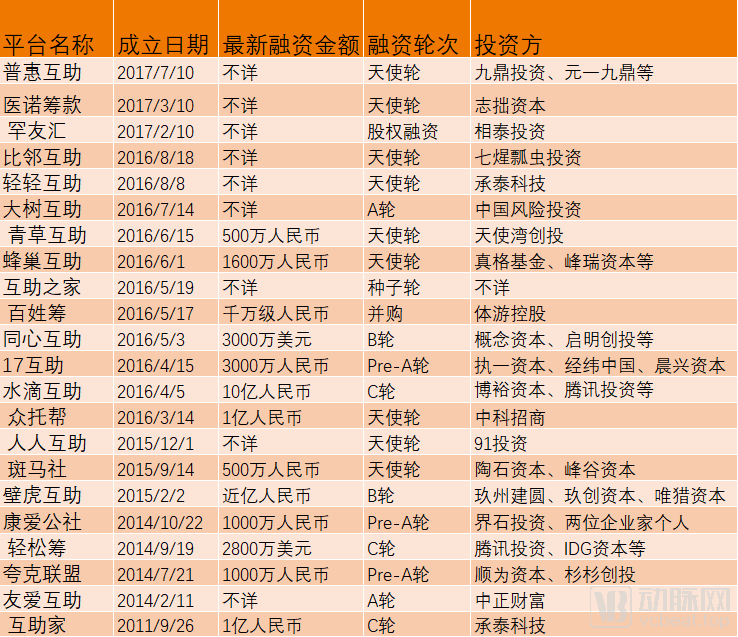
Overview of Online Mutual Aid Platforms That Have Secured Financing (Data Source: Tianyancha)
Recently, the State Council issued a document containing provisions that encourage well-established internet platforms to apply for qualifications as concurrent insurance agents. Meanwhile, Shuidi Inc. secured RMB 1 billion in Series C financing, and Xianghubao’s user base surpassed that of Shuidi. These developments signal that the landscape of online mutual aid is poised for significant transformation.
The Battle of Online Mutual Aid: On the surface, it appears to be a contest among companies over fundraising amounts, fluctuations in mutual aid user data, and exploration of business models. In essence, however, it represents the innovation and disruption brought by the internet to the healthcare payment system. The true battlefield lies beyond online mutual aid.
"Dear compassionate individuals:"
Hello!
"My name is XXX, and I live in XXXX. My mother suffered another relapse of her illness back in our hometown after 6 p.m. on July 28... I sincerely hope that kind-hearted people can help me and my mother."
This is the information displayed after clicking a WeChat Moments link. For most of us, our first exposure to online mutual aid likely began with such crowdfunding campaigns for critical illnesses that appear on social media platforms. In recent years, such posts have become increasingly common. If users click through, they will also see content promoting online mutual aid plans on their mobile screens, such as the slogan from one online mutual aid platform: “Enjoy coverage of up to RMB 300,000 for just RMB 1.”
For most people with modest incomes but a strong sense of security, this is akin to stumbling upon a store transfer sale with massive discounts, prompting a rush of shoppers. In contrast, purchasing critical illness insurance from traditional insurers costs each individual approximately RMB 3,000 per year.
Driven by fundraising campaigns for critical illnesses, many people have joined online mutual aid plans. This has become the primary form through which online mutual aid has gained widespread social adoption. By pooling contributions from participants to create a risk-sharing pool, these plans provide coverage on a cost-sharing basis for individuals facing medical expenses due to illness, accidents, or other hardships. Online mutual aid is highly similar to insurance and represents an innovative business model that emerged in the mobile internet era.
In China, the difficulties and high costs associated with accessing medical care have long been an unavoidable social issue. Although basic medical insurance covers more than 95% of the population, reimbursement limits are restricted, and the penetration rate of commercial health insurance remains below 10%. Consequently, out-of-pocket payment continues to be a significant method of covering healthcare expenses. For an average household, if a family member is unfortunately diagnosed with a serious illness without having purchased health insurance, bearing the substantial medical costs—often ranging from tens of thousands to hundreds of thousands of yuan—becomes exceedingly difficult.
The emergence of online mutual aid has, to some extent, met this demand. Guo Jinlong, Director of the Insurance and Economic Development Research Center at the Chinese Academy of Social Sciences, stated: “Online mutual aid is essentially the most primitive form of protection. Today, internet-based mutual aid represents an emerging model of mutual assistance. After several years of rapid development, it has become a third form of security alongside the basic medical security system and the commercial insurance system, providing substantial protection for many residents and the general public.”
How Did Online Mutual Aid Emerge in China?
For most people, the lasting impression of 2008 is the successful hosting of the Beijing Olympic Games, where China topped the medal table. But for an ordinary young man named Zhang Martin, the most profound memory of that year is his mother’s death from cancer.
“At that time, while caring for my mother during her hospitalization at the Shanghai Cancer Center, my biggest worry every day was that we simply didn’t have enough money. ‘One day in the hospital, I saw a patient approach a doctor and ask for help issuing a certification document. When the doctor asked why, the patient explained that he was a member of a Christian church, and his fellow congregants could help organize fundraising efforts. At the time, my credit cards were heavily overdrawn, and I was deeply troubled by financial pressures, so I envied him for having an organization to rely on. But I was not a believer, so it was impossible for me to seek such assistance,’ ” Zhang Martin recalled in a later interview with the media.
Such experiences prompted Zhang Martin to establish the Anti-Cancer Commune (later renamed Kangai Commune) in 2011. In its early stages, the organization operated initiatives such as QQ and WeChat support groups for patients. By 2014, Kangai Commune had incorporated as a company, marking the transition of its online mutual-aid projects into actual operational phase.
Also in 2014, Yu Liang, a journalist working for an IT media outlet, inspired by the wave of “mass innovation and entrepreneurship,” detected business opportunities in the hottest trend at the time—“crowdfunding.” He started the venture Qingsongchou (Easy Fundraising) with five technicians in a hutong house near the northeast second ring road in Beijing. “I rented a dormitory for the technical team right across from our office. We almost always got off work at 3 a.m. and never left the hutong, hoping to launch the Qingsongchou product as soon as possible,” Yu recalled in a media interview.
The critical illness fundraising feature, which was launched subsequently, represented the early model of Qingsongchou, while its online mutual aid plan was not introduced until 2016.
In the early days of the internet, companies typically operated at a loss, prioritizing metrics such as traffic volume and Gross Merchandise Value (GMV). Even though there was potential to “pluck feathers from a passing goose”—that is, to extract profits from growing cash flows and user traffic—they deliberately let the “geese pass in silence.” This was evident when bike-sharing became a hot investment trend; the most frequent advice OFO’s investors gave to its twenty-something founder, Dai Wei, was: “Just focus on reaching the top spot. You must become number one.”
In December 2014, Qingsongchou secured millions of dollars in investment from IDG Capital and Daosheng Investment.
The most critical aspect of providing protection is claim fulfillment; that is, members receive compensation when a low-probability risk materializes. For the online mutual aid industry and its operating platforms, the key lies in whether the claim fulfillment process can deliver high-quality, efficient service that makes it easier and more convenient for users to receive compensation.
In the early days of Qingsongchou, the rapid surge in traffic placed immense pressure on its operations. Yu Liang recalled the situation at that time: “The system suddenly collapsed under a massive influx of access requests, leading users to believe we had absconded with their money. Meanwhile, as users were frequently unable to get through by phone, Qingsongchou’s customer service hotline was even flagged as a scam number. At that time, our only option was to remain online around the clock, continually appeasing users in QQ and WeChat groups and assuring them that we had not run away.”
At the end of 2014, e-Huzhu, a project incubated by employees within the state-owned enterprise Fanhua Group, was launched.
In early 2015, the China Insurance Regulatory Commission (CIRC) promulgated the Interim Measures for the Supervision of Mutual Insurance Organizations, aiming to expand social insurance coverage across China and diversify the organizational forms within the domestic insurance market. Online mutual aid is a model closely akin to mutual insurance. Driven by policy guidance, alongside the proliferation of social media tools and the maturation of digital technologies such as third-party payment systems, various online mutual aid platforms emerged in rapid succession. Notable platforms established that year included Banma She, Bihu Huzhu, and Renren Huzhu.
Amidst the market’s fervor, the resignation of Yin Ming, an executive at traditional insurance giant China Life, to join Ant Financial seems hardly worth mentioning—much like in 1587, A Year of No Significance: “The realm was at peace, and there were no major events to recount throughout the year.”
In 2016, the online mutual aid market entered a period of explosive growth. Capital flooded in collectively, making it the second hottest trend in the internet sector after live streaming. It was regarded as the “final standard track for competition” in the internet health space, with many companies securing financing ranging from millions to tens of millions of yuan. “At its peak, there were nearly 200 platforms. Some were named after animals, others after plants; the number of online mutual aid platforms was countless,” recalled Long Ge, co-founder of Zhongtuobang, in an interview with VCBeat.
It was also in this year that Shen Peng, who had risen from an intern to a mid-to-senior-level executive and achieved success in Meituan’s internal entrepreneurship initiatives, had already established a solid material foundation in Beijing. As Meituan’s 10th employee who had started his entrepreneurial journey during his sophomore year of college and later joined Wang Xing’s team, Shen chose to follow his heart this year, making the decision to resign from Meituan-Dianping and found Shuidi Inc.
“Founding Waterdrop was more about following my heart to do what I truly love, and calmly working with my co-founders to create the social value we aspire to achieve,” Shen Peng shared at an awards ceremony this year.
Yet at the time, few could have anticipated that this company, named after natural scenery, would ascend to the top position in the industry within less than three years.
"Peak prosperity inevitably leads to decline is the iron law of the market."
Amid the boom in the online mutual aid market, widespread irregularities have also emerged. In a bid to attract a large number of members, many players have crossed regulatory red lines. Some platforms have improperly used insurance terminology, comparing and linking mutual aid plans with insurance products, thereby blurring the distinction between insurance products and mutual aid plans. Others have engaged in false advertising under the guise of “insurance innovation” or “Internet Plus Insurance,” claiming that their mutual aid plans and fund management are subject to government oversight. More egregiously, some have collected insurance premiums under the name of mutual aid plans and illegally established capital pools.
Regulators Have Stepped In.
At the end of 2016, the China Insurance Regulatory Commission (CIRC) issued the "Notice on Launching a Special Campaign to Rectify the Illegal Engagement in Insurance Business in the Form of Online Mutual Aid Plans." The notice categorized online mutual aid platforms into three types: Type I institutions were permitted to continue their exploratory efforts, while Type II and Type III institutions were placed on a negative list and subjected to regulatory interviews, mandatory rectification, and enforced exit.
“When the tide recedes, you find out who’s been swimming naked.” Amid stringent regulatory scrutiny, exhausted financing capital, unclear strategic direction, unproven business models, and intense competition among peers, fewer than 10 online mutual-aid platforms remained by 2017.
At this point, the online mutual aid market was in complete disarray.
The few remaining platforms, such as Shuidi Mutual Aid, Qingsong Mutual Aid, and Zhongtuobang, promptly implemented the required measures. In accordance with the regulatory rectification requirements and the China Insurance Regulatory Commission’s directive to “clarify the nature of the platform,” each company prominently declared on the homepage of its official website and WeChat public account that “mutual aid plans are not insurance” and that “joining a mutual aid plan constitutes a unilateral donation or contribution, with no expectation of guaranteed risk coverage.”

Risk Warnings on the Homepages of Three Online Mutual Aid Platforms (Source: As of each company’s official website)
Beyond the mandatory requirements, companies are also diligently pressing forward, refining their products and perfecting their business models. Qingsongchou, which remained a front-runner during this phase, launched Qingsong Mutual Aid in April 2016. The platform collects service fees from the mutual aid plan’s fund pool to subsidize costs.
In late 2016, Qingsongchou also obtained an insurance brokerage license and subsequently launched Qingsong e-Bao, ultimately developing a three-tier funnel model comprising Qingsongchou, Qingsong Mutual Aid, and Qingsong e-Bao.
"Crowdfunding for critical illnesses drives user acquisition, online mutual aid educates users on insurance scenarios, and the insurance marketplace monetizes the traffic. This model is akin to the Eiffel Tower—a truly brilliant design."
In that year, Qingsongchou secured two rounds of financing, totaling $35 million.
However, before such monetization models were established, critical illness fundraising and online mutual aid services were actually unprofitable. Critical illness fundraising charged zero service fees, while the platform still had to bear costs associated with platform operations, document verification, and other expenses. For online mutual aid services, although platforms collected service fees ranging from 6% to 10%, this segment was also operating at a loss for the platforms at that time, given that the base of mutual aid members was not as large as it is today.
According to Long Ge, co-founder of Zhongtuobang, in an interview with VCBeat, once a member initiates a mutual aid application, the market cost for the platform to commission a third-party company to investigate and verify the claim is approximately RMB 3,000 per case.
At the time, a well-known online mutual aid platform called “17 Hu Zhu” secured RMB 30 million in Pre-A series financing. It later ceased operations due to severe losses and an inability to identify a viable monetization model.
Waterdrop was relatively fortunate, having identified a business model similar to that of Qingsongchou. At the one-year anniversary media briefing in 2017, Shen Peng proudly announced publicly that Waterdrop had also obtained an insurance brokerage license.
"In China, you cannot drive without a license. This is even more true for doing business."
Licenses mean money—lots and lots of it—for Shuidi and Qingsongchou.
In 2018, China’s health insurance sector generated premium income of RMB 544.813 billion, a year-on-year increase of 24.12%. Analysts predict that the health insurance market will reach the trillion-yuan mark within three years. In such a large-scale health insurance market, companies like Shuidi and Qingsongchou could easily earn multiple “small goals” (a colloquial reference to RMB 100 million each) by operating solely as insurance brokers.
In the aftermath, companies have accelerated their fundraising efforts.
In July 2017, Qingsongchou secured $28 million in its Series C funding round; the following month, Shuidi obtained RMB 160 million in its Series A funding round.
"True recluses hide in plain sight within the bustling city." In the arena of online mutual aid, Tencent, as an internet giant, has kept a low profile behind the scenes, assuming the role of an investor.
As for another giant, Ant Financial, its moves in this sector nearly escaped market notice.
“1587, A Year of No Significance” states that some events, though seemingly trivial on the surface, are in essence the crux of major incidents that occurred previously and the catalysts for future upheavals.
Within the Alibaba ecosystem, an employee mutual aid program called the “Dandelion Plan” has long been in place. Employees contribute a small monthly fee of several dozen yuan, and if an employee or their family member unfortunately falls ill, they can receive financial assistance from the pooled fund.
Inspired by the “Dandelion Initiative,” Yin Ming led his team to begin preparations for the “1314” project in late 2016, which later became the prototype of Xianghubao. Initially targeting cancer insurance for individuals born in the 1980s and 1990s, the project featured simple rules and low entry barriers, aligning with Ant Financial’s product philosophy. Moreover, Ant Financial had entered the insurance sector as early as 2013, co-founding ZhongAn Insurance alongside several other companies; ZhongAn has since gained considerable prominence in the insurance industry.
However, what Yin Ming did not expect was that at the project launch briefing in early 2017, “1314” was rejected by Jing Xiandong, Chairman and CEO of Ant Financial.
Jing Xiandong had his considerations. At that time, Alipay’s Insurance Business Group had no prior experience in health insurance, facing challenges such as insufficient claims handling expertise, inadequate traffic capacity, and immature AI technology. Consequently, Yin Ming had to lead his team to forge a new path by learning health insurance operational best practices from insurance companies.
The online mutual aid market in 2018 remained largely uneventful for most of the year, with no significant developments to report.
In April, rumors spread rapidly as multiple media outlets reported that “Shuidichou and Qingsongchou were set to merge,” with some even disclosing details that “the equity ratio between the two companies would be approximately 2:1 following the merger.”
Subsequently, Shen Peng, founder of Shuidichou, responded on his WeChat Moments: “There is no need for a merger; the significance of merging is limited. Shuidi Huzhu currently handles three times the daily order volume of Qingsong Huzhu, while Shuidichou’s daily order volume accounts for 55% of the combined total of the two fundraising platforms, and this leading advantage continues to widen. In terms of team values, the two teams may not be compatible…”
Qingsongchou subsequently issued a response, citing several figures similar to those provided by Shen Peng: “Qingsongchou has absolutely no intention of merging with Shuidichou. As the leader in the health protection market, Qingsongchou holds over 50% market share, firmly ranking first in the industry. Its total fundraising volume is ten times that of its closest competitor. Qingsong Huzhu has accumulated more than 35 million members over two years of operation, with a growth rate three times that of the second-place player. Its insurance business is four times the size of its competitors’…”
"Looking back, it was a farce."
Nevertheless, behind the farce, it has sparked exclamations: Shuidi, established just two years ago, is closing in on the industry leader—or has it already become number one?
As Meituan’s 10th employee, Shen Peng once served as the national business head of Meituan Waimai (Meituan Food Delivery), leading a ground-promotion team of 6,000 people. He survived the “Thousand Groupons War” and emerged as an industry dominant player. At the time of his departure, Meituan had already merged with Dianping, forming the entity known as New Meituan-Dianping.
Capital Favors Shen Peng. Waterdrop secured nearly RMB 50 million in investment within just two months of its founding, with investors including Meituan Dianping and Tencent.
It was not until October that there were any significant developments to report in this market.
On October 17, Ant Financial jointly launched Xianghubao (later renamed Xianghubbao) with Xinmei Life Insurance. At the press conference, Yin Ming, then Vice President of Ant Financial, stepped into the spotlight, stating that his sole aspiration was to ensure every family has warm and reliable protection.
Recently, in response to an interview with VCBeat, Ant Financial explained the original intention behind launching Xianghubao: “We developed Xianghubao with a public-welfare mindset and technological means. We hope to use Xianghubao to enhance coverage for the general public, while commercial and technological approaches can help ensure its operation is more open, transparent, healthy, and sustainable.”
On the third day after the launch of Xianghubao, its user base surpassed 3.3 million; by the ninth day, it exceeded 10 million. In November of the same year, JD.com launched JD Mutual Insurance (which was taken offline by regulators after just one day); in December, Didi Chuxing introduced Didi Mutual Aid.
At this point, industry giants entered the market one after another.
Innovative business models, high growth, low customer acquisition costs, vast untapped markets, and substantial capital support make online mutual aid appear to be an ideal business. Moreover, the massive traffic—often reaching millions or even tens of millions of users—generated by online mutual aid platforms has also attracted the attention of tech giants that built their empires on traffic.
In 2019, Meituan, 360, and Suning also rushed to launch their own online mutual aid platforms.
In China's healthcare payment system, the traditional payers are basic medical insurance, out-of-pocket payments, and commercial health insurance.
However, as the pressure on medical insurance expenditures continues to mount, cost containment in medical insurance has remained a key focus of the government’s healthcare reforms in recent years.
According to the “2018 China Commercial Health Insurance Development Index Report” released by the Insurance Association of China, most respondents indicated that they primarily rely on basic medical insurance and out-of-pocket funds to cover household expenses for major illnesses. The report also noted that the coverage rate of commercial health insurance in China is less than 10%.
The trillion-yuan health insurance market behind online mutual aid may well be the “vast frontier” these companies are aiming for. According to VCBeat, apart from 360, the other five internet giants all hold insurance-related licenses, either directly or indirectly.

Membership Numbers and Insurance-Related License Holdings of 14 Operating Online Mutual Aid Platforms
(As of 9:00 AM, August 15, 2019)
Data source: Compiled from public information
Having a license means they can hit the road as soon as they enter the market.
How Do the Original Players of Online Mutual Aid Feel About the Sudden Entry of Internet Giants?
“We welcome more peers to join us, working together to promote the development of the online mutual aid industry and better meet the public’s health protection needs,” Shuidi Mutual Aid stated in response to an interview with VCBeat.
Long Ge, co-founder of Zhongtuobang, stated, “Their entry will certainly have a significant impact on the market. However, as long as we operate our platform more effectively and provide better services—reducing users’ cost-sharing burdens while enhancing coverage—there is little cause for concern.”
Harmonious coexistence represents the ideal scenario; however, in terms of the market landscape for online mutual aid, all major players have already experienced rapid growth and entered a high-level plateau phase with user bases reaching tens of millions. During this period, leading online mutual aid brands have been firmly established, and the Matthew Effect will become increasingly pronounced.
A decisive moment, in a sense, is approaching for the battles between tech giants, between giants and native players, and among native players themselves.
In June this year, Shuidi Mutual raised RMB 1 billion in its Series C financing round, making it the most heavily funded player in the market. Tencent remained behind the scenes, leading the investment in Shuidi Mutual for four consecutive rounds.
On August 9, Ant Financial announced at a press conference that Xianghubao had become the world’s largest mutual aid protection platform, surpassing Shuidi in terms of participating users. Both platforms have reached the 80-million-user mark, far ahead of other competitors.
This day also marks a new beginning, signaling that the curtain has risen on a new round of market activity.
References
1. “Zhang Martin: The Loss of a Loved One Sparks Entrepreneurial Motivation” Sootoo.com By Fang Yanan
2. “Qingsongchou’s Fourth Anniversary: Yu Liang on Meeting Challenges with Composure, Returning to Its Original Mission to Help More People in Need” Cyzone | Author: HP Zhan Club
3. “The Fast and Slow of Xianghubao: The Viral Rise and Dormancy of the World’s Largest Online Mutual Aid Platform” by Dong Cai Di
4. “On Merger Rumors, Shuidichou Founder Shen Peng Says Not Needed; Qingsongchou Says Completely Uninterested” Tencent Technology By Sun Hongchao