Guo Lai Liao Liao Episode 7: Enablers of China's Bio-manufacturing Industry File IPO Prospectus

YINJIA BIOSCIENCES
Developer, Manufacturer, and Seller of Protein Reagents and Diagnostic Products
WuXi AppTec
New Drug R&D and Production Service Provider
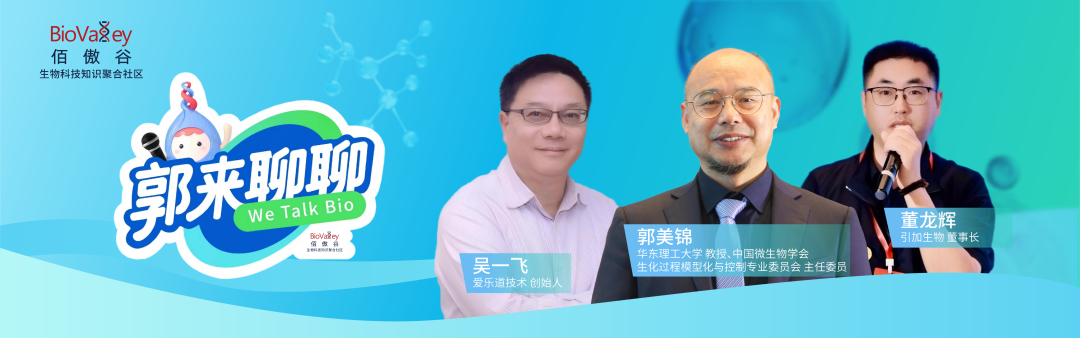

The seventh issue brings to you:Professor Meijin Guo from East China University of Science and Technology, Longhui Dong, founder of Ailedao Technology, and Yifei Wu, founder of YINJIA BIOSCIENCES" The wonderful dialogue, let's talk together about "Empowering the Industrial Chain in Synthetic Biology”
Introduction of this issue's "Guest":
Dong Longhui:Founder of Ailveda Technology
Founder of Shanghai Ailedao Technology Co., Ltd. As the core figure of the company, he has rich industry experience and keen market insight. Under his leadership, Ailedao Technology has built a large-scale technology and production system.
Wu Yifei: Founder of YINJIA BIOSCIENCES
Ph.D. in Cellular and Molecular Biology from the University of Michigan Medical School, USA; Postdoctoral Fellow at Eli Lilly and Company, USA. Possesses over 20 years of firsthand practical work and operational management experience in the biopharmaceutical field. During overseas studies, held positions at Roche Diagnostics USA and Cook Medical USA. After being invited to return to China in 2008, successively held key management roles at CrownBio (Beijing) Co., Ltd., WuXi AppTec, and Yangtze River Pharmaceutical Group. Founded YINJIA BIOSCIENCES (Shanghai) Co., Ltd. at the end of 2020. Appointed as a Senior Researcher at Fudan University Ningbo Institute in 2021.

The synthetic biology industry chain with"Design-Build-Test-Learn"With circulation at its core, a value chain from underlying technology to end products is formed:UpstreamProviding basic tools such as gene sequencing and synthesis, editing tools, design software, etc."Enabling Technology" Layer`, forming the cornerstone of the industry;`MidstreamIt is to use these tools for rational design and high-throughput experiments, developing highly efficient "cell factories" or "enzyme catalysis systems.""Platform Development" Layer, responsible for engineering transformation;DownstreamThis involves scaling up the fermentation and production of engineered strains or systems, ultimately achieving commercial applications in fields such as pharmaceuticals and healthcare, chemical materials, agriculture, and food."Product Landing" Layer。
Currently, China's industry presents"Strong downstream applications, upstream tools catching up"'s pattern, through the combination of technology and capital, is committed to打通从实验室设计到大规模生产的全链条,以可编程的生物系统应对可持续发展挑战。
01Guo Meijin:
What is the current status of Semaglutide and the business of each company?
Dr. Dong Longhui:
Semaglutide has become the new "blockbuster drug" in the global biopharmaceutical field, with its market size and output value now surpassing the well-known Keytruda (K药), reaching more than 65 billion yuan. In the rapid development of this industry, China has become the largest supplier of raw materials for this product, providing about 80% of the active pharmaceutical ingredient (API) production capacity, driving the overall rise of the domestic peptide industry. Previously, companies such as WuXi AppTec and KarryPharm achieved exponential growth in performance due to handling a large number of related orders.
From a technical perspective, the synthesis process of peptide raw materials has evolved from early full chemical synthesis, through enzymatic methods and enzyme-chemistry combination methods, to the current bio-chemical fusion method centered on synthetic biology. The new generation of technology not only effectively controls impurities but also balances cost and efficiency, driving the price of active pharmaceutical ingredients down significantly from 6,000 yuan per gram to around 200 yuan. With continuous technological iteration, there is still room for future cost reduction.
Building on existing technologies, our company has successfully developed an innovative process: upgrading raw materials from single amino acids to designed short peptide fragments, achieving efficient synthesis through fragment ligation. For semaglutide (comprising 33 amino acids), the traditional process requires approximately 120 reaction steps, whereas our technology completes the synthesis in just 6 steps. This breakthrough not only significantly shortens the process but also markedly improves purity—with only 3 process-related impurities, total impurity content can be stably controlled below 0.5%, with the best results reaching 0.3%.
We have深耕ed in this field for many years, gradually establishing an independent technology system rather than simply following or imitating patents. By deeply integrating synthetic biology methods with chemical synthesis, we have improved efficiency and quality while further optimizing costs. These achievements are inseparable from the team's technical accumulation, such as Dr. Wu's research and development in enzyme preparations and Teacher Guo's key contributions in new process development.
Dr. Wu Yifei:
Thank you, Professor Guo, for the invitation. I come from a background in protein technology and was involved in the synthesis processes of peptides similar to tirzepatide during the early stages of semaglutide. Before returning to China, I worked for many years at Eli Lilly and Roche Pharmaceuticals. After returning, I founded YINJIA BIOSCIENCES, and it has been five years since. The company is positioned to become a professional protein platform enterprise. We are committed to developing various protein products, including antibodies, antigens, enzymes, and various specialty protein raw materials.
Our clients mainly include pharmaceutical companies, IVD enterprises, and CGT (cell and gene therapy) companies that have rapidly developed in recent years. At the same time, we have also begun to focus on cutting-edge fields such as organoids and stem cells. Currently, our core focus is to achieve the domestic production substitution of these protein categories. Taking semaglutide or other GLP-1 class peptides as examples, the mainstream synthesis methods currently combine chemical synthesis with biological fermentation, followed by subsequent modifications.
As Mr. Dong mentioned earlier, their technology has reduced the reaction steps from over a hundred to just six, which is indeed a highly creative breakthrough and essentially a process revolution. This simplification not only enhances product purity but also significantly reduces costs while ensuring high quality, aligning perfectly with our development philosophy. To date, we have successfully developed more than 300 types of proteases, specialty antigens, and antibodies, some of which are exclusive products. These achievements are the result of continuous technological breakthroughs, allowing us to ensure high product quality while significantly lowering costs.
In addition, we are also expanding our technology platforms related to ADCs (antibody-drug conjugates), with a focus on targeted enzyme conjugation technology. Currently, there are about 6-7 mainstream pathways in the industry, and new forms such as PDCs (peptide-drug conjugates) will impose higher requirements on enzyme technology in the future. We have established close collaborations with several leading pharmaceutical companies and provide配套的质控试剂盒 (supporting quality control kits) to ensure reliable quality control after customers use our enzyme products. Although we do not directly participate in drug development, we aim to be a trusted partner in pharmaceutical companies' R&D processes.
I believe that the key to the current development of biopharmaceuticals in China lies not only in continuous innovation but also in effectively reducing costs and improving efficiency through innovation.Recently, we have focused on refining a "cell-free protein expression platform." This system enables high-throughput rapid screening of proteins, whereas traditional methods are time-consuming, labor-intensive, and costly. Our platform significantly improves efficiency. Building on this, we have further integrated artificial intelligence technology to quickly evaluate protein expression and functional activity—typically providing expression results within three days, while simultaneously verifying its function-oriented performance, such as whether enzyme activity is enhanced, yield is increased, or solubility is improved. It is especially suitable for the rational modification of difficult-to-express proteins, such as membrane proteins.This platform is precisely the direction where we are currently focusing our efforts and continuously optimizing, aiming to provide more efficient and precise solutions for protein design and development.
02Guo Meijin:
How to Find the Positioning of Your Enterprise in the Industrial Chain?
Dr. Dong Longhui:
We are essentially a technology empowerment platform serving product development and application. Our core positioning is to continuously integrate cutting-edge technologies and build an efficient platform to assist customers in new product research and industrialization. Taking ADC drugs as an example, the reason they have become a hot topic is that various technologies in the industry chain have matured. Innovation can be achieved by precisely conjugating the targeting component with the effector molecule through a linker. Nowadays, competition between companies no longer relies on a single technology but requires a "combination punch" – strengthening and integrating diversified services to provide comprehensive solutions covering the entire process from R&D to production, thereby building true competitive advantages.
At the same time, only by possessing solid capabilities in areas such as quality control and analysis can we quickly respond to customer needs and provide reliable services. Through the conferences and platforms organized by Mr. Guo, I have had the privilege of meeting numerous technical experts, such as Dr. Wu. They are not only our mentors but also partners we sincerely hope to invite to guide us in real-world application scenarios. We look forward to having in-depth face-to-face exchanges with these experts to jointly address the increasingly complex demands of customers—challenges that often cannot be solved by a single company alone and require extremely high technical expertise. While we have the willingness to invest, ready teams, and funding, we fully understand that we cannot work in isolation. Instead, we must collaborate with top-tier teams like Dr. Wu’s. Once the integration of platforms and technologies is achieved, benefits will quickly follow.
Finally, I would like to use a metaphor to illustrate this collaboration: the industrial chain is like agriculture, which can be divided into three types of roles — "seed makers," "seedling growers," and "field farmers." Dr. Wu's team is like the "seed makers," focusing on the research and development of fundamental technologies and core components; Professor Guo’s platform is akin to the "seedling growers," nurturing seeds into transplantable seedlings; and we are like the "field farmers," who, after obtaining high-quality seedlings, promote and plant them across vast fields to achieve large-scale production and harvest. The entire bio-manufacturing industry needs such an interconnected and collaboratively advancing ecosystem platform.
Dr. Wu Yifei:
The key to the entire ecological chain lies in the collaboration and professional division of labor between upstream and downstream. As for our own positioning, although our business may involve production processes, we have always been clear that large-scale production is not our core focus. From the very beginning of our startup journey, we positioned ourselves as an enabler specializing in process development and scale-up.
Specifically, we focus on systematically scaling up proven R&D processes from laboratory-scale volumes of 100L, 200L, or 500L to ton-level production. This is akin to a critical link in the agricultural industry chain – we don’t develop seeds, nor are we directly responsible for large-scale farming; instead, we concentrate on efficiently and reliably nurturing high-quality seedlings into mature crops ready for mass transplantation, thereby maximizing the overall efficiency of the entire industry.
Behind this positioning lies a profound understanding of the entire drug development chain: early research and the IND stage, as well as the subsequent CMC and commercial production, are essentially two distinct professional fields, requiring completely different knowledge structures, talent teams, and resource systems. As the development paths of large overseas pharmaceutical companies over the past two decades have shown, specialized division of labor is an inevitable trend. Therefore, we firmly believe that only when each link focuses on its own area of expertise can the entire industry chain truly achieve efficient integration.
Based on this concept, we continuously and dynamically adjust our layout to closely follow market trends. For example, in the ADC field, our investment is not chasing short-term hotspots but rather a forward-looking plan based on long-term judgment. The relevant layout began at least two years ago.
03 Guo Meijin:
What Should Chinese Enterprises Pay Attention to in the Process of Product Replacement?
Dr. Dong Longhui:
From my experience, I believe it is crucial to persist in expanding channels and cultivating the industry. When I first worked on technology, I thought it was the most important factor; later, when managing a business, I realized cash flow was critical. However, after truly moving towards industrialization, I deeply understood that channels are the core. Today, we have built an international and localized channel network, allowing us to directly reach frontline customers and grasp the most genuine needs. The value of channels lies in their ability to bring scalable market demand. For instance, if the price of an enzyme is as high as $10,000, within a market with 1 billion yuan in output value, it represents only a small cost input. But if our sales channels can cover about 60% of the procurement needs in that market, it means we could achieve a scale of 600 million yuan. In such a scenario, we would be willing to invest resources to develop or adopt such high-cost technologies.
Conversely, if the market share is only 1%, the corresponding scale might be just 60 million yuan. In that case, faced with a unit cost of 10,000 US dollars, we would hesitate — could such an investment be recouped? Therefore, we are making every effort to expand cooperation with mainstream purchasers and key clients, striving to become their first or second supplier. After establishing such channel relationships, customers will directly send us their orders and requirements, which not only reduces market uncertainty but also makes high-value technology investments feasible and sustainable.
Dr. Wu Yifei:
We are dedicated to developing a cell-free protein expression system, primarily targeting proteins that may affect host growth or even cause cell death due to toxicity when expressed inside cells. Although similar systems already exist in the market, we focus on creating differentiated advantages to truly advance the industry. The first version of our system has already been adopted by multiple institutions, including national-level platforms, and the second upgraded version will be released soon.
In terms of protein development, we have accumulated more than 300 protein products, mainly applied in three major directions: the first is the new drug R&D field, including drug structure characterization and post-translational modifications required for drugs such as ADCs, such as glycosylation and phosphorylation; the second is the in vitro diagnostics (IVD) field; the third is the small nucleic acid drug field, where we provide quality control and safety evaluation kits suitable for RNA and small RNA.
We always keep up with the technological development trends and continuously promote the iterative upgrading of our own technologies and products. As President Dong has advanced to the fifth generation in technology, we also highly value the integration and application of new technologies such as AI and computer simulation — the attention given to related topics at this forum highlights the importance of technological synergy. We firmly believe that through professional cooperation across the upstream and downstream of the industry chain, we can achieve a “1+1>2” effect. For instance, we once helped a company solve its problem of relying on imported protein raw materials costing up to $10,000 per milligram by breakthroughs in cell screening and technology, eventually enabling them to use affordable domestically produced alternatives.
Industrialization has always been our core focus. No matter how advanced a technology is, if the cost is too high or it cannot be scaled up, it will be difficult to realize true industrial value. Therefore, from the early stages of development, we focus on process scaling and cost control to ensure that the technology has the potential for industrial implementation. Although our scale is not large, we consistently adhere to an industrial mindset and perspective, closely aligning with customer needs during development. When customers present specific protein or process requirements, we not only provide solutions but sometimes discover new protein properties or optimization pathways during development and feed these back to the customer, working together to find the most suitable conditions for industrial-scale production.
We aim to continuously empower downstream enterprises and partners by providing them with the tools and technologies they truly need and can afford—some of which are not available overseas, while others are impractical due to high costs. Through collaboration, we hope to help more innovative achievements move from the lab to the industry, realizing sustainable commercial applications.
Message from Teacher Guo
We have always believed that technology must be capable of achieving scaled production, which is a distinct characteristic and core advantage of our team originating from East China University of Science and Technology. Our university has many outstanding talents in the industry, such as former COO of Junshi Biosciences and now founder of Antikor Biopharma, Feng Hui, who is highly experienced in process scale-up. Therefore, there is absolutely no issue with the technology here at our university. In this industry, only by creating something distinctive and establishing a differentiated advantage can one truly gain a foothold and achieve a leading position.
We also hope very muchI'm very glad to exchange with you. In today's era of rapid technological iteration, continuous innovation is a common theme for all of us.If everyone in the enzymeIn the field of enzyme proteins, especially in the expression, purification, and preparation processes of enzymes, there is deep technical expertise.If you have any questions, you can contact Dr. Wu Yifei at any time. Additionally, in the field of peptides,Whether it is chemical synthesis or biosynthesis, Dr. Dong Longhui has accumulated valuable experience and resources through rich practical experience. Therefore, he can meet the needs in the research and development, custom synthesis, or process scale-up of peptides (including semaglutide, etc.)., you can contact Dr. Dong Longhui.
"Guo Lai Liao Liao"
"Guo Lai Chat" is a biotechnology-focused interview program jointly produced by BioValley and Professor Guo Meijin's team.
"Guo Lai Chat" is hosted by Professor Guo Meijin from East China University of Science and Technology, gathering elites in the biotechnology field and focusing on the development of the entire industry chain. Relying on Professor Guo’s extensive experience in industry-academia-research collaboration, the program will systematically analyze the frontiers of biotechnology and industrial practices from upstream to downstream. It is committed to promoting knowledge sharing and intellectual exchange. We sincerely invite you to follow us and explore industry trends together, contributing to the prosperity and advancement of biotechnology.
Recommended Reading:

April 17-18, Nanjing, SBC2026 Synthetic Biology Industry Expo Officially Scheduled!
Highlights of This Expo: Global Perspective + Innovation Engine + Future Scenarios
❶ Build an international ecosystem, gathering global synthetic biology forces:Featuring international leading enterprises and innovative pioneers on the same stage, linking global partners from here, and discovering the next growth opportunity.
❷ Unlock the innovation chain, enabling laboratory results to precisely meet industrial needs:Build a fast track from top-tier research papers to mass production processes, accelerate the realization of innovative value, let creativity break ground, and let collaboration take root.
❸ Envision the future of "biological creation of everything," and witness the industrial revolution of "biomanufacturing":Case Unveiled: Exploring the Infinite Possibilities from Healthcare, Cosmetics to Food, Agriculture, and Materials. A Panoramic View of How Synthetic Biology Reshapes Industry Patterns and Human Life.
Meeting Details:
Scheduled! April 2026 ● Nanjing, China ● The 4th SBC Synthetic Biology Industry Expo is Coming
Welcome to add the editor's WeChat to join the communication group.
When adding friends, please note: Name + Company + Position
Companies in the fields of synthetic biology and biomanufacturing are also welcome to submit articles~