

Standardization of Pediatric Growth and Development Assessment Is Urgently Needed: Integrated AI-Hardware Solutions Offer a Breakthrough

YITU
Provider of Full-Stack Intelligent Healthcare Product Solutions
As a critical indicator that accurately reflects the level of growth and development and maturity in children, bone age assessment holds significant importance in evaluating growth status, formulating diagnostic and therapeutic strategies for diseases, and monitoring treatment outcomes. Many developed countries have incorporated bone age assessment into the annual health check-up protocols for children and adolescents.
Alongside China’s rapid economic growth in recent years, problems related to children’s growth and development have become increasingly severe. Pediatric endocrine disorders such as precocious puberty, short stature, and obesity are now commonplace, with incidence rates continuing to rise. Rough estimates indicate that more than 40 million children in China suffer from growth and developmental disorders.
However, the implementation of bone age assessment in China has not been smooth sailing.
On one hand, bone age interpretation is highly subjective, with long-standing issues in efficiency, quality, and consistency of results. On the other hand, parental fear of “radiation” leads to universal avoidance of all radiological examinations, thereby imposing significant limitations on the clinical application of bone age assessment.

“Bone age assessment is key to the early detection, diagnosis, and treatment of pediatric endocrine disorders. Delayed treatment can have numerous adverse effects on a child’s physical and psychological development, as well as on their educational advancement, employment prospects, and future marriage,” stated Professor Fu Junfen, Secretary-General of the Asia Pacific Pediatric Endocrine Society, Executive Vice President of the Children’s Hospital Affiliated to Zhejiang University School of Medicine, and Director of the Center for Pediatric Endocrinology and Metabolism, in a recent media interview on the current state of bone age assessment in China. “In recent years, artificial intelligence (AI) technology has advanced rapidly. The widespread application of AI helps establish a precise, efficient, systematic, and standardized framework for assessing children’s growth and development. Furthermore, integrating AI-based bone age assessment with customized, low-radiation, portable hardware to create an integrated ‘software-hardware’ solution will further unlock the demand for bone age assessment in China.”
Professor Fu Junfen revealed that numerous factors constrain the widespread adoption of bone age assessment in clinical practice, with key issues including insufficient expertise in detailed bone age image interpretation, parental concerns about radiation exposure from X-rays, and challenges in quality control for conventional digital radiography (DR) imaging.
According to statistics, China had only 0.53 pediatricians per 1,000 children (2014 data), and among them, very few physicians were proficient in high-quality image interpretation. Consequently, the Greulich-Pyle (GP) atlas method, which is faster but less accurate and consistent, has long dominated clinical practice in primary healthcare institutions. In contrast, methods with relatively higher accuracy, such as the Tanner-Whitehouse 3 (TW3) method and the Chinese 05 method, have faced certain application bottlenecks due to their time-consuming nature and higher technical thresholds.
Secondly, Chinese parents’ concerns about “radiation” have also significantly hindered the widespread adoption of bone age assessment. Although protective measures are in place when using conventional digital radiography (DR) equipment for bone age imaging, scattered radiation may still expose other parts of the child’s body or accompanying parents. Despite the low dose, this risk continues to cause considerable anxiety among parents, thereby impeding the routine application of bone age assessments.
Meanwhile, the imaging quality of traditional DR equipment is unstable due to various factors, such as the technician’s proficiency in image acquisition. This often results in rejected images, necessitating repeated exposures for children and leading to excessive radiation exposure. Furthermore, it compromises the final image quality, thereby affecting the accuracy of radiological interpretation.
“Artificial intelligence technology has made significant breakthroughs in interpretation efficiency, quality, and consistency. Taking the TW3 method as an example, the image reading process, which originally took 5–10 minutes, has been compressed to a matter of seconds, achieving high consistency in image interpretation and effectively reducing the impact of subjective factors on the results,” said Professor Fu Junfen. “Meanwhile, the application of AI software also helps extend the bone age diagnostic expertise of the Children’s Hospital of Zhejiang University School of Medicine to primary healthcare institutions across China, alleviating the shortage of pediatric healthcare resources at the grassroots level and improving the bone age diagnostic capabilities of primary care pediatricians.”
At the National Smart Maternal and Child Health Big Data and Artificial Intelligence Summit held in July 2019, Yitu Medical, a leading domestic medical AI company, took the lead in China by launching an intelligent one-stop solution for assessing children’s growth and development. Unlike pure AI software for bone age interpretation, this solution integrates customized hardware devices with artificial intelligence technology into a unified “hardware-software” system. Compared with pure AI software, what advancements does this newly released solution offer?
“Bone age assessment is not only useful for evaluating growth and development, but also holds significant value in the standardized treatment and follow-up of pediatric endocrine disorders in clinical practice. Follow-up and management guidelines for certain conditions recommend bone age assessments every 3–6 months,” stated Professor Fu Junfen. “To enable regular bone age monitoring, the challenge of radiation exposure must be addressed.”
It is understood that in traditional bone age assessments, parents or nurses often had to hold lead aprons to help shield pediatric patients from radiation, yet scatter radiation remained difficult to avoid. Although the radiation dose was low, the mere word “radiation” was enough to deter the vast majority of parents. How does the integrated “hardware-software” one-stop solution address this challenge?
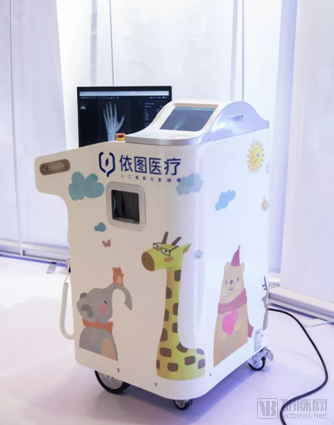
On one hand, the device adopts a novel full-shielding anti-radiation design, reducing the radiation dose to only one-fifth of that of traditional DR equipment. It isolates scattered radiation, ensuring that body organs other than the child’s hands receive no additional radiation exposure. On the other hand, its proprietary automatic hand-position calibration function effectively lowers the rate of rejected images, reduces the number of exposures required, and further decreases the total radiation dose received by children.
Professor Fu Junfen commented on the solution, stating: “The evolution from AI-based bone age software to a one-stop solution is significant not only because it resolves the long-standing dilemma of being unable to achieve both efficiency and accuracy in bone age assessment, but also because it leverages technological means to standardize and regulate the process. This greatly enhances the consistency of bone age assessment results, helping to overcome the current bottleneck of limited medical resources. It facilitates the deployment of bone age testing to primary care settings and broader application scenarios, thereby realizing intelligent and routine bone age assessment and growth and development evaluation for Chinese children and adolescents, and enabling more Chinese children to benefit from high-quality growth and development assessments.”