

Highlights from Eight Industry Leaders at the 2019 World Artificial Intelligence Conference: A Must-Read Summary
This week, artificial intelligence continued to dominate the headlines. From the 2019 Chongqing Smart China Expo on Monday to the 2019 World Artificial Intelligence Conference held in Shanghai over the weekend, the two municipalities directly under the Central Government at either end of the Yangtze River showcased the world’s cutting-edge AI technologies and innovative products to a global audience.
The 2019 World Artificial Intelligence Conference (WAIC), themed “Smartly Connecting the World, Infinite Possibilities,” brought together AI scientists and entrepreneurs from around the globe, along with government leaders, in Shanghai. They delivered speeches on technological frontiers, industry trends, and hot topics in the field of intelligence, jointly exploring the future path of artificial intelligence. Following the Smart China Expo, VCBeat traveled to Shanghai to examine the potential applications of artificial intelligence in healthcare and how it connects with and transforms the medical sector.
What Are the Titans of AI Discussing?

Tom Mitchell, Dean of the School of Computer Science at Carnegie Mellon University
Tom Mitchell stated that AI is accelerating development in the field of perception, and human natural language processing capabilities will advance rapidly across all languages within the next 12 months. This will bring about transformative changes in sectors such as transportation, education, and healthcare. He argued that governments should promote win-win outcomes in artificial intelligence through cooperation, rather than engaging in zero-sum games. “I have studied the AI strategies of China, the United States, and South Korea. These strategies mention certain common technologies and share relatively similar policies. I believe it is essential to clearly distinguish between zero-sum games and win-win cooperation.”
“One point to be reflected in the future planning of artificial intelligence is that, in areas with win-win potential, we should not only permit but also actively promote collaboration to identify ways of sharing. For instance, internationally sharing medical data and algorithms can accelerate AI development, foster these win-win applications, and thereby improve the quality of life for all.”

Tencent Holdings Ltd. Chairman and Chief Executive Officer Ma Huateng
Ma Huateng believes that artificial intelligence technology is a transnational and interdisciplinary scientific exploration endeavor. For any enterprise or country, it is impossible to opt out of the AI competition or pursue development in isolation. Artificial intelligence will exhibit three major development trends:
First, the development trend of artificial general intelligence (AGI) is becoming increasingly clear. AI is moving closer to human society, evolving from specialists to generalists, and achieving a leap forward from narrow artificial intelligence to artificial general intelligence.
Second, in terms of AI applications, the deepening integration of AI with various industries will usher in an inclusive intelligent society characterized by “AI+.” Comprehensive industry solutions—such as smart manufacturing, smart healthcare, smart security, smart transportation, and smart retail—are being implemented across China.
Among these, smart healthcare is a key focus for Tencent. The company has established one of the first national-level new-generation artificial intelligence platforms for medical imaging. “Tencent Miying” has expanded its applications from single-disease to multi-disease scenarios, assisting physicians in diagnosing various cancers and other conditions. Capable of identifying and predicting risks for over 700 diseases, it has become a national benchmark project. Furthermore, Tencent has created a “micro-ecosystem” of AI applications in the healthcare sector by integrating internet hospitals, the electronic health card initiative, and professional medical science popularization projects such as “Tencent Medical Dictionary.”
Third, in terms of AI governance, the principle of “Tech for Social Good” should guide comprehensive AI governance to ensure that AI is “interpretable,” “controllable,” “accessible,” and “reliable.” Interpretability refers to whether AI algorithms can be clear, transparent, and explainable. Controllability concerns how to prevent AI from harming the interests of individuals and society as a whole. Accessibility addresses whether AI can enable the broadest possible population to share in the technological dividends, thereby avoiding a digital divide. Reliability pertains to whether AI can rapidly patch its own vulnerabilities, truly achieving safety, stability, and dependability.

Harry Shum, Executive Vice President of Microsoft
In recent years, the pace of artificial intelligence development has far exceeded our expectations. From computer vision and natural language recognition to machine reading and machine translation, AI has gradually approached human-level performance.
In many games, ranging from Go to Texas Hold'em, artificial intelligence has gradually approached and even surpassed human performance. Today in Shanghai, I am pleased to announce that Microsoft Research Asia has developed the strongest Mahjong AI in history.
Mahjong features exceptionally high complexity and richer hidden information, making the development of Mahjong AI more challenging. Microsoft’s Mahjong AI can effectively handle the high degree of uncertainty inherent in the game, demonstrating human-like intuition, prediction, reasoning, and strategic awareness during gameplay.
Microsoft adheres to six core AI principles in the development and deployment of artificial intelligence: fairness; reliability and safety; privacy and security; inclusiveness; transparency; and accountability. The company has also established an AI Ethics Committee, with plans to subject every future AI product to ethical review.

SenseTime Founder Tang Xiao'ou
Tang Xiao’ou, founder of SenseTime, stated that the development of artificial intelligence requires global wisdom and called for strengthened cooperation among enterprises and institutions worldwide to break down national barriers in AI academic research. He emphasized that the first character in “Artificial Intelligence” (in Chinese, “Ren Gong Zhi Neng”) is “Ren” (human), meaning that with top-tier talent, world-class AI will naturally follow. The “source” in “source innovation” comprises three core elements: First, a favorable innovation environment that protects intellectual property rights and ensures original innovators can make a living; second, respect for talent cultivation, as the proverb goes, “It takes ten years to grow trees, but a hundred years to nurture people,” which allows original innovation to have a lasting impact; third, AI needs to break through boundaries between traditional industries, between academia and industry, and across national borders in academia. With these three elements in place, the vital flow of source innovation will naturally emerge.

Kai-Fu Lee, Founder of Sinovation Ventures
From an investment perspective, Kai-Fu Lee proposes that AI development has gone through four eras: the era of black technology in 2012, the B2B era (AI + traditional enterprises) in 2017, the empowering AI+ era in 2020, and the subsequent era where AI is ubiquitous. We are currently between the second and third eras.
In his speech, Kai-Fu Lee stated that "Internet Plus" was once a widely used slogan. Today, we have entered the era of "AI Plus." Building upon the foundations of the steam engine, electrification, information and communications technology (ICT), and the internet, AI will drive the Fourth Industrial Revolution.
Kai-Fu Lee stated that deep learning has entered a mature phase, and it is unpredictable whether academia will need to invent more and better new technologies to replace it. However, in the industrial and business sectors, there remains significant room to further advance and leverage deep learning.

Liu Qingfeng, Chairman of iFlytek
Liu Qingfeng stated that the artificial intelligence we need should first be positive and healthy, not only changing the world but also contributing to building a better one. Furthermore, the AI we require should adhere to fundamental scientific and technological laws, as well as basic commercial principles and logic, rather than being rash or relying on hype-driven concepts. How can AI applications be implemented and scaled? Liu Qingfeng noted that the true era of AI dividends will arrive only if the following three criteria are met: first, there must be real-world application cases; second, the solutions must be products capable of large-scale deployment; and third, there must be data demonstrating their effectiveness.
Liu Qingfeng stated that iFlytek analyzed homework assignments completed by Chinese students over the past two years and found that 60% of them were ineffective. With AI technology, it is possible to accurately determine learning directions and monitor students’ learning progress. During last year’s College English Test Band 6 (CET-6), iFlytek’s AI translation technology outperformed more than 99% of test-takers in accuracy. As machine reading comprehension capabilities improve, they will pioneer applications across various fields.
What Is the Dividend of Artificial Intelligence? Liu Qingfeng Responded: “The True Dividend of AI Lies in Using Technology to Help More People.”
Jack Ma vs. Elon Musk: Mars Crashes into Earth

The over-40-minute dialogue between the “Two Mas” at the opening ceremony was the highlight of WAIC. They discussed the threats artificial intelligence poses to humanity, Mars colonization, brain-computer interfaces, and AI’s impact on employment, education, and life and health. The conversation between the two tech titans ultimately culminated in the topic of life and health.
Jack Ma wants to know how long human lifespan could be with the help of artificial intelligence, and whether AI can contribute to environmental sustainability.
Musk stated, “Humanity can address the challenge of environmental sustainability; I do not believe this is an easy task. However, I consider it a fully achievable vision for the future. We must take substantial action and sustain this momentum to realize environmental sustainability.”
Musk believes that in the future, humans could use neural connections similar to brain-computer interfaces to store our states and memories, much like a video game, thereby solving the problem of biological aging. Approaches based on modifying DNA would require more time, and whether humanity should alter DNA at all remains a matter for careful consideration.
Jack Ma firmly believes that humanity can enjoy a better living environment and longer lifespans. “What we need is to live healthier lives, which requires a better understanding of the causes of most diseases—indeed, they are largely caused by our own behaviors. I am 100% certain that people will live longer and healthier lives, but this does not necessarily mean they will be happier. If you seek happiness, we must focus on values, vision, and mission, while also having a dream,” said Jack Ma.
Establish a National New-Generation Artificial Intelligence Open Innovation Platform
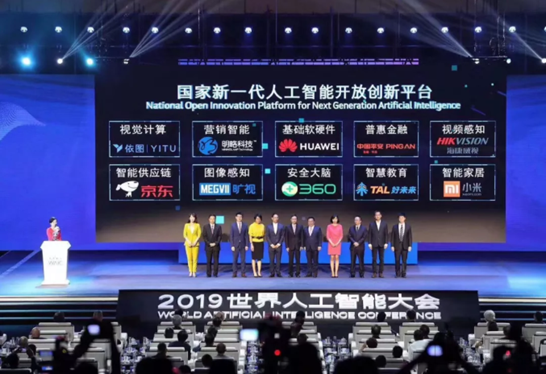
In the latter part of the opening ceremony, Vice Minister Li Meng of the Ministry of Science and Technology announced the launch of ten new National Next-Generation Artificial Intelligence Open Innovation Platforms. The establishment of these platforms is a key component of the "National Next-Generation Artificial Intelligence Development Plan." Relying on leading enterprises in AI technology, the platforms aim to promote the deep integration of artificial intelligence with the real economy, driven by application demands. They are designed to advance technological research and development, foster open sharing, support innovation and entrepreneurship, and lead China’s AI technological innovation and industrial ecosystem development.
These ten platforms are:
Rely on Shanghai Yitu Technology Co., Ltd. to build the National New Generation Artificial Intelligence Open Innovation Platform for Visual Computing;
Relying on Shanghai Minglue Artificial Intelligence (Group) Co., Ltd. to build the National New Generation Artificial Intelligence Open Innovation Platform for Marketing Intelligence;
Relying on Huawei Technologies Co., Ltd. to build the National New Generation Artificial Intelligence Open Innovation Platform for Basic Hardware and Software;
Relying on Ping An Insurance (Group) Company of China, Ltd. to build the National New Generation Artificial Intelligence Open Innovation Platform for Inclusive Finance;
Relying on Hangzhou Hikvision Digital Technology Co., Ltd. to build the National New Generation Artificial Intelligence Open Innovation Platform for Video Perception;
Rely on Beijing Jingdong Century Trading Co., Ltd. to build the National New Generation Artificial Intelligence Open Innovation Platform for Intelligent Supply Chain;
Rely on Beijing Megvii Technology Co., Ltd. to build the National New Generation Artificial Intelligence Open Innovation Platform for Image Perception;
Relying on Beijing Qihoo Technology Co., Ltd. to build the National New Generation Artificial Intelligence Open Innovation Platform for the Security Brain;
Rely on Beijing Shiji Haoweilai Education Technology Co., Ltd. to build the National New Generation Artificial Intelligence Open Innovation Platform for Smart Education;
Relying on Beijing Xiaomi Mobile Software Co., Ltd. to build the National New Generation Artificial Intelligence Open Innovation Platform for Smart Homes.