

VoxelCloud Showcases Full-Spectrum AI Diagnostic Solutions at 2019 World Artificial Intelligence Conference, Expands Focus Toward Consumer Healthcare
Connecting the World with Intelligence, Unlocking Infinite Possibilities: The 2019 World Artificial Intelligence Conference kicked off from August 29 to 31 at the Shanghai World Expo Center and the Shanghai World Expo Exhibition Hall. At this year’s conference, VoxelCloud showcased its three AI-powered products for comprehensive disease coverage under the theme “How Technology Empowers Intelligent Care.” The exhibits included “Clear Insight” (a 3D conceptual display of thoracic products), “Seeing Is Believing” (on-site experience of comprehensive fundus screening for all diseases), and “Skin Deep” (comprehensive dermatological screening experience).
As early as 2017, VoxelCloud pioneered the comprehensive disease coverage framework. Over the following two years, the company successfully developed three product lines encompassing a broad spectrum of conditions—chest CT analysis, fundus screening, and dermatological self-assessment—thereby further advancing the practical implementation of these solutions in clinical scenarios.
Regarding the common single-disease image interpretation in the current industry, such as pulmonary nodule detection and diabetic retinopathy screening, VoxelTech believes that AI tools focused on a single disease cannot provide substantial assistance to doctors in clinical practice. Since physicians comprehensively evaluate all potential conditions of a patient during routine image interpretation, only an AI system capable of multi-disease analysis can offer comprehensive support to clinicians, expand its scope of application, and truly serve as a medical resource to assist in clinical workflows.
VoxelCloud’s comprehensive chest CT solution for all disease types is designed for health screening populations, enabling direct transition from image interpretation to the generation of natural language reports. Given that hundreds of conditions can manifest in the thoracic cavity, developing a separate AI model for each condition is impractical due to excessive workload and insufficient data support. VoxelCloud leverages computer vision features to categorize and classify clinical manifestations observed in hospitals, allowing multiple conditions to be addressed by a single model. This approach significantly saves time. Classification methods include, for example, focal lesions, density-based lesions, and texture-feature-based lesions. This research has gained recognition from numerous medical institutions in both China and the United States. In the future, VoxelCloud’s chest CT product will be deployed in large-scale health screening centers, where the system can generate tens of thousands of CT reports within 3.5 hours daily.
In the field of fundus screening, VoxelCloud’s comprehensive fundus disease screening product has evolved from single-disease screening (diabetic retinopathy) to multi-disease image interpretation. Currently, VoxelCloud’s fundus products can detect dozens of types of lesions. In addition to characteristic features of diabetic retinopathy, diabetic macular edema, glaucoma, cataracts, and age-related macular degeneration, they also identify microaneurysms, intraretinal hemorrhages, hard exudates, cotton-wool spots, preretinal or subhyaloid hemorrhages, neovascularization, laser scars, drusen, and vitreous opacities.
It is worth mentioning the collaboration between Voxel Technology and China’s National Standardized Metabolic Disease Management Center (MMC). As the first AI technology provider integrated into the MMC network, Voxel Technology screened over 40,000 diabetic patients across more than 170 MMC centers within just one year of launch, thereby enhancing MMC’s management of fundus complications in diabetic patients. It is projected that from 2019 to 2020, MMC centers will achieve a screening volume of 300,000 patient visits, with AI-based fundus photography analysis benefiting an even larger number of patients.
Unlike other companies in the same industry, Voxel Technology has shifted its research focus toward the consumer (C-end) market. "Voxel Skin Insight" is a skin AI assessment mini-program developed by Voxel Technology. Patients simply need to upload photos of their skin conditions via their mobile phones to receive image analysis results and reports within one second. Currently, Skin Insight covers nearly 200 common skin issues.
Regarding the R&D of consumer-facing AI for dermatology, Dr. Ding Xiaowei, CEO of Voxel Tech, stated that the challenge far exceeds that of computer vision tasks on natural images, due to the non-standardized nature of image acquisition (e.g., variations in users’ smartphone models, lighting conditions, shooting angles, and image quality). In response to this variability, Voxel Tech’s dermatology R&D team has conducted in-depth research on deep neural networks for skin images, focusing on both model training methodologies and neural network architectures. As Voxel Tech’s flagship dermatological product, the “Fuzhihui” mini-program adheres to the company’s mission of delivering professional medical services to the general public, making skin health management intelligent and lightweight.
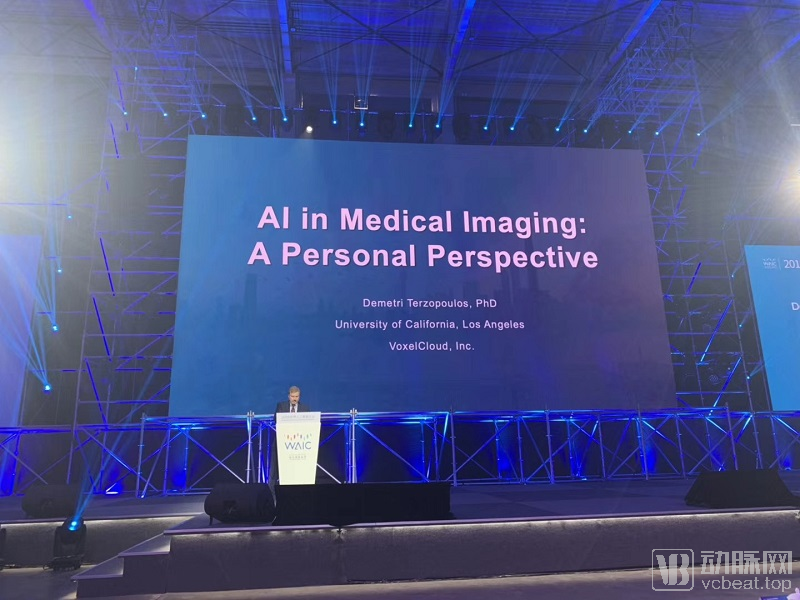
At the forum of the “2019 Global AI Health Summit” held on the 30th, Professor Demetri Terzopoulos, a Fellow of the Royal Society, Chief Scientist at VoxelCloud, and a towering figure in the field of computer vision, delivered a keynote address titled “Applications of Artificial Intelligence in Medical Imaging and Healthcare.”
As the keynote speaker for the healthcare session, Professor Demetri Terzopoulos provided a systematic review of the history of computer vision: from early pattern recognition methods, to later model-based approaches, and now transitioning into the deep learning era.
Since 1978, Professor Demetri Terzopoulos has been attempting to analyze medical images. Beginning in the 1980s, he initiated research on medical imaging based on deformable models.
In 1987, Demetri Terzopoulos, in collaboration with Kass and others, proposed the renowned Snake model. Their jointly published paper was awarded in the inaugural Marr Prize special issue of the International Journal of Computer Vision (IJCV) and has become one of the most cited papers in computer science and even across the entire engineering community. Following the introduction of this model, various methods for image segmentation, understanding, and recognition based on active contours have flourished.
During the lecture, Professor Terzopoulos cited multiple cases of using active contour models for image segmentation and reconstruction. Professor Demetri Terzopoulos believes that computer science, artificial intelligence, and information technology hold immense potential to empower the medical field, serving as the greatest source of future innovation. However, he also cautioned, “While we have cutting-edge data-driven machine learning techniques and powerful model-based methods, we should not blindly assume that deep learning alone can solve all problems.”
Professor Demetri Terzopoulos’s viewpoint also reflects some of the drawbacks that have gradually emerged in deep learning in recent years, such as the “need for large amounts of training data” and “poor interpretability.” In the interview, Professor Terzopoulos also acknowledged that deep learning has been around for five or six years and has influenced many different fields in a very short period. It is therefore normal that deep learning now faces numerous challenges; the development of any technology does not follow a straight upward trajectory but inevitably encounters periods of stagnation.
“Lesion segmentation is a highly challenging problem. In tasks where annotation is expensive and consistency is poor, deep neural networks have not achieved outstanding performance. Another major challenge is image registration. When dealing with multiple datasets and multiple imaging modalities, they must be registered together. For example, in cardiac analysis, tracking is crucial because the vascular structures within the body move during blood pumping, similar to motion during physical activity. Therefore, image registration, like segmentation, is also difficult to implement.”
Therefore, he revealed that his recent interest lies in combining machine learning methods with previously model-based techniques, aiming to develop more powerful medical image analysis algorithms.
“Model-based methods provide better interpretability of the segmentation process. In fact, they allow for interaction with the method. Model-based techniques offer numerous advantages; for instance, some do not require large volumes of training data. Therefore, I believe that integrating these two approaches represents the future direction of development.”
Currently, Professor Demetri Terzopoulos serves as Co-founder and Chief Scientist of VoxelCloud. He noted that VoxelCloud is a relatively young company, currently focusing its efforts on comprehensive, all-condition solutions in four key areas: chest CT, color fundus photography, coronary CTA, and dermatology. Professor Terzopoulos stated, “To date, we have developed systematic technologies for comprehensive, all-condition care frameworks, which I consider one of our greatest achievements.” Currently, more than 200 institutions collaborate with VoxelCloud on its ophthalmology and dermatology all-condition products. Ophthalmology partners include over 200 centers such as the Los Angeles County Department of Health Services, Eyepacs, China’s National Standardized Metabolic Disease Management Center (MMC), Peking Union Medical College Hospital, Beijing Tongren Hospital, and Zhongshan Ophthalmic Center of Sun Yat-sen University. In dermatology, its AI solutions are developed in collaboration with renowned institutions in China and the United States, including Harvard Medical School.
Professor Demetri Terzopoulos stated that computer science, artificial intelligence, and information technology hold immense potential to empower the medical field, serving as the greatest source of future innovation.
“We possess cutting-edge, data-driven machine learning techniques and robust model-based approaches, including the integration of active contour models; however, we must not blindly assume that deep learning alone can solve all problems,” he stated. “Therefore, we need to integrate these technologies with others—specifically, through collaboration with the traditional medical community—to fully leverage deep learning and artificial intelligence in advancing the field of medicine.” Significant research is required to realize the future potential of AI in medicine and to effectively address practical challenges within the healthcare sector.