

WAIC 2019 Highlights Five Key Trends in Medical AI: Commercialization, Regulatory Approval, Value-Based Healthcare, and Clinical Translation Take Center Stage
On August 29, the 2019 World Artificial Intelligence Conference (WAIC) officially opened along the Huangpu River in Shanghai. Leading AI scientists, entrepreneurs, and investors from around the world flocked to the event, where government officials from China and abroad, representatives of international organizations, top-tier scientists including Turing Award laureates, and leaders of major AI companies from both domestic and international markets shared their insights.

As one of the thematic forums at the 2019 World Artificial Intelligence Conference, the 2019 Global AI Health Summit, themed “Smart Health, Foreseeing the Future,” established a diversified, open, and innovative global platform for shared exchange to conduct in-depth discussions on development trends, industry regulation, innovative technologies, practical applications, and investment directions in the field of artificial intelligence in health.
Zong Ming, Deputy Mayor of Shanghai; Houlin Zhao, Secretary-General of the International Telecommunication Union (ITU); Simão Ferraz De Campos Neto, Senior Advisor to the ITU; Zhu Xiumei, Deputy Director of the Department of Science and Technology under the Ministry of Industry and Information Technology; and Liu Wenxian, Deputy Director of the Department of Planning, Development, and Information under the National Health Commission, delivered remarks at the summit. Bao Bingzhang, Secretary of the Xuhui District Committee of the Communist Party of China; Ma Liejian, Deputy Secretary of the Shanghai Municipal Economic and Informatization Work Committee; Zhao Dandan, Deputy Director of the Shanghai Municipal Health Commission; and Liu Duo, President of the China Academy of Information and Communications Technology, jointly attended the summit.
In addition, representatives from institutions such as the UK’s National Health Service (NHS), the Medical Industry Division of Japan’s Ministry of Economy, Trade and Industry (METI), the Hospital Management Center of the National Health Commission, the National Medical Products Administration (NMPA), and the Chinese Health Information Association attended the event. They were joined by executives from leading AI healthcare companies, including United Imaging Healthcare, Tencent Healthcare, AWS Healthcare, Siemens Healthineers, Roche Diagnostics, IBM Watson, AstraZeneca China, Shukun Technology, Landin High-Tech, Deepwise Medical, Babylon Health APAC, Johnson & Johnson, Neusoft, and iFlytek Healthcare, as well as heads of several Grade A tertiary hospitals from Shanghai, Beijing, and other regions, who participated in the event and delivered thematic presentations.
During the event, VCBeat interviewed dozens of healthcare leaders and entrepreneurs and compiled statistics on exhibitor participation, aiming to sketch an authentic portrait of the AI landscape amidst the grand occasion. In this portrait, artificial intelligence is no longer just theoretical; AI has permeated every corner of healthcare.
In April 2019, the State Council issued the Development Plan for New-Generation Artificial Intelligence, which proposed five new directions in the era of big data: swarm intelligence, cross-media intelligence, human-machine hybrid augmented intelligence, and autonomous intelligent systems. This has undoubtedly laid a solid foundation for the development of artificial intelligence technology in China. As technology advances along these broader trajectories, AI is continuously expanding its scope into more specialized application domains.
So, where will these technologies lead healthcare? In his speech, Pan Yunhe, an academician of the Chinese Academy of Engineering, highlighted five key trends:

Academician of the Chinese Academy of Engineering, Pan Yunhe
Trend 1: AI Imaging Companies Are on the Rise
As one of the longest-established segments in AI applications, companies specializing in artificial intelligence imaging can be regarded as pioneers in medical AI. Regarding the development of this technology, Dean Pan Yunhe stated, “AI imaging systems can help many physicians enhance their clinical skills, and numerous companies have provided significant support to technological advancements. For instance, Deepwise Medical’s AI tool for chest radiography has achieved a lung cancer detection rate of over 98%, far surpassing manual interpretation. At Sir Run Run Shaw Hospital affiliated with Zhejiang University School of Medicine, intelligent recognition of keratitis images has attained an accuracy rate exceeding 80%, outperforming 96% of the participating physicians.”
Trend 2: The Emergence of Next-Generation Intelligent Medical Hardware Equipment

Basic Technology Model (Source: Presentation Slides)
The development of AI extends beyond standalone software, driving disruptive changes in many hardware domains. Dean Pan Yunhe illustrated this trend by citing Professor Kong Dexing’s intelligent ultrasound system and Dr. Lian Jianyu’s intelligent departmental mobile MRI at Zhejiang University as examples.
At the First National Ultrasound AI Image Interpretation Competition in November 2018, the intelligent ultrasound device designed by Professor Kong Dexing of Zhejiang University defeated a team of 100 outstanding physicians, achieving an accuracy rate of 90% in just 1 minute and 36 seconds, compared to the team’s average time of 45 minutes and accuracy rate of 74.46%. This demonstrates that AI can indeed assist physicians in making more accurate and rapid clinical decisions.
Dr. Lian Jianyu’s intelligent departmental mobile MRI system enables rapid differentiation of ischemic infarction in the hyperacute phase, overcomes weight-bearing and shielding constraints, and is compatible with life-support and patient-monitoring systems. It leverages AI to automatically flag abnormal tissue regions and provides AI-driven diagnostic recommendations based on imaging and pathology. Compared with conventional equipment, this device allows physicians to perform MRI examinations in more complex environments and improves the accuracy of image interpretation.
Trend 3: The Emergence of Cross-Media Intelligent Medical Devices

Basic Technical Model (Materials sourced from presentation slides)
“The Hand-Eye System + Surgeon” is the core of cross-media intelligent medical equipment, which superimposes the images of lesions currently visible to the surgeon with those from prior examinations, enabling clearer visualization during surgery. For years, the Da Vinci Surgical System has been widely regarded as the premier product in this field.
Nowadays, domestically produced medical equipment is also continuously advancing towards cross-media intelligence. Hangzhou Santan Medical Technology, mentioned by Dean Pan Yunhe, is a good example. Fracture reduction is commonly treated using closed reduction or open reduction. However, closed reduction has poor reliability and heavily depends on the doctor's experience, while open reduction causes significant trauma and bleeding. In contrast, Hangzhou Santan Medical Technology has developed AR glasses that allow doctors to more clearly understand the condition of the patient's injured area. By combining X-rays, 3D reconstruction, and artificial intelligence technology, doctors can perform screw placement and bone fixation with greater precision, thereby treating patients with less trauma.
Fourth Trend: Medical Equipment and Services + 5G Network

Basic Technical Model (Source: Presentation Slides)
5G has three key characteristics. The first is broadband transmission, which facilitates the remote transmission of high-resolution medical images. The second is massive connectivity with precise synchronization, which supports the remote control and monitoring of medical devices. The third is highly reliable, low-latency signal transmission. These three features provide significant support for the integration of medical equipment with 5G technology, enabling the development of new Internet-connected medical devices.
Dean Pan Yunhe stated, “We must not only develop 5G infrastructure for mobile phones but also advance 5G integration in medical equipment. With current capabilities enabling remote MRI scans, the adoption of 5G technology will significantly enhance the quality of telemedicine.”
Trend 5: Technology Integration
From the current perspective, a mature medical device often integrates multiple technologies such as artificial intelligence, the Internet, and 5G. Underpinned by cloud platforms, a new model of healthcare has emerged. In his speech, Dean Pan Yunhe stated, “The technological framework of this operational model essentially combines intelligent devices with cloud platforms, enabling their use not only by hospitals but also by patients and families. Furthermore, it connects ambulances and pharmacies to the cloud platform, thereby serving medical research, education, and management.”
At the conclusion of his speech, President Pan Yunhe summarized: “Through our analysis of these five models, it is evident that next-generation artificial intelligence will drive a transformation in medical devices, thereby bringing about profound changes in the way human healthcare is delivered. This constitutes a major overhaul of the entire system, encompassing the medical care system, the pharmaceutical system, and the broader healthcare delivery system. Amidst this transformation, the standard of medical care will undoubtedly see significant improvement.”
“The key to successful transformation lies in identifying an appropriate model that maximizes satisfaction among hospitals, physicians, patients, and the government; only such a model can rapidly accelerate the advancement of intelligent healthcare. Consequently, we observe that the integration of artificial intelligence into healthcare exerts a profound and systemic impact on the medical and health system. For those navigating this transformation, being at the forefront represents opportunity, while lagging behind poses challenges.”
In addition to Dean Pan Yunhe’s insights on AI trends, the commercialization of medical AI is equally worthy of discussion.
At the opening of the conference, the Center for Medical Device Evaluation of the National Medical Products Administration, the Shanghai Shenkang Hospital Development Center, and numerous Grade A tertiary hospitals involved in the evaluation process participated in this prestigious event. The awarding ceremony for the Chinese counterpart group of the ITU-T Focus Group on Artificial Intelligence for Health (FG-AI4H) was held during the conference.
Focus Group on Artificial Intelligence for Health (FG AI4H) is primarily dedicated to pre-standardization research in health and medical artificial intelligence. It focuses on data formats, standard datasets, and algorithm evaluation and validation in this field. The group aims to draft technical reports on health and medical AI and select best-practice application cases in vertical domains. By collaborating with interdisciplinary experts and scholars from the healthcare and artificial intelligence sectors, FG AI4H jointly promotes the innovative development of health and medical artificial intelligence.
The establishment of the domestic counterpart group to the Focus Group on Artificial Intelligence for Health (FG-AI4H) has summarized and incorporated advanced working experiences from focus groups both in China and abroad. The meeting’s focal point once again returned to the regulatory approval of medical AI devices.
The distinction between non-diagnostic and diagnostic functions effectively determines whether a medical AI product requires Class II or Class III certification, which is fundamentally a question of commercialization.
Undoubtedly, non-decision products will advance more rapidly, as their approval processes are clearer and their business models simpler.
Huang Feng, General Manager of the Intelligent Medical Imaging Business Unit at Neusoft Medical, cited an example in an interview with VCBeat: “When assessing the degree of cardiovascular stenosis, physicians previously had to manually locate, visually inspect, and measure the affected areas. With products developed by some companies, the entire vessel diameter can now be calculated automatically, providing physicians with a clear, at-a-glance overview. Procedures that once took over an hour can now be completed in just a few minutes, demonstrating substantial practical value.”
Such products can give rise to numerous new business models. Taking Keya Medical’s FFRCT service as an example, physicians often outsource the related computational tasks to off-site research laboratories, which need only return accurate AI-based “measurement” results to the hospital.
Similarly, Subtle Medical’s SubtlePET also leverages AI to reconstruct PET (including PET-CT and PET-MR) scan results, thereby enhancing image quality. Through this model, Subtle Medical has signed annual fee agreements with multiple hospitals.
In the aforementioned process, physicians are not concerned with the source of the computational results, but rather solely with their accuracy. These devices primarily focus on the “measurement” aspect.
However, this is a phased development trend; AI will ultimately evolve from non-assistive to assistive roles. During this transitional period, United Imaging, Neusoft, and Siemens have adopted the same approach: providing AI medical imaging companies with a platform to showcase their products, aiming to identify select outstanding solutions with distinct features.
Certainly, this does not hinder them from developing their own excellent AI products. United Imaging has not only independently developed AI-powered intelligent rendering technology for its diagnostic workstations but also leverages AI to better empower clinical practice through automatic target volume delineation during treatment processes. This approach creates an AI solution that spans the entire clinical diagnosis and treatment workflow and covers multiple disease types.
Neusoft Medical is also leveraging AI to reduce CT radiation doses, while in other equipment, it is exploring “decision-making” capabilities while ensuring the accuracy of “measurements.”
This may also be the reason why AI imaging companies are progressing slowly; after all, medical AI still needs some time before entering the era of “decision-making.”
So, how should AI companies choose their development path?
Even though regulatory agencies establish standards for both non-diagnostic AI and diagnostic AI, their primary focus is not on the commercialization of artificial intelligence products, but rather on ensuring their safety and addressing ethical concerns.
Therefore, when considering development strategies, enterprises should prioritize social and technological value alongside the safety and ethical considerations required by regulation.
To address this question, Ding Xiaowei, CEO of Voxel Tech, provided an interpretation using the company’s development strategy in the United States as an example.
One of Voxel’s overseas business initiatives leverages AI technology to enhance the efficiency of family physicians, with the aim of reducing health insurance expenditures. This approach encompasses improving prognosis quality and managing subsequent surgical costs, while also addressing healthcare resource allocation challenges by streamlining consultation efficiency.
Ding Xiaowei told VCBeat, “The core philosophy of Voxel is to develop AI products by addressing the needs of patients, physicians, and even the government. For instance, U.S. family physicians receive only half a day of training in dermatology; by providing them with an AI-powered diagnostic support tool for skin diseases, we can significantly enhance their diagnostic capabilities. This, in turn, leads to savings in healthcare expenditures. In a healthcare system like that of the United States, where hospitals and insurance are closely integrated, there is strong incentive to adopt AI solutions.”
Regarding technological value, Li Jingjue, CEO of Ande Medical Intelligence for Greater China, stated, “Comprehensive coverage of all disease types and the entire clinical workflow is the key to success for AI companies. This is because patients undergoing examinations are unaware of their specific conditions and require a comprehensive product for thorough screening. For physicians, diagnosis constitutes only a small part of their work; only by integrating into the entire diagnosis and treatment process and comprehensively enhancing medical efficiency can hospitals better recognize the value of AI.” Today, this AI company specializing in the nervous system has achieved full coverage of all neurological diseases and has entered the treatment phase through AI-based tumor delineation.
In summary, for an AI product to be viable, it must possess both technical robustness and address societal needs, while also satisfying the safety and ethical reviews mandated by regulatory authorities; neither element is dispensable. Otherwise, products lacking market demand or technical competence will struggle to gain market acceptance even with regulatory approval, whereas products that meet demands and are technically sound cannot be marketed without such certification.
In addition to the keynote speeches and interviews featured on the forum, VCBeat reporters also visited the main forum area (exhibition zone) at the Shanghai World Expo Exhibition and Convention Center, seeking to gain an overview of development trends in medical AI through the products showcased by various companies.
Imaging Screening: A Contested Battlefield with Distinct Strengths
On-site, the reporter observed that companies including SenseTime, Tencent, Fosun Xingmai, Yitu, Infervision, and VoxelCloud all showcased their respective medical imaging screening products.
As a representative of China’s medical AI enterprises, Yitu Healthcare showcased its full-stack AI products under the care.ai brand at this prestigious event. Its comprehensive and mature multi-scenario healthcare solutions drew significant attention from attendees, with numerous application cases—such as the Smart Children’s Hospital Solution, the integrated “hardware-software” one-stop solution for growth and development assessment, the city-level health AI middle platform, and top-tier research papers published in Nature Medicine—frequently becoming focal points of the conference.
Shanghai Tenth People’s Hospital (hereinafter referred to as “Shanghai Tenth Hospital”), which has collaborated closely with Infervision, made its debut at the 2019 World Artificial Intelligence Conference.
In the more than one year since Infervision’s AI medical products were implemented at Shanghai Tenth People’s Hospital, they have cumulatively assisted physicians in interpreting tens of thousands of imaging cases. Tang Guangyu, Director of the Department of Radiology at Shanghai Tenth People’s Hospital, stated on site: “Previously, reporting on pulmonary nodules required physicians with five to ten years of experience, such as attending physicians or senior resident physicians. Now, staff members with only one year of experience can also undertake image interpretation tasks with the assistance of AI.”
Fosun Xingmai showcased its two flagship products—radiology image interpretation and pathology slide interpretation—at the event. These solutions cover disease areas involving the lungs, breast, cardiovascular system, bones, and joints.
It is worth noting that in the interpretation of lung cancer imaging, Fosun has launched a one-stop solution by integrating its subsidiaries Xingmai Technology and Fosun Intuitive. After AI-based image analysis detects nodules, surgical robots can perform high-precision biopsies, with the biopsy specimens then assessed by pathologists assisted by the ROSE system.
The lung biopsy robot on display was developed by Intuitive Surgical, the manufacturer of the da Vinci Surgical System, and Fosun Intuitive, a joint venture between Fosun Pharma and Intuitive Surgical. Reporters learned that the robot received FDA approval in early 2019, and this marks its first exhibition outside the United States. At the event, attendees were able to directly experience operating the surgical robot for bronchial sampling.
SenseTime’s medical AI imaging products are primarily used for pulmonary nodule screening, as well as cardiovascular modeling and lesion detection. The SenseTime Intelligent Diagnosis and Treatment Platform also leverages robust 3D image post-processing capabilities to provide intelligent auxiliary planning for clinical treatment, while helping physicians rapidly complete patient screening, lesion detection, and feature analysis.
Currently, SenseTime’s medical AI business is divided into three major segments: smart hospital and medical consortium upgrades, supporting multi-terminal remote image interpretation, interconnectivity within medical consortia, and tiered diagnosis and treatment scenarios; computer-aided diagnosis of medical images; and intelligent treatment planning assistance.
VoxelTech has successfully developed three comprehensive product lines covering a full spectrum of diseases, including chest CT, fundus screening, and self-examination for skin conditions. Taking fundus screening as an example, VoxelTech has advanced from single-disease screening to comprehensive image interpretation across multiple diseases.
Currently, VoxelTech’s fundus imaging products can detect dozens of types of lesions. In addition to characteristic findings of diabetic retinopathy, diabetic macular edema, glaucoma, cataracts, and age-related macular degeneration, they also identify microaneurysms, intraretinal hemorrhages, hard exudates, cotton-wool spots, preretinal/subhyaloid hemorrhages, neovascularization, laser scars, drusen, and vitreous opacities.
In addition to imaging products, pathology AI solutions were also showcased. Thinker Technology, in collaboration with Fudan University Shanghai Cancer Center, made its debut by comprehensively presenting its implemented AI+healthcare product: the AI-Assisted Cervical Cancer Screening System.
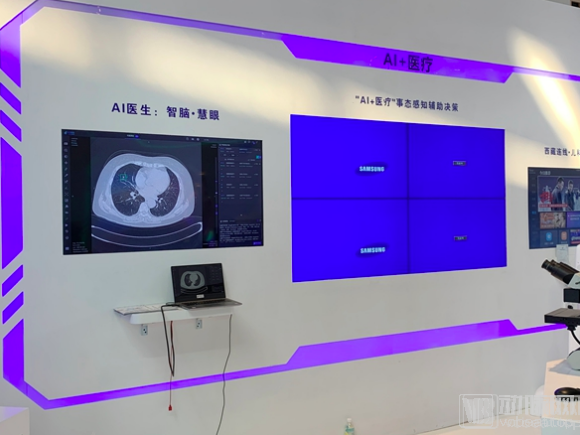
Deep Thinking Booth
Hospitals Emerge as New Service Scenarios
Artificial intelligence, as a technology, is also being continuously integrated into diverse medical application scenarios.
In the internet hospital scenario of Ping An Good Doctor, artificial intelligence plays two roles: first, it collects effective patient information by automatically inquiring about physiological indicators and disease characteristics to gather key data for triage and patient routing; second, it provides intelligent diagnostic recommendations using knowledge graphs.

Ping An Good Doctor Booth
The underlying technological support comes from Ping An Good Doctor’s “AI Doctor” assisted diagnosis and treatment system. This AI-assisted system has been deployed across Ping An Good Doctor’s in-house medical team, all clinical departments, and nearly 150 offline hospitals, covering more than 3,000 diseases. It continues to be optimized through training on Ping An Good Doctor’s vast dataset of over 350 million consultation records.
Tencent has developed Tencent Mijue for hospital management, supporting intelligent decision-making in hospitals. With this technology, hospitals can gain an intuitive, three-dimensional view of the distribution of medical staff and patients, as well as manage property operations. It visually presents data such as elevator operational status and occupancy rates. In the event of emergencies, resources can be rapidly and effectively allocated. Additionally, the Medical Technology Observation Center helps safeguard network assets, protecting hospitals from cyberattack threats.
Wanda Information targets major, high-prevalence chronic diseases to enable chronic disease screening and management for large-scale populations. By leveraging key common technologies such as image recognition and multimodal fusion, the company has developed AI-assisted modules—including end-to-end population screening, intelligent high-risk early warning, and intelligent voice-based health management—to facilitate early detection, prevention, and treatment. Its services currently cover the entire city of Shanghai and multiple other cities across China.
Research Big Data Platform
At the event, reporters also observed that multiple companies have deployed scientific research big data platforms. Their primary function is to structure electronic medical record (EMR) data, thereby facilitating clinical research and innovation by physicians.
Taking the first intelligent clinical research disease-specific database for lung cancer in China, jointly released by Yitu and West China Hospital, as an example, this database aggregates full-cycle data from over 20,000 lung cancer patients, more than one million clinical reports, and tens of millions of raw medical images.
"Establishing a big data platform through structured data to empower scientific research is the first step; Yitu is also exploring intelligent auxiliary diagnosis based on electronic medical records."
Yitu’s intelligent diagnostic system, primarily based on natural language processing (NLP) technology, deep learning, and medical knowledge graphs, deconstructs clinical electronic medical record data to create an intelligent disease database, which serves as the foundation for building auxiliary diagnostic models. In a collaborative paper with Guangzhou Women and Children’s Medical Center, Yitu reported that its auxiliary diagnostic system covers 55 pediatric diseases, achieving a median accuracy of 90%.
It has been learned that Senyi Intelligence is also integrating in-hospital data related to the full disease course with out-of-hospital follow-up data. By leveraging a medical natural language processing engine, the company achieves refined governance and efficient transformation of research data, thereby establishing a big data center for scientific research. Additionally, it provides various intelligent research tools to enhance the efficiency of clinical research and accelerate discipline development. At the current Artificial Intelligence Conference, Senyi Intelligence joined the Shanghai Kunpeng Ecosystem Alliance established by Huawei.
Other Applications in Innovation Hubs
Ping An Health Insurance Technology’s AI for Insurance Risk Control. On-site, VCBeat learned that Ping An Health Insurance Technology’s AI products fall into four major categories: health insurance risk control, prescription review, automated medical invoice recognition, and primary care mobile health clinics.
Due to the limited availability of medical data, health insurance risk control requires a deep understanding of diseases, pharmaceuticals, and clinical workflows, making it a highly challenging task. Ping An Health Insurance Technology has primarily deployed its “Ping An Eagle Eye” system, which is based on “rule-based auditing + big data risk control.” This system helps curb fraud, waste, and abuse of health insurance funds, reduces healthcare costs, and improves patients’ medical experience. It has already been implemented in several cities. Additionally, medical receipt recognition leverages OCR (Optical Character Recognition) technology to enhance claims processing efficiency and reduce labor costs for insurance companies.
AI applications in medical imaging have flourished, but few companies exhibited products for on-site use in biopharmaceuticals. At the event, VCBeat observed that AI applications in biopharmaceuticals appeared in a corner of Yitu’s booth, with limited information displayed. It is understood that Yitu’s expansion into AI-driven biopharmaceuticals is primarily led by its New York branch.
In addition, at the Amazon booth, reporters also found products applied to medical image processing, NGS data processing, and NLP-based clinical information processing, as well as clinical big data modeling and visualization applications.
It is reported that Amazon is not currently developing models specifically for the healthcare vertical; instead, it provides algorithms and underlying infrastructure to industry clients.
Overall, the companies participating in this exhibition are no longer exclusively composed of health informatics and AI imaging firms. The participation of Ping An Good Doctor, Ping An Health Technology, Amazon, and other enterprises has enriched the entire AI healthcare ecosystem. Looking ahead, which area will be the first to achieve practical implementation—new drug development, chronic disease management, or computer-aided diagnosis? Perhaps you already have your own answer.