

Deepwise Medical Advances to Final of 2019 Global Data Intelligence Competition Among 1,635 Teams, Showcasing Multi-Disease AI Diagnostic Innovation

DeepWise
Developer of Artificial Intelligence Medical Imaging Diagnosis System
At the recently held Global Data Intelligence Competition (2019), DeepWise stood out from 1,635 teams and advanced to the finals with first-place finishes in both the preliminary and semifinal rounds.
China bears a significant burden of pulmonary diseases, with high global incidence rates for pneumonia and lung cancer. Pulmonary conditions are diverse; in addition to lung cancer, they include chronic obstructive pulmonary disease (COPD), tuberculosis, and emphysema, all of which can lead to various complications. However, current AI applications in chest CT imaging are limited to the automated screening of a single condition—pulmonary nodules—while other pulmonary diseases still require manual diagnosis by physicians. With the advancement and widespread adoption of artificial intelligence, expanding AI applications from single-disease detection to multi-disease detection within a single anatomical region will yield products that better align with clinical needs and truly address the demands of clinical diagnosis effectively.
To better leverage new technologies to assist in the detection of multiple diseases via lung CT scans, the 2019 Global Data Intelligence Competition was launched on the Alibaba Tianchi platform. VCBeat (WeChat ID: vcbeat) has learned that this year’s competition was hosted by the People’s Government of Guangxi Zhuang Autonomous Region and organized by the Big Data Development Bureau of Guangxi Zhuang Autonomous Region. It attracted a total of 1,635 teams from around the world, including well-known enterprises and universities both domestically and internationally. This year’s “Digital Human” track aims to solicit outstanding artificial intelligence solutions from research teams worldwide, fostering collaborative discussions on intelligent diagnosis of multiple diseases in lung CT imaging, pooling collective expertise to contribute insights and strategies for the development of digital healthcare.
This competition, built upon the task of pulmonary nodule detection, challenges participants to address the more complex and clinically significant issue of comprehensive intelligent diagnosis and treatment for various lung diseases. The competition consists of three stages: the preliminary round, the semi-final, and the final. In both the preliminary round and the semi-final, participating teams are required to propose and integrate artificial intelligence algorithms, such as object detection and deep learning, to localize and identify pulmonary nodules, fibrous streaks, arterial hardening or calcification, and calcified lymph nodes, with their performance evaluated through online benchmarking.
The preliminary round is divided into Leaderboard A and Leaderboard B. Leaderboard B allows only two evaluation attempts, with the results serving as the final score for the preliminary round. The semi-final round provides five evaluation attempts, with the highest score taken as the final result. Based on the semi-final results, the top six teams in terms of algorithmic performance will be selected to participate in the final defense, competing for the championship title.
Currently, both the preliminary and semi-final rounds, which used algorithm performance as the evaluation metric, have concluded. The technical team from DeepWise Research Institute secured first place in both the A/B leaderboards of the preliminary round and the semi-final round with a decisive advantage. DeepWise’s competition team was led by Dr. Wu Zifeng, Principal Investigator at DeepWise Research Institute, under the guidance of Chief Scientist Professor Yu Yizhou. The team also included three doctoral researchers specializing in AI-based diagnosis of comprehensive pulmonary diseases and one master’s intern.
Dr. Wu earned his Ph.D. in Pattern Recognition from the Institute of Automation, Chinese Academy of Sciences, and subsequently conducted postdoctoral research at the University of Adelaide in Australia. During his academic career, Dr. Wu participated extensively in various domestic and international machine learning competitions, achieving outstanding results. In 2013, he secured first place in the Human Parsing Competition hosted by Baidu and received a Special Award as the only team utilizing deep learning at the time. He then competed in the ImageNet Challenge for consecutive years, ranking fourth in object detection in both 2014 and 2015, and second in scene parsing in 2016. In recent years, Dr. Wu has shifted his focus to the healthcare industry. In 2018, he participated in medical imaging challenges organized by MICCAI, winning first place in multiple tracks, including fundus image segmentation and nuclei segmentation. Furthermore, Dr. Wu has published numerous influential academic papers in the fields of computer vision and pattern recognition.
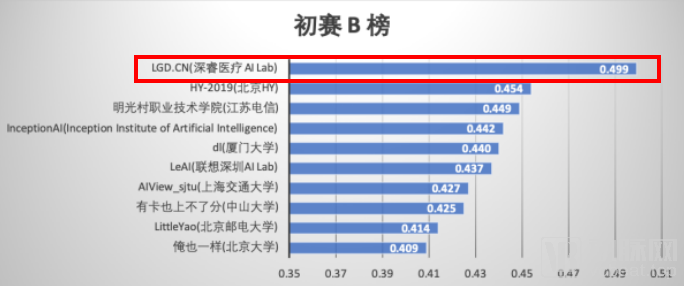
Preliminary Round B-Leaderboard: DeepWise Takes a Substantial Lead
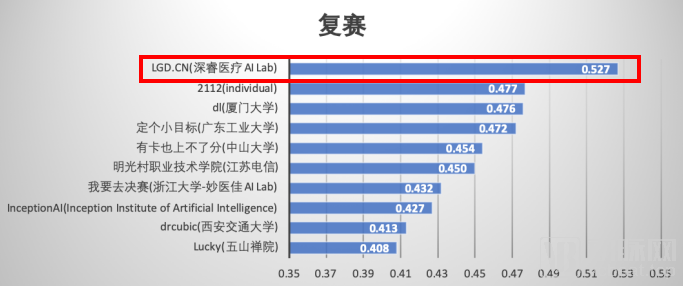
Semifinal Results: DeepWise Leads by a Wide Margin
Deepwise AI Lab is one of the largest research institutions in the industry dedicated to artificial intelligence in healthcare. Under the leadership of Chief Scientist Professor Yizhou Yu, the lab has assembled a team of talents from renowned domestic and international universities and institutions, including Stanford University, the University of Adelaide, the University of Hong Kong, Peking University, and the Chinese Academy of Sciences, to explore frontier medical technologies. Over the past two years since its establishment, the lab has achieved remarkable results in technological innovation and clinical implementation, producing numerous scientific outcomes that combine clinical value with technological innovativeness, which have been successively accepted by top-tier international journals and conferences.
To date, the DeepWise Research Institute has published more than 30 papers in top-tier journals and conferences on artificial intelligence and machine learning, such as TPAMI, TCyb, ICML, CVPR, ICCV, ECCV, and AAAI. These publications cover the three premier international conferences in the fields of computer vision and pattern recognition. Notably, the institute has presented academic achievements at the highly prestigious CVPR conference (ranked in the Top 10 of Google’s 2019 Academic Rankings) for two consecutive years, placing it among the leading technology companies in China’s AI sector. Meanwhile, in the field of medical image computing and analysis, the institute has published nearly 20 papers at top conferences such as IPMI, MICCAI, ISBI, RSNA, and ECR. The results achieved in this competition further underscore the institute’s robust technical capabilities.
DeepWise’s strong performance in this competition is attributable not only to its formidable lineup but also to its extensive accumulated expertise. Beyond its strengths in talent and technology, the research institute places significant emphasis on the clinical implementation of algorithms, providing robust support to the company. Its developed products are currently deployed in over 400 hospitals across China.
At the 28th China International Medical Equipment Exhibition and Technology Exchange (Hospeq), hosted this year by the International Exchange and Cooperation Center of the National Health Commission and the Chinese Hospital Association, DeepWise unveiled the industry’s first AI-powered imaging system for comprehensive whole-lung analysis, capable of detecting multiple diseases within a single organ.
This system has revolutionized the current landscape of AI applications in chest CT, which have been largely confined to automated screening for pulmonary nodules, leaving the diagnosis of other lung diseases heavily reliant on manual interpretation by physicians. It expands AI utility from single-disease detection to multi-disease assessment across the entire lung within a single anatomical region. This encompasses conditions such as inflammation, nodules, tumors, emphysema, bullae, pleural effusion, and fractures, while also supporting end-to-end diagnostic and therapeutic management, including qualitative diagnosis, quantitative analysis, multi-timepoint follow-up, and standardized structured reporting.
Currently, AI-assisted medical diagnostic products for the lungs are limited to the detection of pulmonary nodules. In real-world hospital settings, mere detection cannot effectively address clinical diagnostic needs in a meaningful way. The launch of the Dr.Wise® Whole-Lung AI-Assisted Medical Diagnostic System marks the formal entry of chest CT AI-assisted diagnosis into the era of comprehensive whole-lung assistance. Furthermore, when integrated with DeepWise’s Dr.Wise® Chest X-ray AI-Assisted Medical Diagnostic System—which detects and diagnoses over 30 signs across five major categories—it provides hospitals with a full-cycle solution for thoracic diseases, covering screening, diagnosis, and follow-up across various clinical scenarios.
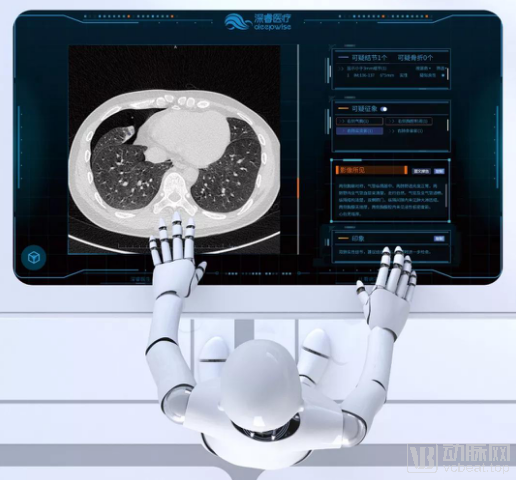
Dr.Wise® AI-Assisted Diagnostic System for Whole-Lung Imaging
As a key initiative of this year’s Guangxi-ASEAN Artificial Intelligence Summit, the finals of the Global Data Intelligence Competition (2019) will be held in Nanning, Guangxi, on September 7. Building on their outstanding performance as top winners in both the preliminary and semi-final rounds, the team from DeepWise Research Institute is expected to fully showcase their capabilities during the final defense and achieve excellent results.