

DingTalk Aims to Become the Digital Infrastructure for Internet Healthcare 2.0, Connecting Over 3,000 Hospitals and 300,000 Doctors
In January 2015, Alibaba officially launched DingTalk—a multi-platform solution specifically designed by Alibaba for internal communication and collaboration within Chinese enterprises. By precisely addressing key pain points faced by businesses, DingTalk rapidly gained widespread adoption across China, becoming an essential tool for professionals in the workplace.
By June 2019, DingTalk’s user base had surpassed 200 million, with the number of enterprise organizations exceeding 10 million. Its active users ranked first in the intelligent mobile office sector, surpassing the combined total of active users from the second through tenth places. Meanwhile, DingTalk’s services covered all primary and secondary industry sectors, encompassing enterprises of all sizes, from super-large corporations to micro-enterprises. At this point, DingTalk had become the preferred choice for intelligent mobile office solutions.
With such a massive user base and comprehensive market penetration, DingTalk logically began to implement its segmentation strategy. In August 2018, during the first Smart China Expo in Chongqing, DingTalk released a full suite of digital solutions tailored for five major vertical industries, formally announcing its entry into segmented industry markets, with healthcare undoubtedly becoming a key focus.
After a year of intensive development, DingTalk has delivered an impressive performance record. At the recently held 2019 China Hospital Information Network Conference (CHIMA 2019), DingTalk and VCBeat (WeChat ID: vcbeat) jointly hosted the “2019 DingTalk Future Hospital New Ecosystem Forum,” where it announced its achievements over the past year in the healthcare sector: In 2018, DingTalk entered more than 3,000 public hospitals at Level II and above, while 300,000 physicians began using the platform.

Wang Hongshuai (alias: Ye Shi), Director of the Healthcare Industry at Alibaba DingTalk
Wang Hongshuai (alias: Ye Shi), Director of the Healthcare Industry at Alibaba’s DingTalk division, who oversees DingTalk’s healthcare business, is a straightforward and forthright individual. Having dedicated five years to deepening expertise in the healthcare sector, he represents an atypical case within Alibaba’s healthcare unit, which has seen frequent personnel changes. “Alibaba’s corporate culture of ‘embracing change’ has led our healthcare business to evolve rapidly. In reality, healthcare is a distinctive industry where meaningful achievements are difficult without substantial accumulated experience,” said Wang Hongshuai, adhering to the principle of “doing the right thing.” He openly acknowledged certain shortcomings in Alibaba’s earlier development of its healthcare business.
So, how did Alibaba’s DingTalk win over clients in the healthcare industry over the past year? VCBeat (WeChat ID: vcbeat) interviewed Wang Hongshuai, Alibaba’s Healthcare Industry Director, and has compiled the following insights.
DingTalk is the cornerstone supporting five online services.
Positioned as a foundational mobile work platform, DingTalk has undergone continuous adjustments and ultimately chose to provide services for all common corporate office scenarios, including attendance tracking, meetings, document management, and approval workflows. It has structured its product offerings into the “Five Online” framework, aiming to enhance organizational capabilities within enterprises. This design philosophy has proven effective in addressing corporate pain points in practice. For hospitals, these remain significant challenges.
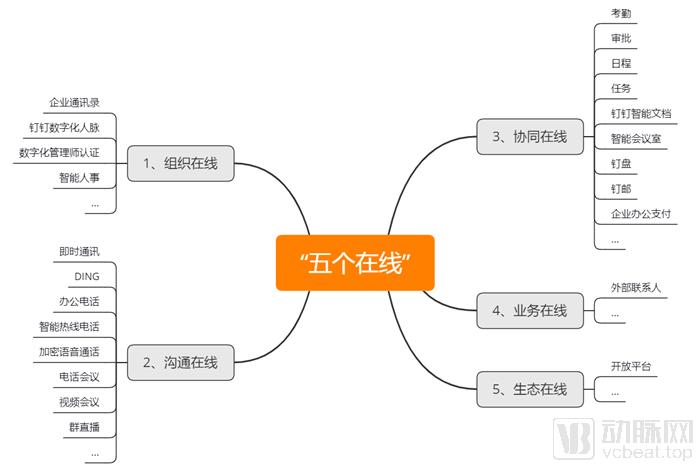
Of course, hospitals require more than just informatization; they need future-oriented digital transformation. Addressing the specific needs of the healthcare industry, DingTalk has further enhanced its platform to build a digital infrastructure for hospitals and empower the healthcare sector through its “Five Online” capabilities.
Organization Online
“Organization Online” means full staff connectivity, providing a clear overview of the entire organizational structure. It leverages new digital business cards to comprehensively improve the efficiency of physician consultations. Based on Wang Hongshuai’s years of tracking hospitals, he believes that there are two core elements in hospital organizations: the first is physicians, and the second is the digitization of medical data.
In particular, online physician services are critical; if all hospital-based physicians were to go online, the resulting quantitative shift would trigger a qualitative transformation, producing unexpected synergistic effects. Among industry players, Haodifu stands out for its strong performance in this area, yet it currently hosts only 210,000 online physicians—a small fraction of the 3.5 million registered physicians nationwide. Therefore, physician online presence is the core element of digitalization.
By deploying DingTalk, hospitals can rapidly bring all physicians online. Unlike applications such as Haodf, DingTalk does not face the so-called conflict between hospitals and online platforms. Consequently, market entry into healthcare institutions is significantly easier. By the end of 2018, DingTalk already had 300,000 physicians online. In 2019, DingTalk was poised to reach a scale of one million online physicians, with the ambitious vision of achieving full physician online presence in the coming years.
According to Wang Hongshuai, DingTalk will develop corresponding applications in the future to enable physicians to increase their frequency of use and expand application scenarios. Leveraging DingTalk’s large user base, this initiative is expected to have a significant impact on the existing landscape.
Communication Online
DingTalk enables a flat and transparent communication model, fostering a more open and positive hospital culture, encouraging employee engagement, and simplifying management. Meanwhile, its professional group categorization facilitates closed-loop departmental management and makes collaborative consultations more efficient and convenient.
Wang Hongshuai illustrated this by highlighting the changes at The First Affiliated Hospital, Zhejiang University School of Medicine (FAHZU), before and after the deployment of DingTalk. Among FAHZU’s staff, DingTalk’s Work Circle is highly popular. With over 7,000 employees across the entire organization, content posted in the Work Circle is visible to all members of the institution.
As colleagues, DingTalk is well-suited for sharing work-related content. For instance, it can highlight a department’s successful completion of complex surgeries, receipt of major awards, or positive patient feedback. Doctors at Zhejiang University School of Medicine Affiliated Hospitals have gradually discovered that even colleagues they do not personally know may reach out to discuss professional matters, giving them a strong sense of accomplishment. At times, they may also notice likes from their department directors or even the hospital president. This fosters increasingly transparent communication across the organization, allowing excellence to be recognized. As a result, employees naturally become more positive and proactive.
A flat organizational structure combined with transparent communication has made the Work Circle a cornerstone of corporate culture building at The First Affiliated Hospital, Zhejiang University School of Medicine. A positive shift in the underlying corporate culture—welcomed by management—has taken place, demonstrating the value of DingTalk’s online communication platform.
Collaborative Online
By leveraging DingTalk, the collaborative efficiency of the entire organization can be significantly enhanced, comprehensively addressing both macro and micro operational loops. This leads to across-the-board improvements in administrative office efficiency, while bidirectional patient referrals and remote consultations between hospitals boost the effectiveness of medical consortia, thereby alleviating the shortage of medical resources.
Wang Hongshuai believes that hospitals are effectively divided into two parts: clinical operations and administrative offices. DingTalk’s online collaboration tools can help all administrative staff achieve digital transformation. In the past, notifications were typically distributed in paper form. With comprehensive digitization through DingTalk, office expenses can be reduced. Meanwhile, DingTalk’s “DING” feature ensures that administrative notices are effectively delivered to everyone, significantly improving efficiency.
Online Business
"Online clinical services" refer to the comprehensive digitization of clinical operations, enabling hospitals and physicians to overcome spatial constraints and maximize the efficiency of medical resource utilization. In particular, AI-assisted diagnostic and therapeutic products, powered by data analytics, can significantly enhance physicians' overall productivity.
In Wang Hongshuai’s vision, DingTalk can help hospitals rapidly build a digital foundation by providing free, high-frequency services for organizational online presence, communication, and collaboration. As user habits are formed and the DingTalk-based digital foundation is established, hospital users will no longer tolerate an information technology landscape that remains fragmented as it was in the past. DingTalk will naturally serve as an integrated entry point; subsequently, bringing business operations online—such as daily reports for hospital directors, mobile ward rounds, and remote multidisciplinary team (MDT) consultations—will seamlessly integrate with the hospital’s existing information systems.
DingTalk’s development at the application layer will subsequently help drive explosive growth in online business operations. Wang Hongshuai believes that high-frequency applications foster user stickiness—the better the user experience, the stronger users’ dependence on the product. Taking Alipay as an example, it initially served merely as a third-party payment platform. As user stickiness increased, Alipay gradually integrated many other types of applications. Today, Alipay has evolved into a cross-application platform.
Therefore, Wang Hongshuai candidly admitted that achieving online business operations in hospitals through DingTalk is not a short-term endeavor. Meanwhile, DingTalk itself should not be responsible for developing the specific applications required for such online operations; instead, this task should be entrusted to the entire ecosystem. The primary focus for DingTalk at present is optimizing product experience to enhance user stickiness.
Ecology Online
DingTalk’s vision for an online ecosystem is to achieve full-lifecycle health management and health early warning by comprehensively driving the upstream and downstream segments of the industry chain, including pharmaceutical companies, pharmacies, insurance providers, primary healthcare institutions, genetic testing firms, and patients.
Over the course of several years, Wang Hongshuai observed that internet healthcare initiatives have largely focused on consumer-facing services, while industry-specific operations remain dominated by traditional companies, with little involvement from internet firms. This context makes it easier to understand why DingTalk has entered this space. After several years of development, DingTalk has effectively established a new digital infrastructure for internet hospitals.
Regarding specific business details, as previously mentioned, DingTalk aims to collaborate with upstream and downstream partners to jointly build an industrial ecosystem. Lianfan Technology serves as a prominent case in point. Specializing in hospital nursing systems, the company previously capped its annual business volume at 20 hospitals. By chance, following customer suggestions, Lianfan Technology integrated its system into DingTalk and decomposed its nursing system into more than 30 modules. After a period of trial use, Lianfan Technology found that the nurse scheduling module had become an essential need for hospitals, featuring broad coverage and high-frequency usage. Consequently, Lianfan Technology optimized this module separately and integrated it into DingTalk as a SaaS product.
Within just one year, this module was rapidly adopted by 3,000 hospitals, one-third of which were large Grade-A tertiary hospitals. This free module also drove sales of Lianfan Technology’s other paid offerings, doubling the company’s revenue last year. This success gave Lianfan Technology considerable confidence and spurred the sequential development of additional application modules. Although its business direction has remained unchanged—continuing to focus primarily on software solutions—Lianfan Technology’s SaaS model, leveraged through the DingTalk platform, is clearly more competitive than the traditional models employed by its rivals. Wang Hongshuai is highly confident in this approach: “Once DingTalk has deeply penetrated the majority of hospitals in China, and Lianfan Technology captures 60%–70% of that market, will it not become China’s largest online nursing platform? Would that not open up entirely new possibilities?”
DingTalk boasts a vast network of service providers that leverage its platform to implement solutions in hospitals. In turn, exceptional providers enhance hospital users’ stickiness to DingTalk by effectively addressing their pain points. This mutually reinforcing relationship embodies the “ecosystem online” model that DingTalk aims to achieve.
Starting with the “Five Online” initiatives, DingTalk has been steadily strengthening its foundation. As DingTalk continues to make significant inroads into hospitals and play an increasingly vital role, it will undoubtedly assume a more prominent position in the future advancement of healthcare informatization. At that point, we will realize that DingTalk’s ambition to become the “digital infrastructure for the Internet Healthcare 2.0 era” is far more than just a slogan. The only question that remains is how it will integrate Alibaba’s healthcare ecosystem. We will wait and see.