

Wanjia TCM Reports 4,800 Monthly Orders: What Sets Its Digital Herbal Supply Chain Platform Apart?
Traditional Chinese medicine is profound and extensive. Outsiders often fail to grasp its intricacies, while insiders are well aware of its many nuances. Taking upstream suppliers of Chinese herbal medicines as an example, they include scattered herbal farmers, planting bases, and major herbal medicine hubs, with significant variations in price and quality. Without unified standards, a centralized platform, or third-party quality certification mechanisms, issues such as “passing off inferior products as premium” and “exorbitant pricing” are likely to arise.
In 2017, Wanjia TCM was established, dedicated to providing an internet-based supply chain service platform for traditional Chinese medicine (TCM) to TCM practitioners, medical institutions, and other stakeholders in the TCM distribution sector. The platform aims to address information asymmetry regarding the quality and pricing of TCM materials, as well as to ensure a relatively standardized supply of TCM formulations. Through the platform’s quality control system for TCM materials, it guarantees the quality of TCM products while ensuring price transparency. On the platform, data flows replace physical material flows, facilitating order processing and improving efficiency. Additionally, TCM formulations are supplied as standardized products, with semi-processed herbal slices manufactured into standard TCM formulations.
VCBeat (WeChat ID: vcbeat) has learned that, as of July 2019, Wanjia TCM had cumulatively certified 5,200 traditional Chinese medicine (TCM) physicians, with the number of doctors increasing by approximately 10% month on month. In July this year, the monthly number of orders reached 4,800.
According to the statistical communiqués issued by the National Health and Family Planning Commission from 2015 to 2018, the compound annual growth rate (CAGR) of the traditional Chinese medicine (TCM) circulation market reached 13.9% during this period, with its market size attaining RMB 360 billion by the end of 2018. From 2015 to 2018, the number of TCM consultations increased year on year, rising from 910 million to 1.07 billion visits. Meanwhile, the proportion of TCM consultations in total medical consultations also increased annually, reaching 12.88% by the end of 2018.
The development of the traditional Chinese medicine (TCM) sector has driven prosperity across its upstream and downstream industrial chains. In 2016, Zhou Lanjun was still an entrepreneur in the field of internet-based chronic disease management. Inspired by the needs of a friend who was a TCM expert, he began to focus on the internet-enabled TCM industry. Recalling his early experiences over the phone, Zhou mentioned that for a long period previously, he had been engaged in marketing and sales of traditional pharmaceuticals and medical devices. In 2013, he founded Shanghai Chuanqi Pharmaceutical Technology Co., Ltd., leading his team to serve as a hospital supplier for traditional pharmaceuticals and medical devices. In 2015, with the rise of the internet, he began to transition into internet-based chronic disease management.
“Chronic diseases are closely linked to Traditional Chinese Medicine (TCM). After hearing insights from a TCM expert, I spent over six months researching the TCM market. Leveraging my prior experience and personal disposition, I decided to establish Wanjia TCM,” said Zhou Lanjun. “My previous chronic disease management project served as a transition and valuable learning experience from traditional healthcare to internet-based healthcare, deepening my understanding of the latter. The decision to focus on the TCM sector was primarily driven by the recognition of significant pain points and substantial unmet needs within the industry, which can be addressed through internet-enabled solutions. Additionally, the sector offers considerable growth potential and a long development cycle.”
Leveraging the demand for TCM experts, Wanjia TCM initially developed tools for TCM prescription and follow-up consultations. It was not until the end of 2018 that Wanjia TCM officially shifted its focus to building a supply chain service platform for traditional Chinese medicine (TCM) decoction pieces. “This decision was primarily driven by the essential demand for TCM herbal materials, which are easier to standardize and replicate compared to TCM medical services. The sector is characterized by low industry concentration and a high growth ceiling, creating an urgent need for data-driven supply chain integration to reduce costs and improve efficiency.”
The traditional supply chain for Traditional Chinese Medicine (TCM) flows from suppliers to medical institutions, then to decoction and dispensing centers, and finally to patients, with each link presenting its own pain points. For TCM suppliers, challenges include a fragmented customer base and high supply chain management costs. For TCM medical institutions, the high costs associated with procuring and managing TCM materials, as well as the expenses of customizing prescriptions for individual patients, pose significant burdens. For decoction and dispensing centers, issues include inconsistent quality control, limited capacity for personalized services, and low levels of scale and brand development. For patients, the process of collecting and decocting herbal medicines is time-consuming and labor-intensive.
Addressing these pain points, Wanjia TCM has restructured its supply chain to empower upstream and downstream partners through scaled transactions, the provision of products and distribution services, and the establishment of a quality control system for traditional Chinese medicinal materials.
For TCM distributors and consumer patients within the industrial chain, the demand is not for individual TCM decoction pieces one by one. However, current supply models still largely involve bulk procurement of hundreds of TCM medicinal materials or require maintaining inventory of hundreds of such materials. In practice, TCM practitioners prescribe personalized formulas for each patient, necessitating manual dispensing based on individual prescriptions.
Since traditional Chinese medicine (TCM) decoction pieces cannot be taken directly and are considered semi-finished products, most TCM medicinal materials require professional services such as decoction, pill preparation, or paste formulation. This process is equivalent to pharmaceutical manufacturing, necessitating scaled and transparent professional services.
Wanjia TCM’s supply chain model can convert prescription demands from doctors, medical institutions, and third-party platforms into standardized order data. Leveraging data flows to replace the physical flow of herbal materials is a major advantage of the internet, helping to reduce costs and improve efficiency in the circulation of traditional Chinese medicine (TCM). In addition, Wanjia TCM established offline clinics in February this year, known as multi-functional cloud pharmacies, which provide patients with services such as decoction preparation and home delivery.
During the process of upstream and downstream integration, Wanjia Traditional Chinese Medicine’s advantages in supply chain management have become evident. In establishing a shared cloud pharmacy system with platform-based physicians, it has successively entered into business collaborations with leading companies in the field of traditional Chinese medicinal materials, including Kangmei Pharmaceutical, Tongjuntang Pharmaceutical, Jiuhe Tang National Pharmacy, Huadong Medicine, China Traditional Chinese Medicine Granules, and Sanjiu Pharmaceutical. Over 90% of these partners are either time-honored brands or publicly listed companies.
Currently, Wanjia TCM has entered into strategic cooperation agreements with several traditional Chinese medicine (TCM) decoction and dispensing centers. Moving forward, Wanjia TCM will recruit quality control specialists, procurement professionals, pharmacists, and decoction staff with supply chain management experience through hiring and consultant engagements, to jointly improve the supply chain standard system.
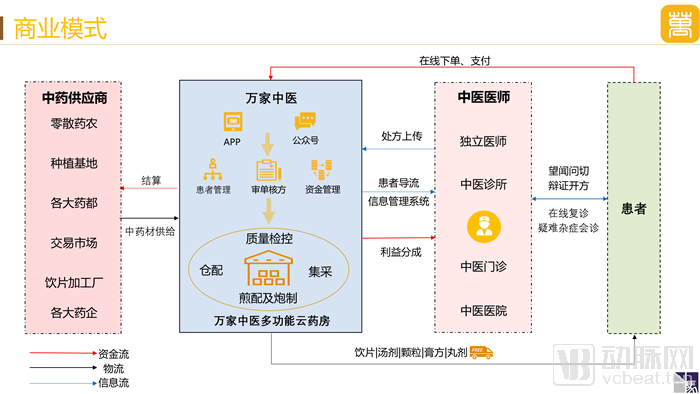
Wanjia TCM Business Model (Source: Provided by the Company)
Looking at the development history of Wanjia TCM, it has evolved from the initial Version 1.0 TCM prescription tool for physicians, to the Version 2.0 internet-based TCM follow-up consultation tool, and now to the Version 3.0 S2B2C (serving doctors and patients) platform for traditional Chinese medicine services. Although the product has been on the market for less than two years, it has undergone more than 50 upgrades and iterations, averaging one update every two weeks.
From physicians and medical institutions to pharmaceuticals, Wanjia TCM has gradually established a comprehensive service closed loop: The Wanjia TCM platform centrally aggregates upstream supplier resources and ensures quality control. Once medical institutions, pharmacies, physicians, or patients upload prescriptions to the platform, they undergo unified review, dispensing, decoction, and preparation, with the final products delivered directly to patients. Throughout this process, patients can connect directly with physicians via the platform if any issues arise, enabling physicians to conduct online follow-up consultations.
Regarding the team, the core members of the founding team possess dual expertise in both the pharmaceutical/medical and internet sectors. The founder, Zhou Lanjun, has nearly 20 years of professional experience spanning healthcare and the internet, and is a serial co-founder.
In terms of future planning, Wanjia TCM will focus on developing SaaS tools and platforms for the traditional Chinese medicine (TCM) supply chain, with a particular emphasis on a data-driven middle-office system for the TCM supply chain.
It is understood that Wanjia TCM is currently preparing for its Pre-A round of financing, having previously secured millions of yuan in angel investment from an investment subsidiary under Health Cloud.