

Professor Mi Jianqing: MM CAR-T Therapy — From Benchmark Treatment to Future Directions, Breakthroughs Reshaping the Clinical Landscape | 2026 CASH

Johnson & Johnson
Medical Device R&D and Manufacturer

Target Iteration, Third-Generation Technology, Synergistic Strategies……
Compiled by | Biyao
On January 10, the 6th Chinese Annual Symposium on Hematology (CASH) kicked off in Tianjin. As China's top academic event in the hematology field, this year’s conference, themed “Tianjin Opens New Horizons・Wisdom Leads the Future,” gathered over 600 authoritative experts from China and abroad. Through two main forums and 31 sub-forums, it comprehensively showcased cutting-edge advancements in fundamental research, clinical applications, and innovative transformations, empowering high-quality development within the discipline.
Professor Jianqing Mi from Ruijin Hospital, affiliated with Shanghai Jiao Tong University School of MedicineAt the Lymphoma/Myeloma Special Forum, a significant report titled "Advances and Future Trends in CAR-T Cell Therapy for Multiple Myeloma (MM)" was presented. From long-term survival data of clinical cases to iterative breakthroughs in target technology, and further to the outlook on future treatment directions, Professor Mi depicted the developmental trajectory and forward path of MM CAR-T therapy with profound expertise and a forward-looking perspective.
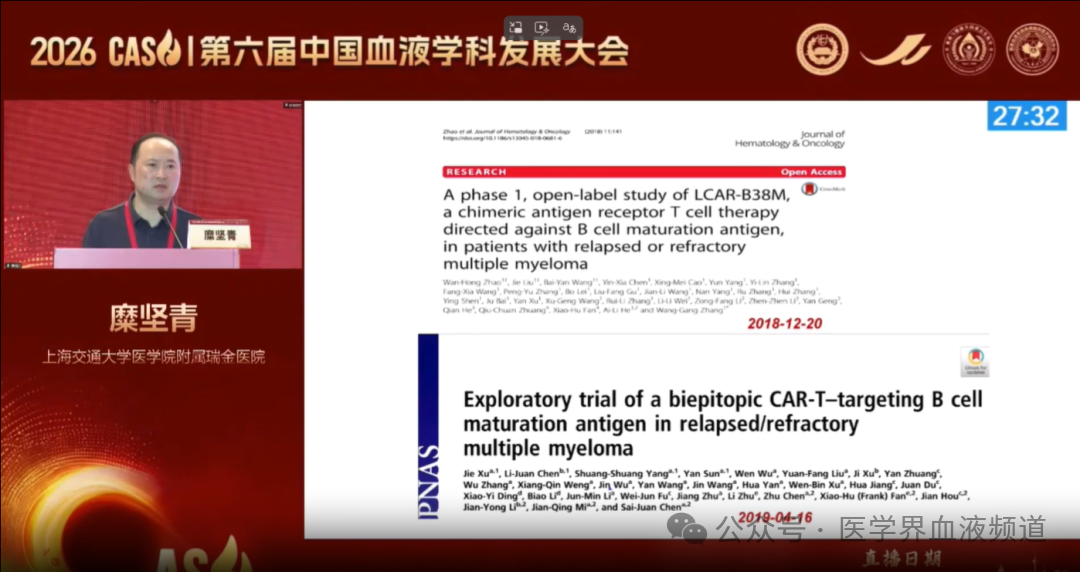
Speaking of the beginning of MM CAR-T treatment, Professor Mi recalled a special case—a patient diagnosed in 2009 who, after relapsing with refractory disease (R/R) in 2017, received CAR-T therapy and has remained relapse-free for nearly nine years, serving as a vivid testament to the potential of CAR-T therapy. "It is cases like this that make us believe CAR-T can help some patients achieve long-term survival and even break the困境 of multiple myeloma being difficult to cure."
From a global perspective, the emergence of CAR-T therapy cannot be separated from innovative breakthroughs. Professor Mi admitted that the BCMA target was first proposed by American scholars. Although its related products did not successfully reach the market, it pointed out the direction for the field. Meanwhile, Chinese scholars are unwilling to lag behind in this track.Professor Wanggang Zhang and Professor Aili He from the Second Affiliated Hospital of Xi'an Jiaotong UniversityThe team conducted the first BCMA CAR-T study in China under rudimentary conditions, becoming a pioneer of innovation in the country. Professor Mi once went to learn.
In the industrialization process, Chinese and foreign teams have achieved respective successes. The first BCMA CAR-T product launched in 2019 showed limited efficacy, whereas the product co-developed by a Chinese team and Johnson & Johnson was launched in 2022, becoming a benchmark for excellent efficacy and sales in the myeloma field. Within China,Professor Zhou JianfengLed the Nanjing Legend/Itorus Therapeutics team's research publication in a top journal, driving its product to become the first CAR-T drug approved for marketing in China;Technology PharmaceuticalsThe product has also been successfully approved, forming a pattern where two major listed products are advancing side by side.
Efficacy data confirms the development achievements. Joint follow-ups by Professor Mi's team and Professor He Aili's team showed that 14% of patients achieved sustained remission, with a median overall survival (OS) of 55.8 months, which is basically on par with 61.3 months reported in similar foreign studies, highlighting the clinical strength of CAR-T therapy in China. However, the 86% relapse rate also reveals the limitations of current treatments, posing an urgent challenge for subsequent research.
In response to the challenge of relapse after CAR-T therapy, the field has embarked on exploring target iteration and technical optimization, leading to diversified breakthrough directions.
GPRC5D Emerges as the Second Core Target. American researchers were the first to report an objective response rate (ORR) of 71% for its CAR-T therapy, while Chinese researchers quickly followed up and achieved surpassing results:Professor He Huang from the First Affiliated Hospital of Zhejiang University School of MedicineThe team reported in 2023 that the effective rate for 10 patients was 100%; Xuzhou Medical University simultaneously achieved significant progress.
To address the issue of murine-derived vectors easily inducing antibody reactions and recurrence, humanization has become a trend. Professor Dujuan’s team, in collaboration with Shanghai Tech Bio, reported on humanized GPRC5D CAR-T, which showed a 100% efficacy rate in nearly 20 patients with lower immunogenicity; Professor Mi's team, in cooperation with...Professor Chunrui Li from Tongji Hospital, Tongji Medical College, Huazhong University of Science and TechnologyCollaborative research achieved effectiveness in 6 out of 7 patients with BCMA CAR-T relapse, with a median progression-free survival (PFS) of 18 months, offering a new option for relapsed patients.
Dual-target Strategy Becomes a Key Path to Overcoming Relapse. Professor Huang He's team explored a single-vector dual-target design with an efficacy rate of 92%, but the survival period needs improvement; another team developed a dual-target CAR-T product that achieves preparation and infusion within three days, offering significant cost advantages. Although its safety still requires validation, it provides new insights for technological transformation.Xuzhou Medical UniversityThe team adopted a dual-vector dual-target approach,Professor Fu Zhengzheng from the First Affiliated Hospital of Soochow UniversityThe team adopted a comprehensive strategy of "transplantation + dual-target CAR-T + maintenance therapy" for patients with extramedullary lesions, demonstrating forward-thinking clinical reasoning.
Structural Optimization and Mechanism Research Provide Support for Enhanced Efficacy. Professor Mi emphasized that "structure is the key," and the superior efficacy of Nanjing Legend's product is attributed to its dual-antibody structural design, outperforming similar single-antibody products. In relapse mechanism research, core directions include biallelic gene deletion, epigenetic dysregulation, and antigen drift. Professor Mi's team discovered that CAR-T with PD-1 gene silencing demonstrated optimal efficacy in preclinical studies, with an over 85% response rate in 10 clinical patients, offering a new paradigm for combination therapy. Additionally, individual case experiences of radiotherapy followed by CAR-T treatment in patients with extramedullary lesions provide a reference for treating special populations.
Professor Mi pointed out that CAR-T treatment will focus on three major directions in the next five years: the development of third-generation products, breakthroughs in universal technology, and optimization of treatment strategies, driving the field into a new phase.
The Optimization Path of Third-Generation CAR-T: Full of Challenges and Hope
Universal CAR-T Provides a Solution to the Challenges of Autologous Cell Preparation. Current research shows that universal CAR-T has an efficacy rate of 55.8% in 24 patients, with the high-dose group reaching 70.8%, albeit with a higher risk of infection. Professor Mi's team explored umbilical cord blood-derived universal CAR-T, which benefits from low immunogenicity and strong expansion capabilities of naïve T cells. Among seven patients, one achieved complete remission (CR), one very good partial remission (VGPR), and one partial response (PR), demonstrating good safety and offering a new pathway for technical optimization.
In Vivo Induced CAR-T Becomes a Technological Innovation Hotspot.Wuhan Union HospitalThe team was the first to publish research on in vivo induction of CAR-T cells in top international journals. By using viral or magnetic particle vectors to generate CAR-T cells in vivo, they simplified the preparation process. Their product has achieved technological transformation, marking a significant breakthrough by Chinese scholars in this field.
The synergistic application strategy of CAR-T and bispecific antibodies is becoming increasingly clear. Clinical data shows that CAR-T is superior to bispecific antibodies in terms of remission depth, with a longer median OS; whereas bispecific antibodies have the advantages of being readily available and fast-acting, making them suitable for critically ill patients. Professor Mi proposed the concept of "dialectical combination use": prioritize the use of CAR-T for suitable patients to achieve deep remission, and then use bispecific antibodies for salvage treatment upon relapse; for critically ill patients, bispecific antibodies can first be used to control the condition, followed by sequential CAR-T therapy, optimizing timing to maximize patient survival.
Professor Mi Jianqing emphasized in the summary that BCMA CAR-T has become the benchmark treatment for R/R MM, and GPRC5D CAR-T is expected to become a key target in the future. Innovations such as dual-target design, structural modifications, and universal technologies will continue to enhance the efficacy of CAR-T. In the future, through the rational combination of CAR-T with bispecific antibodies, the clinical translation of third-generation products, and further in-depth mechanistic research, MM treatment will gradually move towards precision and long-term effectiveness, bringing hope of a cure to more patients.
From the arduous exploration of the first case to the current flourishing of technologies, Chinese scholars in the MM CAR-T field have achieved a leap from catching up, to running neck-and-neck, and even leading in some areas. As Professor Mi said, on the path of scientific research, it is important to draw on advanced experiences while adhering to independent innovation; only by facing our shortcomings and focusing on meticulous efforts can we continue to advance on the road to conquering myeloma.

In order to understand the reading habits and interests of our fans and users, so as to provide more interesting, useful, and opinionated content, the medical communityTumorFrontierThe channel welcomes everyone to take a few seconds to complete the following survey ~ only five seconds!
Source: Hematology Channel of Medicine Circle
Editorial Responsibility:Cat
*"Medicine World" strives to ensure that its published content is professional and reliable, but does not guarantee the accuracy of the content; relevant parties should verify independently when adopting it or using it as a basis for decision-making.
