

DaXi Tech Files IPO Prospectus: Bringing Indoor Hospital Maps to Smartphones, Partnering with Over 100 Top Hospitals Including Peking Union and Beijing Tiantan
“Three hours waiting, three minutes consulting” has become a major pain point for most public hospitals. Noisy and overcrowded crowds, coupled with the need to queue multiple times for payment during a single visit, leave many patients physically and mentally exhausted. Furthermore, the complex internal layout and poor connectivity within hospital buildings make “finding one’s way” a significant challenge for patients seeking care.
To address this challenge, Beijing DAXI Technology Co. LTD (hereinafter referred to as “DAXI Technology”), established in September 2015, has developed an intelligent indoor 3D mapping and navigation system. This solution helps patients overcome difficulties with wayfinding, reduces consultation time, enhances hospital service efficiency, and lowers operational costs.
Headquartered in Zhongguancun, Beijing, DAXI Technology secured RMB 10 million in angel funding at its inception. As a professional provider of smart healthcare and location-based services, the company is dedicated to developing intelligent indoor 3D navigation technology to address wayfinding challenges in various indoor settings such as hospitals, railway stations, and exhibition centers, with a strategic focus on the healthcare sector.
Zhao Ke has been researching navigation technology for nearly two decades. The core team of Beijing DAXI Technology Co., LTD is composed of senior experts from former companies such as AutoNavi, NavInfo, and Alibaba, as well as seasoned professionals in healthcare informatization, bringing a profound understanding and insight into navigation services. Their prior professional experiences enabled the DAXI Technology team to early on recognize the opportunities presented by indoor navigation technology within hospital settings.
In 2014, while collaborating with colleagues on the “Future Hospital” project under Alipay, Zhao Ke identified significant pain points in hospital patient triage and guidance services.
Zhao Ke introduced that, according to third-party survey statistics, approximately one-third of outpatients in public hospitals visit the information desk or seek assistance from medical staff each day, with 42.6% of inquiries related to location and wayfinding.
Prior to founding the company, the team at Beijing DAXI Technology Co., LTD conducted a comprehensive analysis of the demand for indoor navigation across major industries in China. The decision to focus on the healthcare sector was driven by the fact that indoor navigation technology addresses a critical, non-negotiable need for hospitals. “In settings such as shopping malls or exhibition centers, navigation technology serves merely as an auxiliary tool,” said Zhao Ke. “Hospitals represent a unique social environment where time sensitivity is paramount.”
According to the "National Healthcare-Related Statistical Data from January to November 2018" released by the Statistical Information Center of the National Health Commission, there were 12,072 public hospitals in China in 2018, with approximately 2.76 billion patient visits during this period. The data indicates that the average annual number of patient visits per public hospital exceeded 100 million. Hospitals experience high patient traffic and significant population mobility. To maintain orderly medical services, hospitals have established triage desks, mobile posts, security personnel, and even volunteer programs. These measures not only require substantial manpower but also increase operational costs.
Pain points indicate direction, while favorable policies present opportunities. In April 2018, the National Health and Family Planning Commission issued the Standards and Specifications for Hospital Information Construction, which included indoor navigation. On August 1, 2019, the Graded Evaluation Standard System for Smart Hospital Services was officially launched, making “availability of an indoor navigation system” a criterion in the rating of smart hospitals.
Against this backdrop, the DAXI Technology Indoor 3D Map Intelligent Navigation System has begun to gain industry attention.
Beijing DAXI Technology Co. LTD leverages 3D navigation technology to bring hospital maps onto mobile devices. "Consultation Room Navigation" integrates with applications such as WeChat, Alipay, and hospital apps to guide patients through consultation messages and link their medical visit steps based on indoor navigation, thereby achieving self-service patient care.
First, the system automatically pushes the next-step visit instructions to the patient based on their medical visit information and the current stage of the visit, without requiring any input from the patient. Then, the navigation system automatically guides the patient to the appropriate department based on the destination specified in the visit instructions. Finally, upon arriving at the consultation area, the patient completes self-check-in using accurate positioning information.
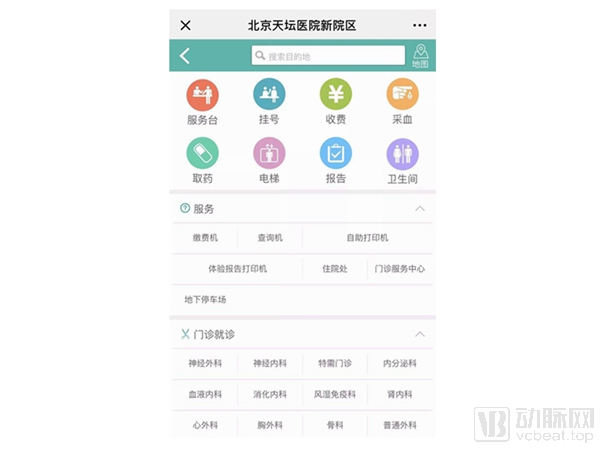
Example of DAXI Technology’s Indoor 3D Map Intelligent Navigation System (Image provided by the interviewee)
To facilitate quicker department searches for users, high-traffic locations (such as registration counters, payment kiosks, restrooms, and elevators) are prominently displayed on the app’s home screen. By clicking to automatically generate a route, users can directly view the specific locations of departments and facilities within the hospital. Zhao Ke explained that while traditional 2D maps struggle to represent the complex internal environment of hospitals, 3D maps can convey this information intuitively.
Beijing DAXI Technology Co. LTD creates one-to-one renderings based on the actual hospital environment, ensuring that objects displayed on the map correspond precisely to their real-world counterparts. To meet patients’ needs for location-based services, the system integrates multiple positioning technologies to achieve accurate, layered, and smooth localization. Leveraging a 3D perspective from high-definition indoor maps, the system provides patients with precise, real-time navigation to various locations within the hospital campus, thereby establishing a refined, intelligent, and patient-friendly in-hospital navigation service.
To accommodate elderly patients and users unable to operate smartphones, Beijing DAXI Technology Co. LTD has deployed intelligent triage kiosks in partner hospitals. Equipped with voice recognition capabilities, these kiosks allow users to specify their desired destination verbally. The system then highlights the location on the screen, displays the destination floor and surrounding facilities via a 3D map, and guides patients along the route using voice prompts and animated directions. Additionally, users can quickly query the locations of basic amenities and clinical departments through the kiosk, addressing high-frequency informational needs.
Notably, the triage kiosk supports expedited payment via medical insurance. Users can scan a code to pay on the kiosk, eliminating the need to queue for fee settlement. The kiosk enables real-time medical insurance settlement, addressing challenges associated with mobile payments. Currently, products from Beijing DAXI Technology Co., LTD have established partnerships with over one hundred hospitals, including Peking Union Medical College Hospital, Beijing Tiantan Hospital, Peking University Third Hospital, the First Affiliated Hospital of China Medical University, the Third Xiangya Hospital of Central South University, the First and Second Affiliated Hospitals of Wenzhou Medical University, Jiangsu Province People’s Hospital, and Henan Province People’s Hospital.
Zhao Ke told VCBeat that hospital navigation is merely the foundation of intelligent hospital services. Given the high volume and mobility of foot traffic in hospitals, a foundational system integrated with the Internet of Things (IoT) and various other systems—including outpatient, inpatient, and logistics—is required to unify the management of people, vehicles, and assets. This integration enables round-the-clock monitoring and efficiency optimization across all operational systems.
To this end, Beijing DAXI Technology Co. LTD is launching a new round of financing and seeking relevant partners and service providers in the hospital industry to expand its business scope, offering more extended services based on navigation services.