

SuitX Submits IPO Prospectus: FDA-Approved PHOENIX Exoskeleton Priced at Half of Competitors, Set for 2020 Market Launch

SuitX
Modular Exoskeleton Developer
Research on exoskeletons dates back to20Century60In the early years, it was first applied in the military field to enhance soldiers' load-bearing capacity. Subsequently, it gradually entered civilian applications, primarily in the medical and industrial production sectors.
Exoskeletons, as assistive devices, serve two primary functions in the medical field: first, to facilitate rehabilitation training for patients; and second, to restore mobility for individuals with disabilities. Currently, medical exoskeletons on the market predominantly focus on the first function, while ongoing research and development are directed toward enhancing control precision and flexibility.
Research on exoskeletons is still in its early stages in most countries, with relatively few commercial products available. Among them, the United States, Japan, Israel, and South Korea possess strong R&D capabilities. Representative companies include SuitX (US), ReWalk Robotics (Israel), EKSO Bionics (US), Cyberdyne (Japan), Parker Hannifin (US), and Hyundai Motor Group (South Korea).
How do exoskeleton robots assist patients in rehabilitation training? How do they help patients regain mobility? What does the future hold for exoskeleton robots? With these questions in mind, the reporter called Jack, the head of SuitX’s China region.
China’s rehabilitation industry is still in a developmental stage. In terms of public awareness, most patients do not regard rehabilitation as a necessary process. The rehabilitation workflow is also inadequate; after exiting the acute phase, most patients lack access to corresponding rehabilitation stages, resulting in high disability rates. Furthermore, the scarcity of rehabilitation therapists poses a major constraint on the development of China’s rehabilitation industry. Based on the number of stroke patients in China, over 400,000 rehabilitation therapists are needed, yet there are only approximately 20,000 practitioners in the field—a figure that is utterly insufficient to meet the demand.
Addressing the critical shortage of rehabilitation therapists, the emergence of exoskeleton robots has brought new hope to China’s rehabilitation industry. Robots do not suffer from fatigue, making them highly suitable for tasks that are highly repetitive and physically demanding.
During the rehabilitation process, patients require assistance from multiple physical therapists, resulting in significant labor consumption. In foreign countries with more severe aging populations and higher labor costs, there is likewise an urgent demand for robots.
Robots can be equipped with numerous sensors to achieve real-time monitoring of human physiological status. They can perform assessments without relying on the experience or knowledge background of rehabilitation therapists, and can be pre-loaded with diverse algorithms to provide intelligent training based on real-time data, thereby achieving better rehabilitation outcomes.
Since 2012, the Ministry of Science and Technology has issued special plans for the development of intelligent manufacturing technology, explicitly stating that priority should be given to developing technological products such as safety robots and medical rehabilitation robots. In 2015, the 13th Five-Year Plan for the Robotics Industry also indicated the need to achieve demonstrative applications of robots in key areas such as elderly and disability assistance, consumer services, and healthcare, while carrying out key tasks including breakthroughs in core components, development of frontier generic technologies, and application of medical rehabilitation robots.
Jack told reporters, “SuitX’s medical exoskeleton robot, PHOENIX, can help patients regain mobility, which represents a significant market. PHOENIX can also assist patients with rehabilitation training, and the robotic rehabilitation market is worth over RMB 10 billion.”
PHOENIX has received FDA approval, with its indicated population including patients with low-level paraplegia, stroke survivors with hemiplegia, individuals with multiple sclerosis, those with lower-limb joint injuries, elderly individuals with mobility impairments in the waist and legs, and patients requiring rehabilitative training. Jack introduced, “The original purpose behind the design of PHOENIX was to help paralyzed patients regain a certain degree of mobility, assist individuals with functional loss or limited mobility in restoring normal movement capabilities, and support patients who require rehabilitative exercise due to illness.”
So, how does PHOENIX help patients achieve the above goals? Jack introduced: “The entire PHOENIX unit weighs only 12 kilograms, with potential for further weight reduction; the future target is under 10 kilograms. The weight of PHOENIX is light enough to allow individuals with disabilities to don the exoskeleton independently.”
“The PHOENIX exoskeleton robot also adopts a modular design concept, providing modular exoskeleton components for patients with varying degrees of impairment. For instance, patients with hip or lumbar spine injuries need only wear the waist-and-hip exoskeleton component, while those with knee joint injuries require only the knee-joint exoskeleton component.”
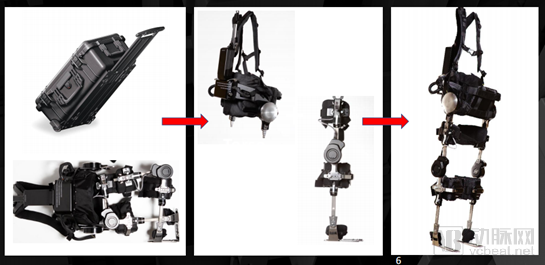
(PHOENIX Modular Design, Easy to Carry)
According to Jack, PHOENIX includes one hip module, two knee modules, and two foot modules. Users can use the modules individually or as a complete set, and adjust the height of PHOENIX and leg dimensions according to their individual needs. PHOENIX also comes with two crutches, allowing users to select modes such as walking, standing, or sitting based on their requirements.
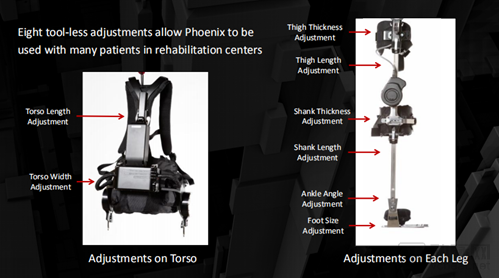
(Users can adjust PHOENIX according to their own conditions)
With the full set in use, users can wear PHOENIX and walk continuously for 4 hours after a full charge; for daily use, PHOENIX offers a battery life of approximately 8 hours. The average walking speed is 1.77 km/h, while the maximum speed depends on the user’s condition.
Furthermore, PHOENIX has undergone significant optimizations in control systems, particularly in software design that better aligns with user movement patterns, thereby enhancing the intelligence of the exoskeleton robot. SuitX, Inc. uploads user wearing data to the cloud and leverages big data analytics to improve its devices and continuously optimize the user experience.
In terms of pricing, PHOENIX is priced at half that of other similar products on the market. Jack explained, “PHOENIX was originally designed to develop an exoskeleton robot suitable for industrial-scale production and individual users. Therefore, we are actively seeking manufacturing opportunities in China, aiming to directly reduce the unit price to a level affordable for individual consumers.”
Currently, SuitX exoskeletons are sold in more than 40 countries worldwide, including the United States, the United Kingdom, and Canada. PHOENIX enables many individuals to stand up and regain mobility (walking ability) in medical, workplace, or home settings, allowing users to interact with loved ones, colleagues, and friends at eye level.
As a specialized developer of exoskeleton robots, SuitX originated from the Mechanical Engineering Laboratory at the University of California, Berkeley. The University of California, Berkeley is one of the earliest institutions globally to conduct research on exoskeleton robots.
Homayoon Kazerooni, Ph.D., Founder and CEO of SuitX, is the Director of the Robotics and Human Engineering Laboratory at the University of California, Berkeley, and a leading authority in the fields of exoskeletons, robotics, control science, human-machine systems and augmentation, bioengineering, mechatronic design, intelligent assistive devices, and power and actuation.
The SuitX project team consists of seven members, all from the University of California, Berkeley’s Robotics and Human Engineering Laboratory. Each holds a Ph.D. and brings nearly a decade of experience in the field of robotic exoskeletons. Jack stated, “The project team has led and participated in the research, development, and manufacturing of multiple major robotic exoskeleton products.”
According to VCBeat’s in-depth article, “Billions in the Rehabilitation Market Await Activation, and a Talent Gap of Hundreds of Thousands Calls for ‘Iron Man’: When Will Exoskeleton Robots Become a Reality?”, the development of exoskeleton robots requires affiliation with universities to enhance technological competitiveness; qualified manufacturing capabilities are necessary to facilitate the commercialization of technological achievements; and efforts must be made to reduce prices and expand into the home-use market, thereby enabling profitability while helping more patients and feeding back into scientific research.
Backed by the University of California, Berkeley, SuitX has sold exoskeleton robots in more than 40 countries. Jack stated, “SuitX will establish an assembly center in China and sell exoskeleton robots in the Chinese market. The products are expected to launch in the second half of 2020. In terms of production capacity, we anticipate an initial annual output of 3,600 units.”
Regarding the future direction of product R&D, Jack revealed: “First is intelligence. The future development of medical exoskeleton technology will inevitably focus on enhancing the machine’s ability to recognize human movement intentions, improving exoskeleton motion control, and optimizing joint power output. Second is cost-effectiveness. We aim to develop lighter, more miniaturized exoskeleton robots that are affordable for the general public. Finally, our vision is for SuitX to become a world-class exoskeleton robot R&D company, helping more patients.”
Jack concluded, “SuitX is currently preparing for a new round of financing to support the establishment of its production and assembly center in China, CFDA applications, and market promotion.”