

Lingyi Zhihui Advances Industry's First Group Standard for AI-Based Fundus Image Annotation
On the afternoon of September 5, 2019, at a breakout session of the 24th National Ophthalmology Academic Conference of the Chinese Medical Association, Lingyi Zhihui, in collaboration with Professor Zhang Xiulan and Professor Zhang Shaochong from the Zhongshan Ophthalmic Center of Sun Yat-sen University, jointly released the enterprise standard titled “Annotation and Quality Control for Color Fundus Photography Oriented Toward Artificial Intelligence” (hereinafter referred to as the “AI Color Fundus Photography Annotation” Enterprise Standard), marking a first in the industry. It was announced at the conference that Lingyi Zhihui would collaborate with more medical and technical experts to actively refine and expand the “AI Color Fundus Photography Annotation” Enterprise Standard, thereby accelerating the implementation of the corresponding group standard.
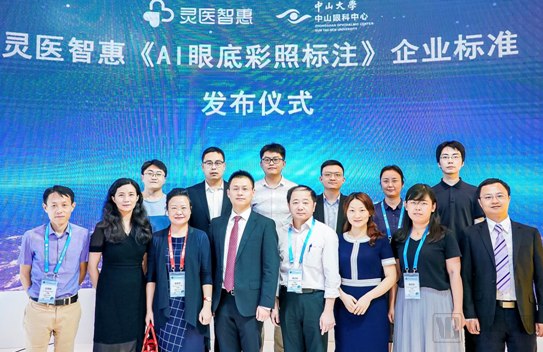
Group Photo at the Launch Ceremony of the Enterprise Standard for “AI Annotation of Color Fundus Photography”
As early as 2018, Baidu established its Smart Healthcare division to empower primary care with artificial intelligence technologies. Recently, it upgraded its AI healthcare brand to “Lingyi Zhihui.” With the vision of “empowering primary care through evidence-based AI,” Lingyi Zhihui is committed to serving all scenarios both within and outside hospitals, helping industry partners such as hospitals, Hospital Information System (HIS) vendors, electronic medical record (EMR) vendors, and health management operators improve quality and efficiency. Among its extensive product portfolio, the fundus image analysis system plays a significant role; this system was officially unveiled at the Baidu World Conference in 2018. To develop a fundus image analysis system that better aligns with clinical logic, Lingyi Zhihui has engaged in multifaceted collaboration with the Zhongshan Ophthalmic Center of Sun Yat-sen University on AI-based fundus imaging since last year. Currently, the functionalities of the fundus image analysis system have been continuously refined, achieving an accuracy rate of 94% in analyzing various ocular diseases and delivering results within 10 seconds. The system has already been implemented for research purposes in more than ten hospitals in Zhaoqing, Guangdong Province, and as of August this year, it has assisted in screening 1,136 patients.
During the development and refinement of fundus image analysis systems, stakeholders have encountered various challenges, with data annotation being the most prominent. Fundus color photographs are typically interpreted based on physicians’ subjective experience; in the absence of other medical auxiliary tools, relying solely on a single fundus color photograph for disease diagnosis entails significant uncertainty. Variations often exist in the “criteria” applied by different physicians when annotating fundus images, which can substantially compromise the quality of data annotation. This is not merely a challenge faced by Lingyi Zhihui; many researchers in the field of fundus imaging encounter the same dilemma: how to ensure the quality of data annotation.
Lingyi Zhihui firmly believes that “deeply understanding medical scenarios and rigorously addressing medical issues” is the key to success in the AI healthcare industry. Only by staying grounded and approaching every aspect and element of “medical care” with meticulous professionalism can AI healthcare truly benefit the public. To address the issue of low-quality annotation of color fundus photographs, it is essential to tackle the problem at its root by focusing on both the data itself and the physicians performing the annotations, thereby maximizing the quality of fundus image analysis systems. To this end, Lingyi Zhihui, in collaboration with Professor Zhang Xiulan, a senior glaucoma specialist, and Professor Zhang Shaochong, a retinal disease specialist, from the Zhongshan Ophthalmic Center, initiated efforts to promote standardized data annotation last year.
In May this year, Lingyi Zhihui convened dozens of ophthalmology experts, AI R&D personnel, and physicians involved in product data annotation to hold the “Symposium on Annotation Standards for AI Color Fundus Photography.” During the symposium, participating physicians and technical professionals shared their insights and perspectives on “how to achieve annotations that balance clinical relevance with algorithmic precision,” addressing practical challenges. Thanks to thorough preparatory work by the organizers, the three-day symposium proceeded efficiently and in an orderly manner, resulting in a preliminary draft of the “Enterprise Standard” by the closing day. Following the conference, participating physicians and technical staff refined many details, and the expert panel conducted multiple rounds of review and proofreading of the draft, ultimately finalizing the enterprise standard. This is the Lingyi Zhihui Enterprise Standard for “AI Color Fundus Photography Annotation” released at this conference, which balances clinical precision and algorithmic accuracy. Currently, no such annotation standards for color fundus photography exist within the industry; the Lingyi Zhihui Enterprise Standard is the first of its kind.
This enterprise standard primarily defines the annotation and referral rules, as well as the annotation workflows, for diabetic retinopathy, glaucoma, macular region lesions, and high-risk myopic lesions. It also provides detailed explanations for cases of inconsistent annotations. Furthermore, the standard expands and redefines “macular degeneration” within the product, updating it to “macular region lesions” to better align with referral objectives in practical applications. The official release of this standard signifies that every color fundus photograph annotated by Lingyi Zhihui strictly adheres to this benchmark, which embodies the craftsmanship of experts, clinicians, and technical professionals, thereby promoting more standardized and efficient clinical research and industrial practice of artificial intelligence in ophthalmology.
Driven by the commitment to foster standardized industry development and promote high-quality data, Lingyi Zhihui will, in the near future, collaborate with two professors and additional medical and technical experts. Leveraging official associations, we will advance the elevation of enterprise standards to group standards, thereby expanding their reach and enabling more industry participants to have a clear basis for data annotation, ultimately benefiting from high-quality data labeling.
It is reported that “group standards” are jointly and voluntarily developed by relevant societies, associations, enterprises, or research institutions to respond promptly to market changes and establish standards aligned with market needs; these standards are intended for common and repeated use. Since the new Standardization Law came into effect on January 1, 2018, “group standards” have been explicitly granted legal status. Playing a highly positive role in promoting technological innovation, regulating market order, and guiding industry development, group standards have become a valuable complement to the official standardization system.
In late August, at the “2019 Global AI Health Summit,” the World Health Organization (WHO) and the International Telecommunication Union (ITU) officially established the China National Promotion Group for the Focus Group on Artificial Intelligence for Health. This initiative aims to foster in-depth collaboration among Chinese stakeholders in developing international standards for medical artificial intelligence. Lingyi Zhihui participated in the summit as a deputy leader of the Promotion Group, further working with international peers to advance the “international standardization” of artificial intelligence in the healthcare sector.
It is evident that, as a “universal language,” the role of “standardization” is becoming increasingly prominent in various areas such as economic and trade exchanges, technological cooperation, and industrial capacity collaboration. At present, as “AI + Industry” has transitioned from the conceptual stage to the value-creation stage, “standardization” holds significant guiding importance for the comprehensive implementation and development of technology.