

Zenith Healthcare Empowers Chinese Hospitals Through Exclusive Partnership with UCSF Medical Center International Office
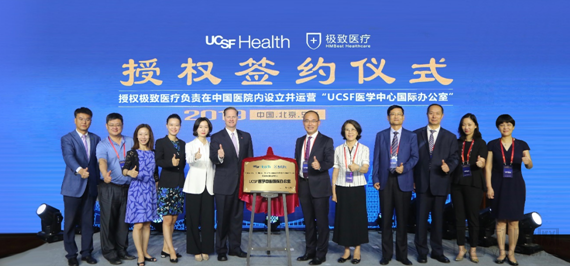
Jizhi Medical Expands Its International Medical Consortium with Another Strategic Move! On September 5, 2019, the authorization ceremony for the “International Office” of the University of California, San Francisco (UCSF) Medical Center was grandly held in Beijing. During the ceremony, Jizhi Medical received authorization from UCSF Medical Center to establish and operate the “UCSF Medical Center International Office” within Chinese hospitals, facilitating in-depth collaboration between Chinese hospitals and UCSF Medical Center.
This is a vivid manifestation of Jizhi Medical’s commitment to integrating top-tier global medical institutions, building an international medical consortium, and creating a closed-loop healthcare ecosystem. As China’s leading third-party professional institution for hospital management and medical services, Jizhi Medical leverages integrated international hospital management solutions to localize the resource, experience, and operational models of world-class medical institutions in clinical practice, scientific research, and education. This empowers Chinese medical institutions and physicians with international capabilities, while simultaneously providing Chinese patients with world-class medical services.
In recent years, with the vigorous development of the healthcare industry, Chinese hospitals have gradually expanded in scale and enhanced their medical capabilities. According to the "Statistical Bulletin on the Development of China's Health and Health Services in 2018" released by the National Health Commission, the total number of medical and health institutions nationwide reached 997,434 by the end of last year, an increase of 10,785 from the previous year.
However, compared with international advanced standards, there are still significant deficiencies in the soft management aspects of hospitals in China. For the same disease, the quality of diagnosis and treatment often varies across hospitals of different tiers. Patients and their families frequently distrust diagnoses made by smaller hospitals and seek confirmation at larger institutions, leading to overcrowding in major hospitals while small clinics remain nearly empty. This situation reflects underlying inadequacies in various areas of China’s healthcare industry, including hospital management, physician training, clinical practice guidelines, and health insurance coverage. These shortcomings can be effectively addressed by introducing external resources.
Driven by profound insights into the current state of China’s healthcare industry, Jizhi Medical has creatively introduced the concept of an International Medical Consortium. Through exploratory practice, it has established a framework comprising three major systems and a product matrix of six offerings. According to reports, Jizhi Medical’s three major systems are: (1) a training curriculum system, covering management training and specialty-specific training; (2) an international exchange system, encompassing visits from overseas experts and overseas advanced study programs; and (3) a complex and critical care system, featuring remote grand rounds and remote consultations.
Sharing resources and services from top-tier international medical institutions, empowering Chinese hospitals, and serving Chinese patients are the distinguishing features of Jizhi Medical’s three major systems and six core products. Taking specialty training as an example, Jizhi Medical collaborates with a series of leading international medical schools and institutions, offering training that covers all clinical departments, administrative staff, nursing personnel, and general practitioners. Meanwhile, remote consultations leverage modern tools to overcome language and geographical barriers, enabling patients to access medical support from top international experts without leaving the country.
In August 2015, the Mayo Clinic established a referral office in Beijing, operated by VCare Health, marking VCare Health’s completion of the “last mile” in implementing international medical consortiums.
To maximize the effectiveness of the Mayo Clinic Joint Venture’s Referral Office in China, Jizhi Healthcare has meticulously implemented a “Three-Step” strategy: first, translating Mayo Clinic’s professional materials into Chinese; second, localizing Mayo Clinic’s knowledge and management systems; and third, providing tailored solutions for each partner hospital.
Hard work pays off. After more than three years of exploration and innovation, the Mayo Clinic has now established diverse forms of collaboration with multiple hospitals, including China-Japan Friendship Hospital, Peking University Cancer Hospital, Shanghai General Hospital, Sun Yat-sen Memorial Hospital of Sun Yat-sen University, and Henan Provincial People’s Hospital, thereby significantly advancing the localization of international medical resources.
To explore more opportunities for international medical collaboration, Jizhi Medical, in partnership with the China Medical Tribune, hosted the inaugural China-US Hospital Cooperation Summit on April 12–13 this year. The summit invited administrators from several U.S. hospitals ranked among the top ten by U.S. News & World Report, including Johns Hopkins Medicine, Cleveland Clinic (Abu Dhabi), Cedars-Sinai Medical Center, UC San Francisco Health, UCLA Health, MD Anderson Cancer Center, and Memorial Sloan Kettering Cancer Center. Together with Chinese healthcare professionals, they explored shared best practices in hospital management between China and the United States. This marked the first large-scale summit in China dedicated to sharing medical management expertise between the two countries.
Qu Wei, Founder and CEO of Ultimate Medical, stated at the conference that the advanced patient management experience in the United States is widely recognized globally. The summit aims to gather resources from the most prestigious and top-tier U.S. hospitals to showcase their valuable best practices in hospital management, clinical practice, patient services, talent development, discipline construction, clinical research, and innovative technologies. This platform facilitates dialogue with Chinese hospitals, enabling mutual learning and complementary strengths.
At the “International Office” authorization ceremony, partner UCSF Medical Center was recognized globally for its innovative patient care, advanced technology, and pioneering research. It ranked first in California and among the top ten hospitals nationwide in the U.S. News 2018–19 Best Hospitals rankings. Home to five Nobel laureates, UCSF Medical Center has pioneered more than 1,700 innovative medical treatments, performs the highest number of kidney transplants worldwide, and operates the largest brain tumor treatment center in the United States. UCSF Medical Center will engage in long-term collaboration with Chinese hospitals across management, clinical practice, scientific research, and education.
Qu Wei, Founder and CEO of Ultimate Healthcare, hopes that more Chinese hospitals will establish partnerships with the UCSF Medical Center to jointly explore practical and replicable product and operational models, accelerate the implementation of international medical consortia, and promote the development of China’s healthcare sector.