

Implementation Plan for the Public-Private Partnership Initiative on Affordable Elderly Care Services (2019 Revised Edition)
VCBeat (WeChat ID: vcbeat) has learned that on September 9, the National Development and Reform Commission, the Ministry of Civil Affairs, and the National Health Commission jointly issued the “Implementation Plan for the Special Action of City-Enterprise Collaboration in Inclusive Elderly Care (2019 Revised Edition)” (hereinafter referred to as the “Implementation Plan”).
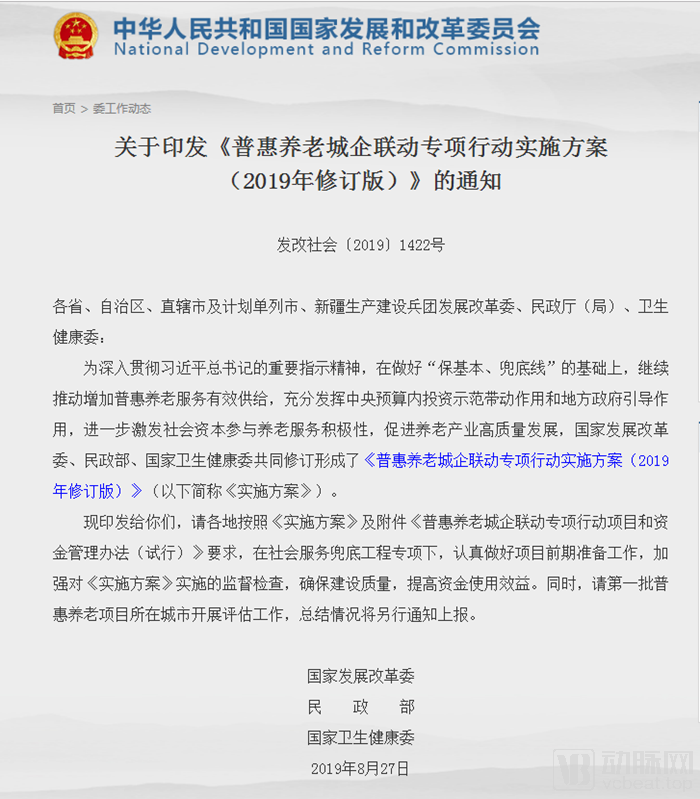
The Implementation Plan clarifies the establishment of a new, effective model of cooperation to support social forces in developing inclusive elderly care services. In participating cities, the number of elderly care beds per 1,000 older adults shall reach 40, with nursing care beds accounting for more than 60%. Deep integration of medical and elderly care services will be promoted, striving to achieve the goals of “three improvements,” “two reductions,” and “one satisfaction.” The “three improvements” refer to significant increases in the number of inclusive elderly care beds, service quality, and corporate profitability. The “two reductions” entail lowering enterprises’ construction and operational costs and reducing service prices through a combination of supportive policies in land use, finance, and other areas. The “one satisfaction” aims to benefit more older adults and enhance public satisfaction with social elderly care services. The Implementation Plan proposes encouraging enterprises to establish urban health and wellness industry development funds or issue corporate bonds to finance the construction of elderly care facilities, procurement of equipment, and acquisition and renovation of underutilized social resources. It also encourages the initiation and establishment of elderly care investment funds that operate independently through market-oriented mechanisms such as equity investment, thereby attracting partner enterprises into the infrastructure and service sectors of elderly care.
The full text of the Implementation Plan is as follows:
Implementation Plan for the Special Action on City-Enterprise Collaboration in Inclusive Elderly Care
(2019 Revised Edition)
To thoroughly implement the important instructions of General Secretary Xi Jinping, and on the basis of ensuring basic coverage and providing a safety net, this Plan is formulated to continue promoting an effective increase in the supply of inclusive elderly care services, fully leverage the demonstrative and driving role of central budgetary investment and the guiding role of local governments, further stimulate the enthusiasm of social capital to participate in elderly care services, and promote the high-quality development of the elderly care industry, by launching the Special Action for City-Enterprise Collaboration on Inclusive Elderly Care under the Special Project for Social Service Safety Net Engineering.
I. Main Approach
Centered on the principles of “government support, social operation, and reasonable pricing,” entities shall fulfill their public welfare obligations as agreed and deepen city-enterprise cooperation. The state supports and guides city governments in the systematic planning and construction of elderly care service systems through central budgetary investments. City governments provide a comprehensive policy support package encompassing land supply, urban planning, financing, fiscal and tax incentives, integration of medical and elderly care, and talent development. In return, enterprises deliver affordable elderly care service packages, which are disclosed to the public and subject to oversight. City governments and enterprises sign cooperation agreements that specify the content of affordable services and establish a price adjustment mechanism dynamically linked to factors such as the Consumer Price Index (CPI). This approach aims to expand the effective supply of elderly care services, meet diverse, multi-level societal needs, and enhance the public’s sense of gain, happiness, and security.
II. Basic Principles
(1) Inclusiveness-Oriented. Support inclusive elderly care projects for the general public, providing affordable and accessible elderly care services to the older adult population.
(II) Voluntary Participation. Cities with strong initiative are encouraged to voluntarily submit applications, and enterprises with robust capabilities, good credit standing, and investment willingness are encouraged to apply voluntarily in accordance with the specified conditions.
(3) Openness and Transparency. Cooperation agreements between cities and enterprises, service content, price lists, and other relevant information shall be disclosed to the public and subject to public oversight.
(4) Competitive Selection Based on Merit. Priority shall be given to cities with high initiative and scientific planning; strong support shall be provided to enterprises with robust capabilities, high-quality projects, and a track record of integrity and good faith; and financial institutions with low financing costs and high service quality shall be prioritized.
(5) Standardized Management. Clearly define the entities responsible for construction, operation, and regulation to ensure standardized processes in construction and operation, effective regulatory oversight, and smooth project implementation.
III. Work Objectives
Establish new and effective models of cooperation to support social forces in developing inclusive elderly care services. Participating cities shall achieve a target of 40 elderly care beds per 1,000 elderly residents, with nursing-care beds accounting for more than 60% of the total. Deep integration of medical and elderly care services will be promoted, striving to achieve the goals of “Three Improvements,” “Two Reductions,” and “One Satisfaction.” The “Three Improvements” refer to significant increases in the number of inclusive elderly care beds, service quality, and corporate profitability. The “Two Reductions” involve leveraging a combination of policies—such as land use and financial support—to reduce enterprises’ construction and operational costs, as well as service prices. “One Satisfaction” aims to benefit more elderly individuals and enhance public satisfaction with social elderly care services.
IV. Construction Content
(I) Scope of Support for Central Budgetary Investment.
Through the construction of new elderly care service facilities, as well as the renovation and expansion of suitable factories, hospitals, vacant school buildings, office spaces, training facilities, convalescent facilities, and other infrastructure, central budgetary investment will prioritize support for four categories of projects: “community-based care, integrated medical and elderly care, lifelong learning, and sojourn-based wellness.”
First,Support the construction of the backbone network for elderly care services, and strengthen the home- and community-based elderly care service network.Develop community-embedded, distributed, and small-scale elderly care facilities and day care centers with nursing beds under centralized management and operation; support chain-based, integrated, and branded operations; expand home service functional modules; strengthen capabilities in meal assistance, cleaning assistance, mobility assistance, bathing assistance, and medical assistance; and enhance the coverage and service capacity of the elderly care service network.
Second,Support the Development of Elderly Care Institutions with Strong Specialization and Integrated Medical-Nursing Capabilities, strengthen long-term care services for elderly individuals with disabilities and dementia.
Third,Support the development of elderly care service institutions that include learning facilities such as universities for the elderly.
Fourth,Support the Development of Inclusive Elderly Care Institutions for Sojourn Living, taking into account the resource endowments of each region, develop seasonal local recommendation catalogs, strengthen cross-regional coordination and linkages, and build a nationwide inclusive sojourn elderly care market.
Furthermore, training and recuperation facilities affiliated with Party and government organs and state-owned enterprises and public institutions are supported in transforming and developing into the aforementioned four categories of inclusive elderly care projects.
(II) Recommendations for inclusion in local regional plans.
First,Strengthen the development of the integrated elderly care service consortium mechanism.Centered on professional elderly care service institutions,Form a “1+N” Consortium with the Elderly Care Service Backbone Networksystem, promote the integrated development of home-based, community-based, and institutional elderly care, strengthen technical guidance, personnel training, and referral coordination, and enhance the overall level of elderly care services within the region.
Second,Strengthening the Construction of Collaborative Mechanisms for Integrated Medical and Elderly Care ServicesFacilitate the integration of specialized medical resources with elderly care services, strengthen the construction of systems for the prevention, diagnosis, treatment, rehabilitation, and nursing care of age-related diseases, establish stable and efficient referral mechanisms and health support systems, and provide high-quality integrated medical and elderly care services to the elderly in the region. Encourage elderly care institutions and medical institutions to innovate their models of cooperation.
Third,Strengthen the promotion and application of products for the elderly.Encourage cities with the necessary conditions to carry out research and development, production, adaptation, and rental services for rehabilitation assistive devices and AI-powered elderly care products. Continuously promote the development of the smart health and elderly care industry, and strengthen the in-depth application of next-generation information technologies—such as artificial intelligence, the Internet of Things, cloud computing, and big data—as well as intelligent hardware products in the field of elderly care services.
Fourth,Strengthen the development of cultural and sports facilities, elderly dining services, and other living amenities for older adults.
Fifth,Strengthen the age-friendly renovation of community-based home care infrastructure.
V. Work Tasks
(I) Clarify the responsibilities of cities and enterprises.
1. Participating cities shall formulate overall plans for the development of elderly care service systems and submit them to our Commission for record-filing,Develop and Roll Out a Package of Supportive Policies, scientifically determine the benchmark level and reasonable range for the inclusive pricing of basic elderly care beds.
The plan should differentiate between basic and non-basic elderly care services. For basic elderly care services, the scope of beneficiaries and baseline standards must be clearly defined to reflect government responsibility. For non-basic elderly care services, development goals should be established, support for social forces increased, and a batch of inclusive elderly care service projects planned, with clear specifications on project types, scale, financing models, target populations, and scheduled commencement dates, so as to expand effective supply.
The policy support package shall be formulated with reference to the “List of Local Government Support Policies for the Special Action on City-Enterprise Collaboration in Inclusive Elderly Care” (Attachment 1), taking into account local conditions. The policy support package includes mandatory and optional items, and the level of municipal support shall serve as an important basis for project prioritization.
In light of local conditions, and taking into account factors such as enterprise construction and operating costs, policy support, fiscal and tax subsidies, and the affordability of older adults, it is essential to strengthen market supply-and-demand research and analysis. On the premise of ensuring sustainable business operations, scientifically determine the benchmark level for inclusive pricing of basic elderly care beds, establish a reasonable range for upward and downward adjustments, and prioritize the selection of projects that fall within this inclusive price range.
2. Participating enterprises must calculate and propose the inclusive pricing and detailed breakdown for basic elderly care beds as a prerequisite for participation in the special initiative.Market-Driven Pricing for Tiered Inclusive Elderly Care Services, provide differentiated services to elderly individuals with disabilities or partial disabilities. Propose construction and operational plans, secure investment, clarify the public-welfare service content to be undertaken, and accept public supervision. There is an obligation to report progress to government authorities as required and to publicly disclose service pricing.
3、The municipal government signs a cooperation agreement with the enterprise. The agreement shall specify the inclusive pricing for basic elderly care beds in the project., implement the policy support package into specific city-enterprise collaboration projects to ensure that enterprises receive the promised preferential policies, and clarify enterprise responsibilities in pricing, operations, standards, and public welfare services with reference to the "Enterprise Responsibility List for the Special Action on City-Enterprise Collaboration for Inclusive Elderly Care" (Attachment 2). Service fees beyond the basic elderly care bed price, such as nursing care, should also fully reflect the principle of inclusiveness to cover a broader population of low- and middle-income elderly individuals. Enterprises shall provide inclusive elderly care services to the elderly in their daily operations in accordance with the cooperation agreement.
(II) Standardize project applications.
Municipal governments shall submit projects to the provincial development and reform commissions. The development and reform commissions of all provinces (autonomous regions, municipalities), and cities with independent planning status shall review and recommend projects, fully solicit opinions from the civil affairs departments and health commissions, and then submit them to the National Development and Reform Commission (NDRC) in order of priority based on key support areas, among other criteria. Requirements for construction projects, such as average floor area per bed, total number of beds, and construction scale, shall be implemented in accordance with the "Administrative Measures for Projects and Funds of the Special Action for City-Enterprise Collaboration in Inclusive Elderly Care (Trial)" (Attachment 3). When submitting projects, municipal governments must simultaneously submit an overall plan for the construction of the elderly care service system and a letter of commitment regarding policy support. Cities without current projects may also register to participate under the same requirements, and their future projects will receive priority support. Projects involving the transformation and development of training and sanatorium institutions into inclusive elderly care facilities shall be submitted through their respective city governments and are exempt from the separate submission of a letter of commitment.
Participating enterprises (including social service organizations) are not distinguished by ownership type (state-owned or private), profit orientation (for-profit or non-profit), or capital source (domestic or foreign). Enterprises can leverage complementary strengths, and investment-oriented and service-oriented institutions are encouraged to form “strong–strong” partnerships for joint construction and operation. The selection of enterprises may refer to the *Notice on Recommending the First Batch of Elderly Care Service Enterprises and Reserve Projects for the Special Action on City-Enterprise Collaboration for Inclusive Elderly Care Services*, which shall serve as an important basis for project prioritization.
(3) Central differentiated subsidies.
Central budgetary investments adopt a differentiated subsidy approach, providing support at a standard of RMB 20,000 per elderly care bed for the construction of home- and community-based institutions and those integrating medical and elderly care services, and at a standard of RMB 10,000 per bed for learning-oriented and sojourn-type institutions. Where a project qualifies for multiple types of support, the subsidy shall be granted according to the highest applicable standard. In principle, the annual number of subsidized beds per city shall not exceed 10,000; if the number exceeds this cap, subsidies will be provided for only 10,000 beds, or the project may be implemented over multiple years. For construction projects spanning multiple years, funding arrangements may be made on an annual basis.
(4) Strengthened provincial support.
Provincial-level development and reform, civil affairs, health, and other relevant departments shall study and improve policies on subsidies and allowances, substantially increase financial support, and coordinate with central government subsidies and urban preferential policies to jointly foster an inclusive elderly care market, enhance service quality, expand coverage, and increase the effective supply of services.
(V) Conduct credit evaluations.
Introduce credit service agencies, leverage the National Credit Information Sharing Platform, and fully utilize public and market-based credit information to comprehensively assess the credit status of elderly care service enterprises. Conduct pre-approval credit verification and implement ongoing and post-event credit supervision. Enterprises with serious dishonesty records shall be banned from market entry in accordance with laws and regulations. Supervise dishonest conduct by local governments and all participating parties during the implementation of special campaigns, and strengthen corporate self-discipline and regulatory oversight.
(6) Improve financial support.
Comprehensively leverage various policy instruments to formulate an integrated financing implementation plan aimed at addressing shortcomings in elderly care services. Using cities participating in the Special Action for Urban-Enterprise Collaboration in Inclusive Elderly Care as models, adopt a combined approach of “subsidies, loans, bonds, funds, procurement, and insurance” to reduce construction and operational costs. Encourage banks, insurance companies, funds, and other financial institutions to engage in collaboration, providing multi-tiered and diversified financial services for the special action. Guide strategic partner institutions to actively align with projects and carry out targeted innovation in financial products.
(VII) Innovative Service Supervision.
Leverage internet platforms and other channels to integrate, centrally display, promote, and cultivate the market for inclusive elderly care projects; strengthen monitoring of inclusive pricing and establish a market risk early-warning mechanism. Fully stimulate the enthusiasm of social forces to participate, introduce third-party regulatory evaluations through market mechanisms, and drive improvements in service quality.
(8) Establish an inclusive alliance.
Explore the establishment of substantive cooperation platforms, such as an Inclusive Elderly Care Industry Alliance built through multi-stakeholder collaboration. Adopt a multi-pronged approach—including fiscal investment, policy support, credit management, preferential financing and investment policies, and platform promotion—to reduce enterprises’ construction and operational costs while enhancing service quality. For elderly care projects already completed, enterprises are encouraged to embrace the principle of inclusiveness, provide inclusive services, apply for membership in the Alliance, and enjoy equal treatment.
(9) Ensure the proper allocation of investment funds.
Local projects adopt the method of block allocation, namely the “×× Province ×× Year Inclusive Elderly Care Government-Enterprise Collaboration Project,” under which central budgetary investments are allocated to the relevant provinces. The provinces shall distribute the funds to specific projects within 20 working days after receiving the allocation notice.
(10) Strengthen investment management.
Central budgetary investments shall be managed through dedicated accounts and earmarked funds. Local government departments, including finance and state-owned assets supervision authorities, shall oversee central subsidy investments in accordance with their respective responsibilities. Credit rating agencies shall be engaged, and the “Credit China” website shall be fully utilized to impose credit penalties on enterprises that fail to fulfill their obligations after receiving funds. For projects with serious violations, national subsidy investments shall be recovered and public notices issued. A reward and punishment mechanism shall be established to reward localities that demonstrate genuine commitment and achieve significant results in special campaigns, while penalizing those with inadequate oversight of central funds.
Policy Source: Website of the National Development and Reform Commission