

YiJiaYi Founder Xu Yi: Who Says Digital Health Can't Be Profitable? This One-Stop Oncology Platform Is Quietly Unlocking Its Revenue Model
Xu Yi, the founder of Yijiayi, has a baby-faced appearance. If it weren’t for his prematurely graying hair and his statement that “I only started my entrepreneurial journey at the age of forty,” it would be difficult to associate him with being an “industry veteran” who entered the field in the 1990s and has deeply cultivated expertise in oncology.

Xu Yi, Founder of Yijiayi
Speaking of Yijiayi, Xu Yi’s eyes lit up as he spoke with unrestrained enthusiasm. It had been exactly five years since he left his position at a Fortune 500 multinational corporation to embark on his entrepreneurial journey. Amidst the waxing and waning fortunes of internet healthcare, which shifted from feverish hype to a chilly downturn, the substantial opportunity costs prompted many entrepreneurs with similar backgrounds to return to their roles as professional managers in large corporations. Yet, Xu Yi’s passion remained undiminished.
“I have never regretted starting my own business. Everything that has happened was largely anticipated before I embarked on this journey, and in many ways, it has even exceeded my expectations,” said Xu Yi. “Indeed, pharmaceutical companies have extended invitations to me over the past two years, but I have never considered returning. I am passionate about my current venture and hold a more favorable outlook on Yijiayi now than at any time before.”
Xu Yi prefers to refer to Yi Jia Yi as his “career.” As he puts it, it helps cancer patients, supports physicians, empowers partner companies, and provides opportunities for personal and team growth. “I can’t think of any other job that so closely integrates helping others with self-fulfillment. Isn’t that precisely the kind of career worth striving for?” he said.
What is your perspective on internet healthcare? Do you believe there are still opportunities in this field?
To be honest, I have always held a rather pessimistic view of internet healthcare. This was not a recent development; I maintained this stance even during its peak popularity in 2014 and 2015. The main reasons are as follows:
First, the needs targeted by many projects are not rigid; some are even pseudo-needs.For instance, many initiatives are founded on the premise of “difficulty in accessing medical care,” which is, in fact, a false proposition. In Chinese cities with robust 4G mobile coverage, seeking treatment for minor or chronic conditions is not difficult, provided patients act rationally and do not insist on visiting the most prestigious hospitals or seeing top-tier specialists. Patients can register upon arrival, consult with a physician immediately after registration, and undergo examinations and treatment right after the consultation—often without even needing an appointment. This level of accessibility is unimaginable in the United States and Canada.
Therefore, the practical feasibility of developing an app to address the “difficulty in accessing medical care” by enabling patients to bypass hospital visits, pay out-of-pocket for online consultations, receive treatment plans without blood tests, and subsequently purchase medications for home delivery, remains debatable.
Second, there is a lack of a profitable business model.For the vast majority of diseases, major expenses are covered by medical insurance, leaving patients with little opportunity to spend money on these platforms. With the opening of internet hospitals, mobile healthcare has finally found a profitable business model: selling medications online via apps. This has attracted a rush of interest from major companies.
However, with the advancement of volume-based procurement, drug prices in public hospitals have plummeted, and health insurance coverage has become widespread. Patients no longer choose to pay out-of-pocket for expensive medications online. Even if health insurance eventually covers internet hospitals, where will mobile healthcare providers derive their profits given the zero-markup policy in public hospitals?
Third, there are no barriers.Homogeneous app products and business models with no barriers to entry will see profits driven toward zero by competition from latecomers, even if they are initially profitable.
However, internet healthcare is not entirely devoid of opportunities. On one hand, medical services closely aligned with the consumer sector, such as dentistry and medical aesthetics, certainly hold immense potential due to the substantial volume of out-of-pocket payments. On the other hand, within the core medical domain, critical illness areas that also involve significant out-of-pocket expenses—such as oncology—may harbor considerable business opportunities. In short, the greater the demand for self-paid services, the more opportunities exist for entrepreneurs.
Why Has Yijiayi Survived in the Internet Healthcare Sector? What Is Its Current Status?
YiJiaYi has survived to this day and is experiencing robust growth, primarily because its positioning and business model have avoided the major issues plaguing the online healthcare sector as previously mentioned.
I. Essential Demand.Yi Jia Yi serves cancer patients and their families, a user base with unequivocally inelastic demand. The commonly cited challenge of “difficulty in accessing medical care” in China often refers precisely to patients suffering from such serious illnesses. Leaving their hometowns for unfamiliar cities, navigating large hospitals they have never visited before, undergoing a bewildering array of diagnostic tests, and receiving life-critical treatments—patients and their families are in dire need of assistance.
II. Revenue.There are numerous out-of-pocket payment opportunities in the oncology sector. High-end medical services—such as physician and medication consultation, overseas medical care, consultations with renowned specialists for surgical procedures, and private physician services—along with products like oncology nutrition, rehabilitation aids, genetic testing, and early screening for family members, largely fall under the category of self-pay expenses. Moreover, such payments are often not one-time transactions; instead, there are frequent opportunities for repeat purchases from the same user. Once trust is established between patients and the platform, users are not only willing to pay but also tend to be less price-sensitive, resulting in a relatively high average transaction value.
III. Barriers.Oncology startup ventures require founding teams to possess deep industry insights, substantial professional expertise, and extensive resource networks to successfully launch and operate, thereby establishing high barriers to entry.
For the above reasons, Yijiayi’s current operations are relatively healthy and progressing steadily. In fact, we achieved break-even on a book basis in 2018. We expect to turn a profit and generate positive operating cash flow in 2019.
What is Yi Jiayi’s primary revenue model? Has it changed since the company’s inception?
At its inception, Yi Jia Yi positioned itself as a healthcare platform dedicated to connecting cancer patients with appropriate physicians. After the platform became operational, it became evident that while physician resources materialized as anticipated, acquiring patients proved far more challenging than expected. This difficulty primarily stemmed from the fact that cancer patients are not typical internet users; conventional digital marketing strategies were ineffective for customer acquisition and incurred prohibitively high costs. Furthermore, patients acquired online were often already undergoing treatment or had completed their therapy, resulting in a relatively weak demand for physician matching. Additionally, establishing trust with patients acquired through online channels required a considerable amount of time.
YiJiaYi later shifted its model from simply connecting doctors and patients to building an oncology service platform, gradually beginning to generate revenue. However, transitioning directly to a business model primarily driven by consumer (C-end) payments remains highly challenging. Therefore, we have actively pursued partnerships with B-end clients—such as insurance providers, health examination centers, and online crowdfunding platforms—to deliver oncology-related services to their users in the pre-diagnosis phase. In the post-diagnosis phase, we have established various collaborations with pharmaceutical companies, nutrition providers, and diagnostic testing manufacturers. These efforts not only enhance value for our B-end enterprise clients but also unlock additional resources for patients.
This strategy has enabled us to gain a firm foothold during the capital winter. Currently, Yijiayi’s revenue structure comprises both B2B and B2C segments. As the platform continues to develop, both our To-B and To-C businesses are poised for robust growth, and we anticipate that the proportion of B2C revenue will gradually increase in the future.
What are Yi Jia Yi’s next steps? Will it consider establishing an internet hospital?
We currently have no plans to establish an internet hospital. As previously mentioned, the primary purpose of launching an internet hospital is largely to sell medications online. However, setting up an internet hospital requires significant investment, while pharmaceutical sales yield minimal profits. Therefore, we will continue to monitor the situation.
Secondly, internet hospitals primarily address follow-up consultations for minor and chronic conditions. Given the complexity of cancer diagnosis and the diversity of treatment modalities, patients must seek in-person medical care, as these issues cannot be adequately managed through online platforms. Furthermore, chemotherapy agents and targeted therapies used in cancer treatment often cause significant adverse reactions, making them unsuitable for prescription via internet hospitals.
Yi Jiayi’s implementation strategy involves establishing offline oncology clinics. Although setting up physical clinics is complex and time-consuming, their face-to-face model is better suited to serving cancer patients and can serve as a supplement and complement to public hospitals. For the Yi Jiayi platform, this creates an opportunity to channel patients seeking online services to its offline clinics for consultations and medication dispensing; meanwhile, it also enables the redirection of offline clinic patients to the Yi Jiayi platform for long-term management, thereby unlocking follow-up consumption potential.
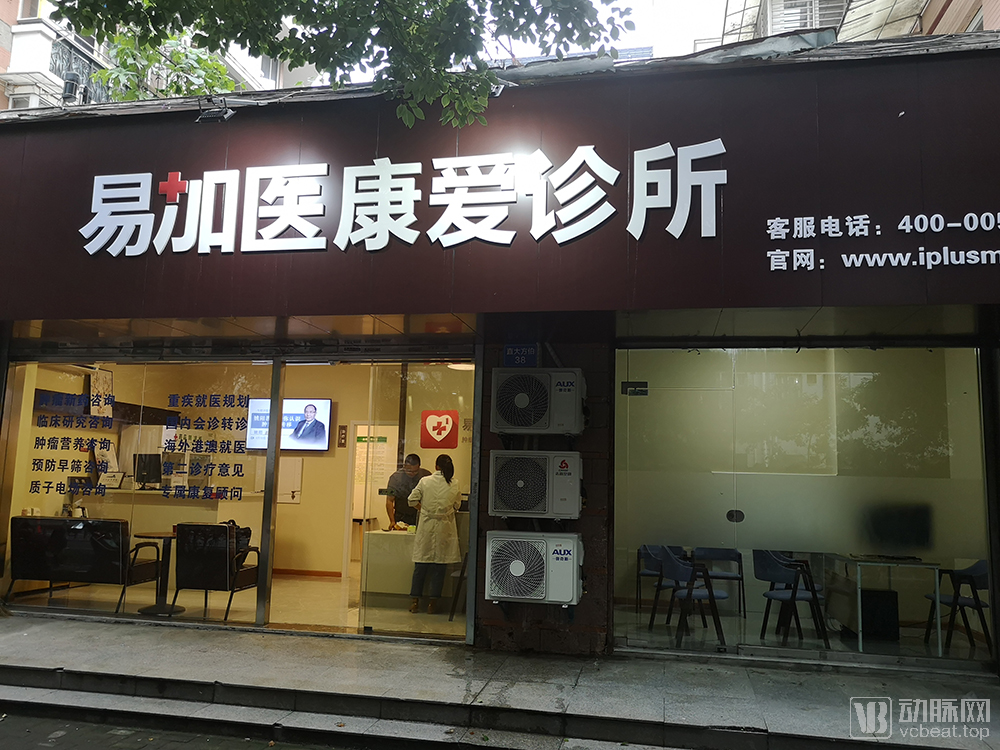
YiJiaYi Kang'ai Clinic (Image provided by the company)
Currently, the first Yijiayikangai Clinic has opened its doors, located near the First and Second Affiliated Hospitals of Zhejiang University School of Medicine in Hangzhou.
After several years of entrepreneurial experience, what insights would you like to share with us?
First, talk less about “startups” and more about “business.” The former conjures images of fundraising, roadshows, and user acquisition; the latter brings to mind revenue, profit, cost control, and living within one’s means. Rather than catering to venture capitalists, focus on building a profitable business model. I believe that the less a company needs money, the more interested capital becomes.
Second, return to the essence of business. Countless cases have proven that the approach of using internet thinking to first acquire users and then seek a profit model is not suitable for the healthcare sector. Instead, it is more effective to establish a prototype, validate it on a small scale, and then replicate it at scale. This returns to the traditional way of “doing business,” which may prove more useful.
Third, maintain independent thinking. As previously mentioned, many so-called “common sense” beliefs are not necessarily correct. What everyone flocks to may not be the suitable choice for an individual. We need to clearly know where we are heading, design the path that best maximizes benefits and minimizes harms, and then proceed with determination.