

Wanjia Yan Health Industry Group Files IPO Prospectus: Building an Integrated Healthcare Ecosystem through Self-Operated Hospitals and Pharmacies under the '3D Healthcare Model'
Recently, the 2019 China International Smart Industry Expo was held in Chongqing, where an internet hospital platform from a local Chongqing enterprise made its debut. The platform was developed by Chongqing Wanjia Yan Health Industry Group, which has introduced a “multi-dimensional healthcare” model and entered the internet healthcare sector, backed by its physical operations in medical services, pharmaceutical retail chains, and internet technology.
What Are the Characteristics of the “Three-Dimensional Healthcare” Model? How Can It Be Integrated with the Real Economy? Yan Hong, Chairman of Wanjia Yan Health Industry Group, Provides Insights in an Exclusive Interview with VCBeat (WeChat ID: vcbeat).
To date, the development of internet-based healthcare requires at least several key components—online platforms, physical hospitals and physicians, as well as pharmacies and medications—to constitute a complete diagnostic and treatment process. When medical institutions or enterprises enter the field of internet-based healthcare, common approaches include:
1. Internet companies or informatization enterprises leverage their technological and operational advantages to establish connections.
2. Physical hospitals expand their online presence, with IT enterprises providing platform development services.
3. After establishing a pharmaceutical distribution network, e-pharmacy platforms or chain pharmacies collaborate with physical hospitals to set up internet hospitals.
As Wanjia Yan entered the internet healthcare sector with a foothold in the local market, it had already laid out its industrial segments spanning healthcare, pharmaceuticals, chain operations, and network technology. In other words, Wanjia Yan established its own informatization enterprise to build an internet platform that connects its self-operated hospitals, clinics, and chain pharmacies, creating a closed-loop healthcare service ecosystem through its “multi-dimensional healthcare” model.
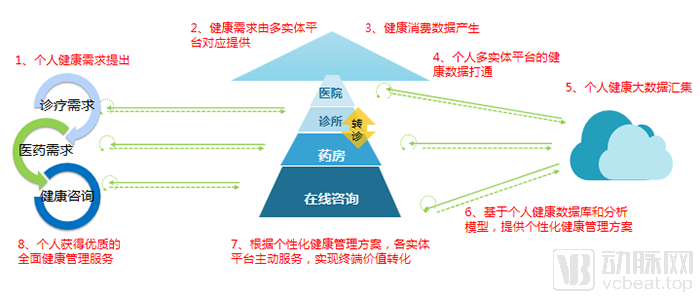
Wan Jiayan's "Three-Dimensional Healthcare" Strategy
Currently, the business architecture of Wanjia Yan Group is as follows: Wanjia Yan Hospital Management Co., Ltd. operates one secondary general hospital, one tertiary plastic surgery hospital, and nearly ten clinics; Wanjia Yan Chain Pharmacy Co., Ltd. operates more than 130 chain pharmacies within Chongqing; Wanjia Yan Pharmaceutical Co., Ltd. engages in pharmaceutical wholesale business; and Yikang Xiaoyan Network Technology Co., Ltd. is responsible for building the internet healthcare platform.
By cross-referencing these physical operations with the “Three-Dimensional Healthcare” schematic, a clear pathway for medical services and health management emerges: For common and chronic diseases, patients can seek online consultations via Wanjia Yan’s Internet Hospital platform at nearby Wanjia Yan pharmacies and clinics, where physicians may issue follow-up prescriptions or provide relevant medical advice. For serious, complex, or specialized conditions, Wanjia Yan leverages its resource advantages to offer timely and efficient referral services, establishing a coordinated referral mechanism between online and offline settings, as well as between primary care institutions and general hospitals. Additionally, the Wanjia Yan Internet Hospital platform provides value-added services such as home medication delivery, utilizing its physical pharmacies as hubs for 24-hour pharmaceutical distribution. It also incorporates health big data collection and analysis capabilities to deliver health management and follow-up services, particularly for patients with chronic conditions.
“The primary pain point in healthcare services lies in the severe shortage of primary care resources, which makes it difficult for people at the grassroots level to access medical treatment. The internet is one of the important solutions,” said Yan Hong. This is a key reason why Wanjia Yan has proposed the “multi-dimensional healthcare” model and is promoting it through its various physical business segments.
However, Rome was not built in a day; Wan Jiayan’s various business segments were gradually established after nearly two decades of accumulation.
Yan Hong was originally a Chinese language teacher. Influenced by her mother, who was a physician, she developed a strong interest in the pharmaceutical and healthcare industry and gained firsthand insight into the difficulties and high costs faced by ordinary people in accessing basic medical care. In 2000, Yan Hong resigned from her teaching position to embark on an entrepreneurial journey, opening her first pharmacy, “Liancheng Grand Pharmacy.” After eight years of development, she established the “Wanjia Yan” brand and launched dozens of Wanjia Yan chain pharmacies across Chongqing.

Yan Hong, Chairman of Wanjia Yan Group
“Pharmacies can only alleviate the problem of high medical costs for people at the grassroots level to a certain extent, but they cannot resolve the fundamental challenge of difficult access to medical care,” Yan Hong explained. This was his original motivation for establishing a hospital and led him to guide his team’s transformation after 2008.
Beyond large tertiary Grade A hospitals, ordinary brick-and-mortar hospitals have a limited service radius. Where is the most suitable location for a hospital? While most social capital investors opt for areas with convenient transportation and high foot traffic, Yanhong chose Dadukou District, a relatively remote area within Chongqing’s main urban core at the time. Yanhong believed that precisely because medical resources were relatively scarce in Dadukou, residents there had a greater need for hospital services, and establishing a hospital in this location would offer greater potential for growth. Unlike most private hospitals that choose to lease premises, Yanhong opted to build its own facility. “The process was extremely difficult and painful, but only by treating healthcare as a long-term endeavor can one continuously accumulate resources and talent, thereby achieving sustainable development,” stated Yanhong.
Private hospitals require substantial capital investment and have long payback periods. To secure sufficient funding for hospital construction and subsequent operations, Yan Hong partnered with Jiang Rensheng, the head of Zhifei Biological Products. Chongqing Weisheng Investment Co., Ltd., under Jiang Rensheng’s ownership, made a strategic investment in Wanjia Yan.
During this period, the state successively introduced a series of policies, including the “Notice on Further Encouraging and Guiding Social Capital to Establish Medical Institutions” and the “Several Opinions on Promoting the Development of the Health Service Industry.” These measures aimed to guide and encourage social capital investment in healthcare, broaden market access for social capital, deregulate pricing for medical services provided by non-public medical institutions, and promote multi-site practice for physicians. Amidst these developments, Wanjia Yan seized greater opportunities, and Yan Hong became even more resolute in his chosen path.
In 2014, a hospital building with a construction area of over 11,600 square meters was completed at a cost of RMB 120 million. After one year of preparation, Chongqing Wanjia Yan Hospital opened in 2015, offering departments including internal medicine, surgery, obstetrics and gynecology, and stomatology. In 2018, Wanjia Yan Plastic Surgery Hospital was also established on the same site. Currently, Wanjia Yan Hospital has recruited more than 20 physicians with associate senior professional titles or above from renowned medical institutions such as Southwest Hospital of Army Medical University. Additionally, Wanjia Yan Plastic Surgery Hospital has engaged in in-depth collaborations with multiple well-known medical institutions.
To ensure the public-welfare nature of the hospital, Wanjia Yan Hospital has become the first social service base established by the Central Committee of the Chinese Peasants and Workers Democratic Party (CPWDP) in Chongqing, as well as the first social service practice base of the CPWDP Chongqing Municipal Committee. “This is not only a form of oversight but also a spur and encouragement,” said Yan Hong.

Wanjia Yan Hospital
Meanwhile, after the physical hospital was completed and put into operation, Wanjia Yan established a network technology company to explore and practice a regional three-dimensional medical service model. At this point, all business segments supporting Wanjia Yan’s “three-dimensional healthcare” model were fully in place.
With the promulgation of policy documents such as the “Administrative Measures for Internet Diagnosis and Treatment (Trial),” the “Administrative Measures for Internet Hospitals (Trial),” and the “Management Specifications for Telemedicine Services (Trial),” internet healthcare has entered a phase of standardized and orderly development. In accordance with the new regulatory requirements and building on its prior exploratory experience, Wanjia Yan is preparing to establish an internet hospital, leveraging Wanjia Yan Hospital and connecting its chain clinics and pharmacies.
On the hospital and physician fronts, in addition to connecting its self-operated hospitals, Wanjia Yan plans to collaborate with more hospitals. “We expect at least one partner hospital in each district of Chongqing, onboarding more physicians with associate senior professional titles or above,” said Yan Hong.
On the pharmacy side, in addition to more than 130 self-operated stores, Wanjia Yan has partnered with chain pharmacies including Tongjun Ge, Wanhe, Yixintang, Zhenghexiang, Jianzhijia, Wanxin, and Hongrui Lebang. It currently covers over 500 pharmacies and health institutions, with plans to connect 3,000 pharmacies within the next year. While expanding its service scope, Wanjia Yan also empowers pharmacies through processes such as prescription issuance and review.
In Yan Hong’s vision, the future healthcare service scenario for Wanjia Yan will be as follows: Within Wanjia Yan’s integrated medical and pharmaceutical system, patients can access online consultations, in-person hospital visits, prescription issuance and review, medication delivery, chronic disease management, and follow-up services tailored to the complexity of their conditions, thereby fostering patient loyalty. “We are piloting this model in Dadukou District, Chongqing. Once validated, patients will be able to obtain a broader range of healthcare services through our externally partnered hospitals and pharmacies,” said Yan Hong.
Looking back, Yan Hong believes that the core mission of Wanjia Yan is to stay true to its original aspiration by focusing on the public’s dream of better health; its core driving force is continuous innovation centered on the public’s health needs; its core capability lies in timely transformation in response to new changes in the new era; and its core guarantee is keeping pace with national development and making full use of policy support. Only by achieving these can it have the strength to grow from a single pharmacy into an industrial group covering four major sectors: healthcare, pharmaceuticals, chain retail, and internet technology.