

CardioCentury Medical Advances in CT-FFR Technology for Precision Diagnosis of Coronary Artery Disease, Aiming for CFDA Approval by Year-End

HEART CENTURY
Cardiovascular Imaging Intelligent Analysis Platform R&D Company
According to the “China Cardiovascular Disease Annual Report 2018,” cardiovascular disease accounts for more than 40% of all disease-related deaths among Chinese residents, surpassing cancer and other diseases to rank first. Among cardiovascular diseases, coronary heart disease has become one of the most serious threats to the health of the Chinese population, with approximately 11 million prevalent cases each year. The burden of cardiovascular disease in China is increasingly heavy, posing a major public health challenge, and making the prevention and control of cardiovascular disease an urgent priority.
Currently, the common method for diagnosing coronary heart disease is coronary angiography (CAG), an interventional cardiology diagnostic technique that requires a minimally invasive incision at the patient’s femoral artery, followed by the injection of a contrast agent to obtain angiographic images of the arterial lumen using X-ray imaging equipment. However, this method can only provide anatomical information, such as the location of coronary stenosis, and cannot determine whether the stenosis causes myocardial ischemia; therefore, CAG has limited functional significance in the diagnosis of coronary stenosis.
In recent years, the fractional flow reserve (FFR) value, which reflects the hemodynamic impact of vascular stenosis, has come into focus. FFR is defined as the ratio of the maximum blood flow achievable in the myocardial region supplied by a coronary artery with stenotic lesions to the theoretical maximum blood flow that would be attainable in the same region under normal conditions. In the United States, HeartFlow, a medical technology company, utilizes artificial intelligence to measure FFR values (known as FFRCT). Its product received FDA approval in 2014. FFR has also become the internationally recognized gold standard for assessing whether coronary artery stenosis causes hemodynamic impairment (functional ischemia).
CT-FFR utilizes existing CT images and principles of fluid dynamics to calculate blood flow velocity and pressure, thereby deriving three-dimensional FFR values. This non-invasive FFR technique requires neither vasodilator drugs nor expensive pressure guidewires.

Zhang Jing, Founder and CEO of HEART CENTURY
In China, within the coronary artery disease (CAD) sector focused on CT-FFR technology, no company has yet successfully implemented automated and precise CAD diagnosis using CT-FFR in clinical practice. Among the competitors in this field, HEART CENTURY is advancing rapidly. The company has completed patient enrollment for its clinical trials, expects to conclude the trials this October, and will subsequently apply for certification from the China Food and Drug Administration (CFDA). It is poised to become the first medical company in China to commercially deploy CT-FFR technology.
Engaging with Cutting-Edge CT-FFR Technology: HEART CENTURY Adopts the U.S. Success Model
Dr. Zhang Jing, founder of HEART CENTURY Medical, graduated from Tsinghua University with a major in Automation. During her doctoral studies, she studied under Academician Li Yanda and conducted research in bioinformatics. After earning her Ph.D., Dr. Zhang spent six years at a research institute working on artificial intelligence before joining a state-owned enterprise as deputy general manager. This experience provided her with insights into integrating technological R&D with real-world market demands and sparked her initial interest in pursuing a business career.
“The founding of HEART CENTURY was quite serendipitous,” said Zhang Jing. “In 2017, when artificial intelligence was a major trend, I discussed with my fellow alumni from Tsinghua University over dinner how we, as a group proficient in both AI and healthcare, could create socially valuable initiatives in such an environment.”
Zhang Jing carefully analyzed the market environment at the time and found that companies in the “AI + Medicine” sector were mainly concentrated in imaging diagnostics, such as pulmonary nodule detection and mammography. A large number of startups had flocked to this track, and their future business models remained unclear. Consequently, Zhang Jing determined that this field was not suitable for entry. How, then, could one identify a sector with significant market growth potential and high technological barriers?
Coincidentally, Tsinghua University was engaging in academic exchanges with international scholars, which allowed Zhang Jing to learn about CT-FFR technology. This technology has a high barrier to entry; in the United States, corresponding products have already received FDA approval, and insurance companies have included them in their reimbursement coverage, establishing a certain foundation for its business model there. In light of this mature overseas business model, Zhang Jing considered entering the market with a CT-FFR product, replicating the U.S. model for promotion in China to reduce entrepreneurial risks and increase the likelihood of success.
Zhang Jing stated bluntly, “Currently, there are not many companies in the CT-FFR sector, and a large proportion of founders from startups know each other. Each company has had its own rugged entrepreneurial journey; some have exited, while HEART CENTURY has persisted to the present day.”
HEART CENTURY’s journey has not been without its challenges. At its inception, the company’s strategic direction was to leverage its technological advantages to rapidly secure a leading position in the academic community, thereby obtaining registration certification from the China Food and Drug Administration (CFDA). However, clinical trials are costly, and the company lacked both experience in conducting such trials and sufficient funding. Facing these difficulties, HEART CENTURY was fortunate. As Zhang Jing stated, “We encountered Professor Zhu Dequan from the Tsinghua University Institute of Industrial Research, who specializes in incubating innovative enterprises. He not only provided us with angel investment but also offered substantial guidance on entrepreneurship, helping us resolve critical issues such as securing facilities and partnering with clinical hospitals. This support significantly accelerated HEART CENTURY’s development and put our operations on the right track.”
Achieved automated FFR measurement with an accuracy of approximately 90% in clinical cases.
“In my view, the FFR value is the most accurate indicator for assessing whether patients with coronary heart disease require stent therapy,” said Zhang Jing.
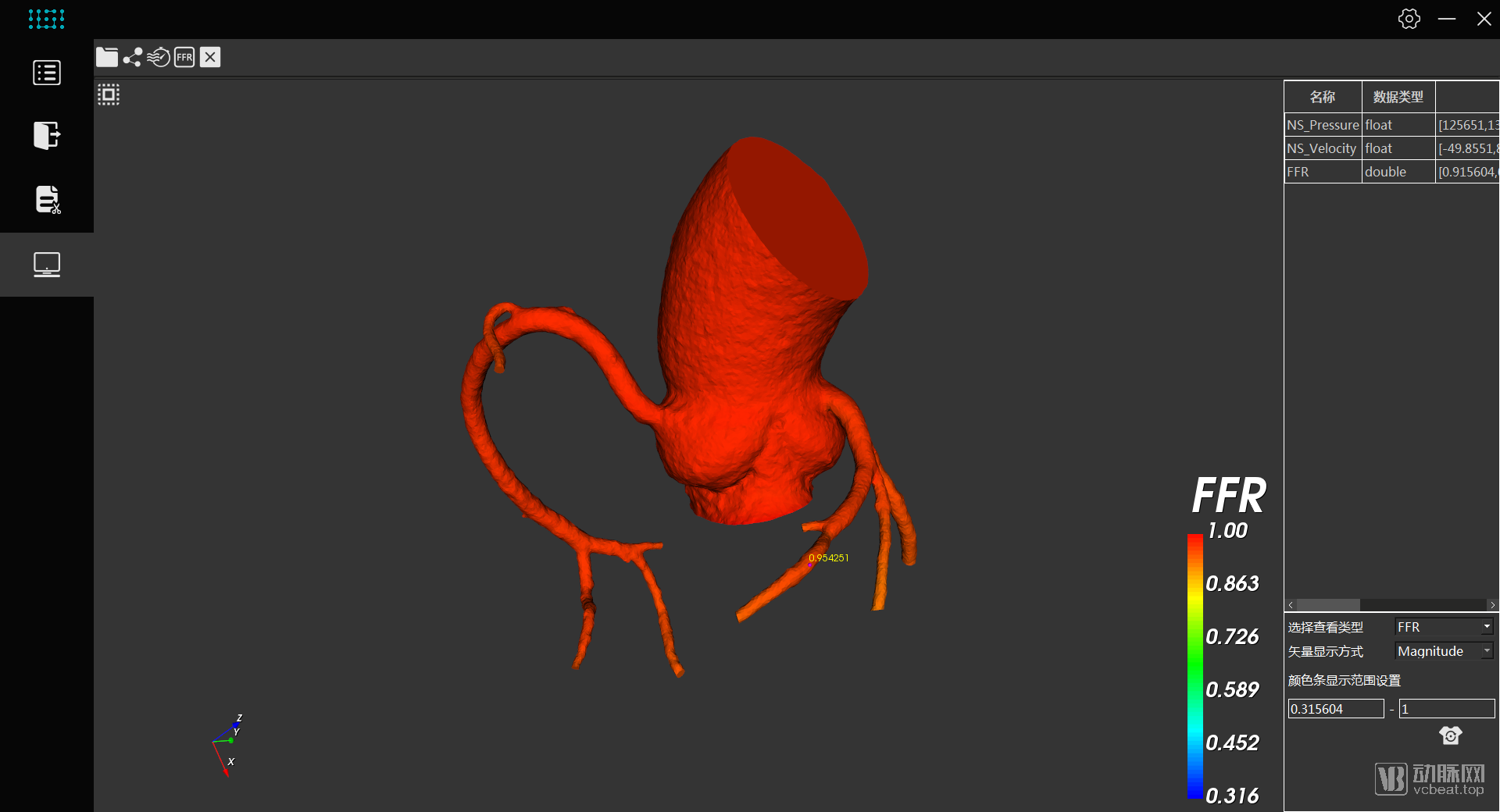
CT-FFR Calculation Results Show
HEART CENTURY has independently developed a software system for the non-invasive assessment of coronary ischemic lesions based on CT-derived fractional flow reserve (CT-FFR). By leveraging artificial intelligence to integrate multidisciplinary technologies—including image processing, computational fluid dynamics, and anatomy—the system simulates calculations based on CT data to obtain FFR values. This approach can effectively replace current invasive diagnostic procedures, significantly reducing surgical risks for patients and lowering healthcare costs.
Zhang Jing stated, “We encountered numerous challenges during the product development process. The primary difficulty lay in the accurate extraction of coronary arteries. Human coronary vessels are extremely thin, with a diameter of only about 2 mm. Coupled with various motion artifacts and noise, this makes automated vessel recognition highly challenging. In many cases, even physicians find it difficult to accurately assess vessel caliber. In response to these characteristics, we designed and optimized targeted algorithms, significantly improving accuracy and laying a solid foundation for subsequent FFR calculations.”
Generally, the diagnostic workflow for coronary heart disease involves an initial CT scan followed by invasive coronary angiography. When clinical diagnosis reveals vascular stenosis exceeding 70%, stent implantation is indicated. However, with the CT-FFR software service provided by HEART CENTURY, patients can undergo CT-FFR analysis directly after the CT scan. If the CT-FFR value is less than 0.8, further angiography and stent treatment are recommended; if it is greater than 0.8, conservative management is sufficient.
Currently, overseas CT-FFR diagnosis takes approximately 5 hours, with an accuracy of around 80%. The diagnostic accuracy is generally lower for patients in the gray zone (i.e., FFR values between 0.75 and 0.85).
HEART CENTURY employs large-scale parallel computing technology to decompose computational tasks across multiple CPU threads. By leveraging current multi-threaded concurrency capabilities of CPUs, it significantly reduces processing time, enabling diagnosis to be completed in approximately one hour.
In terms of accuracy, the company has developed a computational model that integrates multiple data sources by incorporating basic physiological parameters, such as sex, age, height, weight, blood pressure, and heart rate. By learning from and modeling large-scale historical data, the company has improved the accuracy of FFR calculations. Currently, in a retrospective study conducted at Fuwai Hospital of the Chinese Academy of Medical Sciences, HEART CENTURY has achieved a diagnostic accuracy of 90%.
Furthermore, according to clinical data from Fuwai Hospital of the Chinese Academy of Medical Sciences, only one-third of patients require interventional surgery after undergoing coronary angiography. By reducing the false-positive rate of coronary CT scans using HEART CENTURY’s CT-FFR product, it is estimated that the number of coronary angiographies performed could be reduced by 50%.
HEART CENTURY finalized its clinical protocol in June 2018 and commenced clinical trials in October of the same year, with completion expected by October 2019. Zhang Jing also revealed that the company has already completed clinical trials involving several hundred participants, with preliminary results indicating a diagnostic accuracy of approximately 90%. The clinical trial is now nearing its conclusion.
In addition to partnering with Fuwai Hospital, the largest cardiovascular disease hospital in China, the company also collaborates with six other renowned Grade A tertiary hospitals, including Beijing Chaoyang Hospital, Sir Run Run Shaw Hospital in Zhejiang, Qilu Hospital of Shandong University, TEDA International Cardiovascular Hospital in Tianjin, the First Affiliated Hospital of Harbin Medical University, and Beijing Tongren Hospital.
It is worth noting that HEART CENTURY has also developed a cloud computing platform. In the future, the company will provide remote CT-FFR analysis services to hospitals through a cloud service model. Hospitals only need to upload raw CT data to HEART CENTURY’s cloud platform, which will automatically schedule and perform the computations, ultimately returning the results to the hospitals. The company also aims to deploy CT-FFR in health checkup institutions, leveraging non-invasive methods to enable large-scale screening.
Regarding short-term goals, Zhang Jing stated that the company will focus on the registration and application of its CT-FFR product, aiming to become the first enterprise in China to obtain a Class III medical device registration certificate for CT-FFR.
Currently, HEART CENTURY has initiated its pre-A round of financing, which is planned to be used for market development activities after the completion of clinical trials but prior to obtaining the registration certificate.