

Junshi Biosciences Announces First-Ever Presentation of Toripalimab Plus Chemotherapy in Advanced NSCLC at WCLC 2019
Junshi Biosciences
Innovative Drug Developer
Recently, Junshi Biosciences (NEEQ: 83330, HKEX: 01877), a leading domestic innovator in biopharmaceuticals, announced that the research findings on its self-developed anti-PD-1 monoclonal antibody, toripalimab, in combination with chemotherapy for advanced or recurrent non-small cell lung cancer (NSCLC) with EGFR-sensitizing mutations after failure of EGFR-TKI therapy, were presented as an oral presentation at the 2019 World Conference on Lung Cancer (WCLC 2019).
This marks the debut of clinical data for Junshi Biosciences’ toripalimab at the WCLC, as well as the first public disclosure of its research findings in the field of lung cancer treatment.
The 2019 World Conference on Lung Cancer (WCLC 2019) was grandly held in Barcelona, Spain, from September 7 to 10. Organized by the International Association for the Study of Lung Cancer (IASLC), this year’s conference theme was “Conquering Thoracic Cancers Worldwide.” As the largest annual academic conference in the field of lung cancer and thoracic malignancies, WCLC brought together clinicians, researchers, and scientists from over a hundred countries to share the latest research findings.
On the afternoon of September 9 (local time), Professor Zhang Jie from Shanghai Pulmonary Hospital presented an oral report on the latest results of the study (NCT03513666) evaluating toripalimab combined with chemotherapy in patients with advanced or recurrent non-small cell lung cancer (NSCLC) harboring EGFR-sensitizing mutations who had experienced failure of EGFR-TKI therapy.
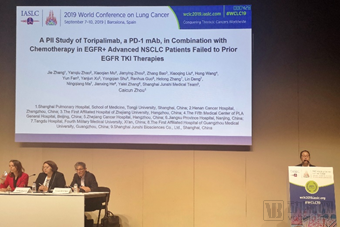
Professor Zhang Jie Delivers an Oral Presentation at WCLC 2019
Lung cancer has become the malignant tumor with the highest incidence and mortality rates in China and worldwide. Among its subtypes, non-small cell lung cancer (NSCLC) is the predominant form, accounting for approximately 85% of all cases. Notably, about 50% of Asian NSCLC patients harbor EGFR sensitizing mutations. After failure of standard first-line EGFR-TKI therapy, these patients are still primarily treated with traditional platinum-based doublet chemotherapy. There remains a significant unmet medical need for patients with advanced NSCLC harboring EGFR mutations who have progressed after EGFR-TKI treatment.
A prospective, multicenter, open-label, single-arm, Phase II study led by Professor Zhou Caicun of Shanghai Pulmonary Hospital, aimed at evaluating the efficacy and safety of toripalimab combined with chemotherapy in patients with advanced or recurrent non-small cell lung cancer (NSCLC) harboring EGFR-sensitizing mutations who have progressed after EGFR-TKI therapy.
In the study, patients received toripalimab in combination with pemetrexed/carboplatin for 4 or 6 cycles (once every 3 weeks), followed by maintenance therapy with toripalimab plus pemetrexed until disease progression or lack of clinical benefit. Efficacy was assessed by investigators every 6 weeks based on RECIST v1.1. The primary endpoint was the objective response rate (ORR) at 12 weeks (per RECIST v1.1 criteria). Secondary endpoints included safety, overall ORR, disease control rate (DCR), progression-free survival (PFS), and overall survival (OS).
A total of 40 patients were enrolled in the study. At the week 12 assessment,ORR reached 32.5%; as of July 25, 2019,The overall ORR was 50.0%, and the DCR was 87.5%, with 20 cases of partial response (PR) and 15 cases of stable disease (SD) (including one unconfirmed PR). The median duration of response (DOR) was 7.0 months, and the median PFS was 7.0 months (95% CI, 4.8–10.3 months).。
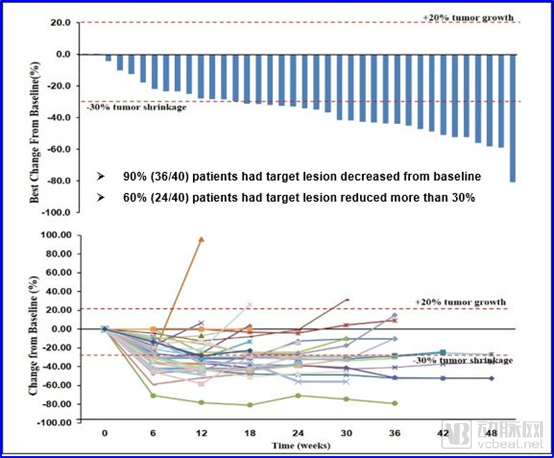
Changes in Patient Lesions
In his presentation, Professor Zhang Jie stated that toripalimab in combination with carboplatin and pemetrexed demonstrates robust antitumor efficacy and a manageable safety profile in patients with advanced or recurrent non-small cell lung cancer (NSCLC) harboring EGFR-sensitizing mutations who have progressed on EGFR-TKI therapy. This regimen holds promise as a new standard-of-care option for EGFR mutation-positive NSCLC patients following failure of EGFR-TKI treatment.
As an invited expert commentator at WCLC 2019, Professor Zhou Qing from Guangdong Provincial People’s Hospital and the Guangdong Lung Cancer Institute stated that this study from China demonstrates promising development prospects for immunotherapy (toripalimab) combined with chemotherapy in EGFR-mutated NSCLC patients who have developed resistance to EGFR-TKIs. He expressed anticipation that its efficacy will be further confirmed in subsequent Phase III randomized controlled trials.