

Synthetic Biology Industry Q2 2019 Funding Report: $1.9 Billion Raised in First Half, with Strong Focus on Therapeutics
Recently, SynBioBeta published an analysis of synthetic biology financing and investment in Q2 2019, based on a report by Crunchbase. The article was translated by VCBeat (WeChat ID: vcbeat). According to Crunchbase’s report, overall startup funding across all industries remained stable in the second quarter of 2019, while the synthetic biology sector stood out with exceptional performance. Following the first quarter, the field is on track to set a record for the total number of investment deals, although the total investment amount is not expected to surpass the remarkable $3.8 billion recorded in 2018. Nevertheless, Q2 of this year has been the strongest on record, even outperforming Q1, indicating robust and growing investor interest in the sector.
In the first half of 2019, 65 synthetic biology companies raised a total of $1.9 billion in funding. Both figures surpassed those of any previous year except for the prior year, underscoring the rapid growth of the synthetic biology industry. If investment continues at this pace, the number of deals in 2019 will increase by 33%, with the total amount matching the previous year’s $3.8 billion.
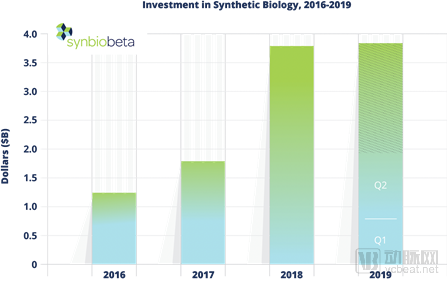
Figure: Total Investment in the Synthetic Biology Industry, 2016–2019
The 2019 Cohort of Funded Companies Is Reimagining the Pharmaceutical Industry
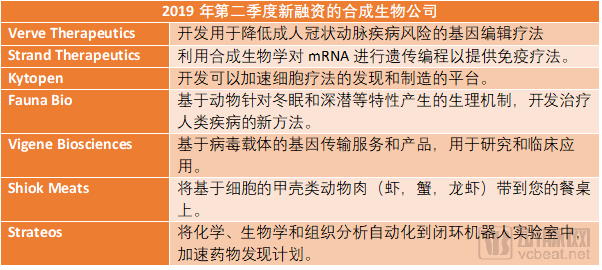
Of the 37 companies that received investment this quarter, seven were in their first round of financing. With the exception of one, all seven are focused on therapeutic applications. This may indicate that synthetic biology tools and technologies are enabling small, innovative, fast-growing companies to reimagine the pharmaceutical industry and pursue previously inaccessible market opportunities. More importantly, successful fundraising by both small and large companies will also benefit patients with rare diseases and those suffering from conditions with unmet therapeutic needs.
More Companies Are Getting a Slice of the Pie in Synthetic Biology
At the 2018 SynBioBeta Investor Summit, Alicia Jackson of Genoa Ventures stated that while capital is abundant worldwide, exceptional entrepreneurs are scarce. Nevertheless, the number of financing rounds in 2019 was projected to increase by approximately one-third compared to the previous year, indicating sustained strong investor support for synthetic biology companies and their technologies.
Overall, the key factor driving substantial capital raising within a year lies in mega-financing rounds rather than the number of funding rounds a company completes. In 2018, a significant surge in funding amounts—such as the combined $1 billion raised by Moderna and Zymergen—drove this shift. This year, although Impossible Foods secured $300 million in financing, it will require several additional rounds of similar magnitude to continue breaking fundraising records.
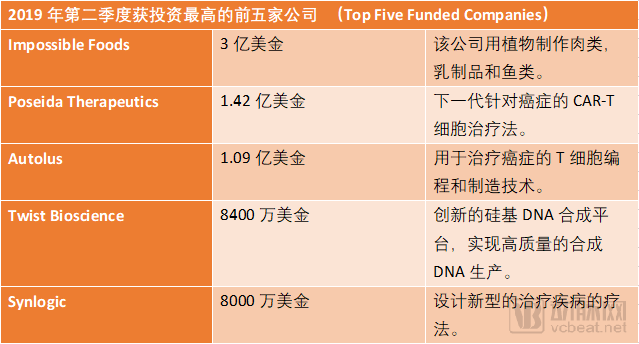
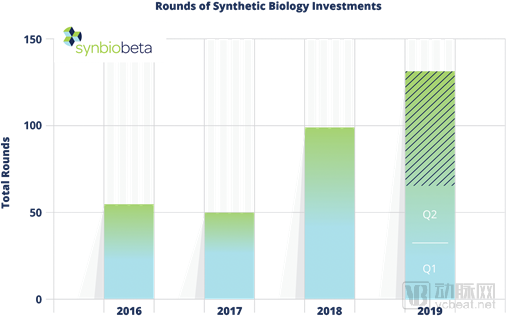
Figure: Number of Investment Rounds in the Synthetic Biology Industry, 2016–2019
Investment Directions in the Synthetic Biology Industry
Will Canine, the author of Opentrons, recently published an article on Synbiobeta discussing the concept of the “synbio stack.” We will refer to this as the “synthetic biology stack” (or more aptly for Chinese readers, the “synthetic biology ecosystem chain,” as noted by the translator), which is a way of abstracting synthetic biology products by analyzing their position within the synthetic biology ecosystem.
At the base of this ecosystem are the materials and tools that enable the rapid, easy, and precise design of customized biological systems. One level up, we begin to see products based on synthetic biology but applied in other fields. These products may be further refined after entering other sectors, such as industrial chemicals, or they may be consumer goods sold directly to end users.
Financial support is critical for all companies across the entire ecosystem, from upstream to downstream, as they are all essential to building a robust and healthy ecosystem. Synthetic biology must have applications that positively impact people’s lives to fulfill our commitments to the public and alleviate concerns about genetic engineering. Meanwhile, tool and reagent companies can help application-focused firms bring their products to market.
By categorizing the fundraising activities of different companies in the second quarter, we can see that all sectors have attracted investor attention.
The following section introduces several key hierarchical levels that constitute the entire ecosystem.
Biological Reagents
To build and customize a product with genetically engineered biological systems, we need tools capable of shaping the genome.
This is where reagent companies play a pivotal role, enabling faster, easier, and more cost-effective biological construction by providing new systems. Twist Bioscience supplies the majority of DNA used by synthetic biology companies and stands as an extremely significant contributor to the biological reagent repository. The company went public in 2018 and recently completed an $84 million fundraising round to support further research and development.
Process Execution Category
Advances in the automation and optimization of biological processes are among the key drivers behind today’s synthetic biology revolution. These advances have made it possible to construct and test thousands of biological designs at high throughput.
Inscripta is developing an unprecedented suite of tools for synthetic biology researchers and raised an additional $20 million in April for its C.Inscripta series, as it builds the world’s first scalable platform for benchtop digital genome engineering. Inscripta recently announced results from a single experimental library comprising 200,000 edits, which included multiple types of modifications to Escherichia coli biosynthetic pathways, revealing novel biology within the lysine metabolic pathway.
A major advantage of working with biology is the ability to generate substantial diversity with relative ease; however, until recent advances in the field of process execution, this diversity remained largely unexplored. Kytopen is a new company in this space that has raised $3.6 million in seed funding to commercialize its Flowfect technology. Their breakthroughs will significantly simplify the development and manufacturing of cell therapies, paving the way for treatments targeting new indications.
Biological Computer-Aided Design/Manufacturing Software (Bio-CAD/CAM)
Biological software is becoming increasingly important for designing and tracking all experiments to monitor progress in process execution. However, this is an area that has seen a significant decline in investment this year. Among the companies that raised funds this year, less than 3% belong to this category, marking the lowest level in recent years. Whether this is due to waning investor appetite for such companies or a lack of new startups being established in this field, we need to continue paying close attention to this sector to ensure that this segment of the business is sustained.
One company excelling in this field is Riffyn. The company empowers researchers to access the data generated from their experiments and transform it into actionable insights that can inform subsequent design cycles. To support this critical work, Riffyn closed a AUD 15 million Series B financing round in May. It is hoped that this will spur greater interest in Bio-CAD/CAM software and bring more software solutions into the field.
Application Category
Finally, the ultimate goal of forming a complete “synthetic biology tech stack” is to create biological devices that deliver value to consumers beyond other synthetic biology companies. Although these application products are still in their early stages, they demonstrate the diverse fields that can benefit from synthetic biology. This is further evidenced by companies that secured funding in the second quarter of 2019, whose application products span sectors ranging from healthcare and chemicals to fashion.
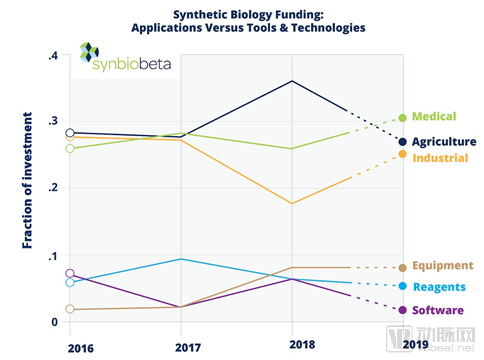
Figure: Types of Synthetic Biology Companies That Received Funding from 2016 to 2019
Codexis is a publicly traded protein engineering company that raised $50 million through a private placement. Codexis’s proteins are widely used across various industries, but the company has recently made significant strides in developing proteins as therapeutic agents, establishing partnerships with GSK and Merck.
Another young company is Checkerspot, which uses microalgae to produce functional materials. The company recently raised $13 million to advance this goal. Checkerspot’s technology illustrates why every company needs a biological strategy: because biology can achieve what other fields cannot, the microbes in its products can generate fatty acids with unique chemical properties.
Materials produced by Checkerspot will soon hit the market in the form of novel apparel, but they are not the only company dedicated to harnessing the power of biology to revitalize the fashion industry.
Pili is developing bio-based dyes to replace the petroleum-based dyes currently used by textile companies. This shift benefits both the environment and consumers, as bio-based dyes are likely less toxic. To fund this work, the company announced the closing of a $4 million financing round. SOSV, an investor in this round, recognizes the significant potential of the synthetic biology sector and frequently invests in this field.
Who are the investors?
The number of new investors in the synthetic biology sector surged in 2019. This was partly attributable to Impossible Foods’ Series E financing round, which attracted a wave of celebrity investors, ranging from Katy Perry to Kirk Cousins. Investors are flocking to the field from diverse backgrounds: many traditional venture capital firms have shifted their focus from information technology to synthetic biology, recognizing the potential of integrating computation with biology. Other investors, such as charitable organizations and family offices, are drawn by the positive environmental and human health impacts that synthetic biology companies can achieve when bringing their products to market.
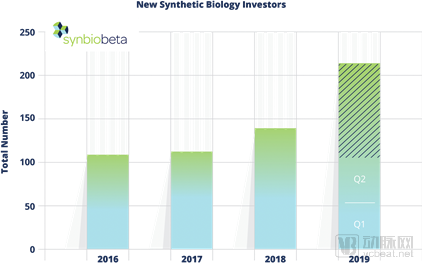
Figure: Number of New Investors in the Synthetic Biology Industry, 2016–2019
Analysis of the Geographic Distribution of Financed Companies
The East Coast and West Coast have long been the primary beneficiaries of new investments in synthetic biology, with the robust biotechnology sectors in San Francisco/Silicon Valley and Cambridge/Boston accounting for the majority of synthetic biology financing.
Last quarter, Boston led with $295 million in investment. The Midwest actually ranked second with $162 million, while San Francisco came in third with $64 million. This quarter, San Francisco reclaimed the top spot, bringing in $570 million. Boston ranked second, with companies raising $230 million. Third place went to the sunny shores of San Diego, where a large Series C financing round for Posieda Therapeutics boosted the region’s total funding to $150 million.
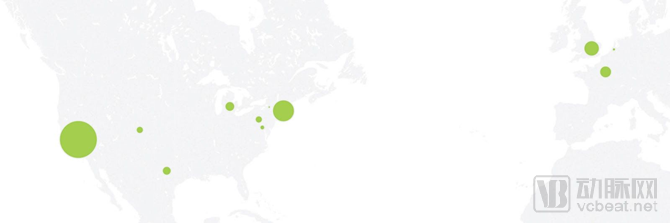
Figure: Synthetic Biology Investment by Region. This quarter, synthetic biology investment in the San Francisco Bay Area totaled $542 million, followed by $230 million in the Boston area. Other regions in the United States accounted for a total of $297 million, while the rest of the world totaled $147 million.
Analysts such as Dr. Dhruv K. Vig, Senior Associate for Digital Health at Silicon Valley Bank, have pointed out that investment capital and deal activity in the life sciences and healthcare sectors are beginning to increase in the central United States, marking growth beyond the mature coastal tech hubs. Indeed, funding in the U.S. Midwest rose in the first quarter, with several companies in the region securing substantial investments. The trends this quarter were relatively typical, with the San Francisco Bay Area leading regional funding totals, largely driven by Impossible Foods’ $300 million investment round in Emeryville, California. These investments illustrate the extent to which synthetic biology tools and technologies are influencing biotech companies and helping to attract new and emerging biotech hubs across the United States and around the world.
Analysis of Corporate Financing Rounds
A trend emerging in the general startup market is that a larger proportion of investment is going to late-stage companies. These financing rounds are typically much larger, leading to an increase in the total amount of capital raised while the total number of funded companies declines. The substantial influx of capital into startups, driven by a lack of new innovations, has obscured certain unsustainable aspects of the market. Funding for synthetic biology has been increasing for years; is this phenomenon beginning to appear in this field as well?
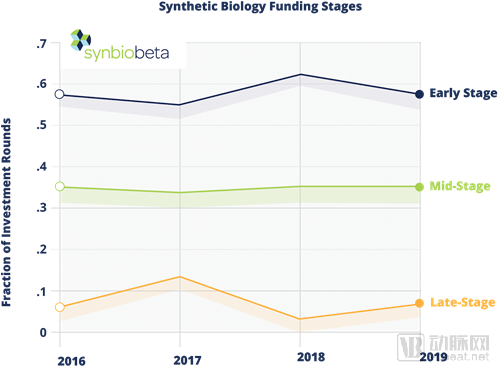
Figure: Sources of funding at different company stages. Funding for synthetic biology companies remains consistent across early, mid, and late stages. The investment portfolio indicates that new companies continue to enter the industry at a healthy pace.
Over the past few years, the distribution of early-stage, mid-stage, and late-stage investments has not undergone significant changes. Late-stage companies continue to account for only about 10% of the total number of investments. The increase in total funding for this sector is more likely attributable to a broad-based rise in the amount of capital raised by companies, indicating a sustained influx of new entrants into the synthetic biology field.
Summary
Crunchbase reports indicate that within the broader North American investment market, various data metrics point in divergent directions. While IPO activity remains robust and transaction volumes have increased, total investment amounts have remained flat. Overall, the financing environment for the synthetic biology sector appears to remain resilient.
In the second quarter of 2019, the synthetic biology industry set new records, as investors remained optimistic about its capacity to leverage biology to address critical challenges, create superior products, and drive new markets. Post-IPO performance was also robust, with companies such as Twist Bioscience and Beyond Meat achieving valuations significantly higher than their initial offering prices.
A broader market has sustained continuous growth in the synthetic biology industry. Social and political factors, such as the Green New Deal, may influence and establish a new roadmap for strategic investment in this sector, or enhance industry-public engagement to build trust in bioengineered products. Time will provide the answers. For now, however, the investment community appears to be keeping pace with developments and moving forward at full speed.
Author: Zhang Xian
Original report: https://synbiobeta.com/reports/