

NGS Industry Evolution: BGI Embraces 'Smart Manufacturing' While Berry Genomics Bets Big on Oncology
BGI
Scientific and Technological Service Provider and Precision Medical Service Operator

Berry Genomics
High-throughput Gene Sequencing Technology Developer
In 2016, the first NIPT kit was approved for market launch, marking the formal entry of NGS technology into clinical testing. This period also witnessed the turbulent era of NGS industrialization, during which NIPT gave rise to several leading enterprises in the NGS field. Today, the NIPT market has largely stabilized, and a new battle for market share is underway. Amidst the industry’s evolution, what developmental paths have these once-prominent companies taken?
To this end, we have traced the footprints of these enterprises in recent years, hoping to infer the direction of industry development by summarizing their development layouts in recent years.
BGI has always been the most talked-about company in the industry. As the first domestically listed NGS company, startups affiliated with BGI are commonly referred to as “Huachuang.” BGI and its affiliated companies have established a presence across China, becoming a prominent feature of the domestic biotechnology startup landscape.
NIPT has moved from the height of hype to a phase of steady development. It has been two years since BGI’s IPO; what is BGI up to now?
The latest annual report shows that BGI Genomics achieved an operating revenue of RMB 2.536 billion in 2018, a year-on-year increase of 21.04%; the net profit attributable to shareholders of the listed company was RMB 387 million, a decrease of 2.88% compared with the same period last year. Among the four major business segments, the total revenue from reproductive health in 2018 was RMB 1.376 billion, a year-on-year increase of 20.86%. The non-invasive prenatal genetic testing business, which had previously raised questions, completed more than 4.3 million cases cumulatively in 2018 according to the annual report. The business covers all stages including premarital, preconception, pregnancy, newborn, and childhood.
In terms of R&D, BGI invested RMB 265 million in research and development in 2018, increasing its R&D efforts in the development of key products for genetic diseases, infectious diseases, and tumors, as well as in obtaining corresponding regulatory approvals. Compared with 2017, BGI’s R&D investment in 2018 increased by 51.93% year-on-year.
Among the 36 key R&D projects disclosed in the annual report, six were focused on genetic diseases, eight on oncology, and eight on infectious diseases. However, BGI’s investment in upstream instrument manufacturing may have been even more substantial. Although this was not extensively highlighted in the annual report, we note that BGI has already spun off its instrument business into its subsidiary, MGI Tech.
Compared with research in application-oriented fields, instrument development requires greater investment. BGI’s decision to spin off this business segment may have been driven by concerns that such R&D expenditures could impact the financial performance of its listed entity. According to data disclosed by Qichacha, MGI Tech was established in 2016 and has raised over USD 200 million in financing to date. A review of BGI’s series of moves following its IPO makes the rationale even clearer.
In October 2017, at the 12th International Conference on Genomics hosted by BGI, MGI Tech unveiled two new high-throughput sequencers, marking the dawn of domestically manufactured sequencing instruments.
The two high-throughput sequencing systems launched this time are the MGISEQ-2000 and the MGISEQ-200. One year later, MGI Tech re-released the MGISEQ-T7 product at the 13th International Genomics Congress. Compared to the MGISEQ-2000 and MGISEQ-200, the MGISEQ-T7 has seen significant improvements in throughput and capacity, with daily output data reaching up to 6Tb.
In addition to the previously launched BGISEQ-500 and BGISEQ-50, MGI Tech currently offers five sequencer products (according to its official website, the BGISEQ-1000 is not currently attributed to MGI Tech). Among these, the BGISEQ-50 and BGISEQ-500 received certification from the China Food and Drug Administration (CFDA) in 2016 and 2017, respectively. The MGISEQ-2000 and MGISEQ-200 also passed the review by the CFDA in June 2018, obtaining medical device registration certificates.
In May 2019, the world’s first intelligent identification instrument for genetic sequencing of traditional Chinese medicine (TCM) herbs, jointly developed by MGI and the Institute of Chinese Materia Medica, China Academy of Chinese Medical Sciences, passed acceptance inspection. It is reported that the instrument enables one-stop sequence processing, simplifies complex bioinformatics workflows, and allows for accurate, rapid, and stable identification of TCM herb samples.
Following the launch of its sequencers, BGI has been seeking to commercialize its products. In addition to actively advancing regulatory approval processes, BGI is promoting its sequencers internationally through scientific research collaborations both domestically and abroad, having already signed agreements in 22 countries, including Thailand and South Africa. For the domestic market, besides actively participating in various medical device forums and exhibitions, MGI Tech held a Summit Forum on Sequencing Technology and Applications in June 2019, aiming to identify more potential customers for its sequencers.
We also note that BGI has been frequently investing in numerous companies affiliated with the Huachuang Group since 2017:
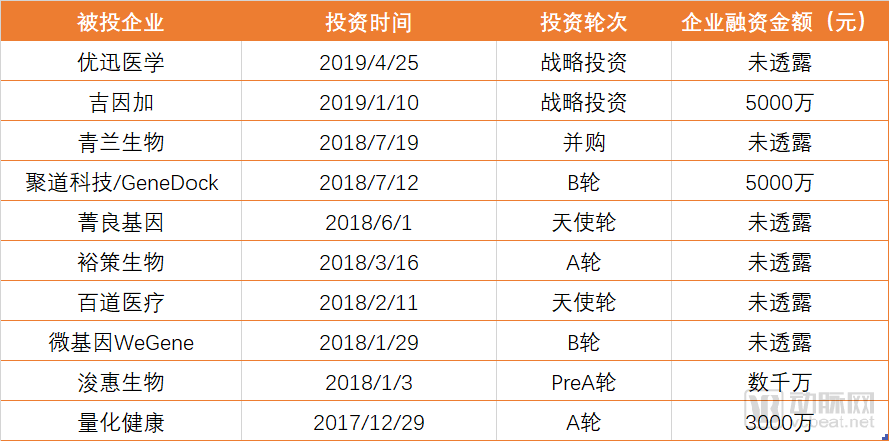
Data source: VCBeat Knowledge Base
One aspect of the investment is to optimize product portfolio, while another may be to promote the industrialization of domestically produced sequencers. In addition, MGI’s sequencing platforms are seeing a continuous rollout of related sequencing components.
On January 8, 2018, MGI and 10X Genomics simultaneously announced that the BGISEQ-500RS is compatible with 10X Genomics’ Linked Reads technology and single-cell transcriptome library preparation technology.
On March 2, 2019, MGI Tech unveiled its latest base-calling technology, CoolNGS, at the 2019 Advances in Genome Biology and Technology (AGBT) conference. This novel base-calling technology employs unlabeled nucleotides combined with four-color fluorescent labeling to identify bases during sequencing, thereby enabling non-destructive base detection. This technology will significantly enhance sequencing read length and accuracy, playing a pivotal role in advancing the application of sequencing technologies across various fields.
On May 27, MGI Tech released its independently developed domestic FPGA-based bioinformatics analysis accelerator, MegaBOLT. This accelerator significantly reduces the time required for genomic sequencing analysis, effectively improving the efficiency of genomic data analysis while also emphasizing user experience and integration with upstream sequencing workflows.
On June 15, BGI released its “high-definition” assembled genome solution and standards at the European Society of Human Genetics Conference (ESHG 2019). This solution and its associated standards are based on MGI’s proprietary DNBSEQ™ sequencing technology and stLFR. The newly announced criteria for high-precision genome sequencing data are: Contig N50 > 10^6, Scaffold N50 > 10^7, and assembled whole-genome data > 6 Gb, collectively referred to as the “676” standard.
In addition to high-throughput sequencing, MGI is also attempting to expand into other areas of in vitro diagnostics.
On January 24, 2018, MGI Tech and Luohu Hospital reached a cooperation agreement on the research and application of “remote ultrasound diagnosis.” This collaboration further improved Luohu Hospital’s telemedicine infrastructure and marked the first step for MGI Tech’s remote ultrasound products to enter the market.
On April 11, Huasheng Medical and MGI Tech officially signed a strategic cooperation agreement at the 79th China International Medical Equipment Fair (Spring). The two parties will jointly develop a remote ultrasound diagnostic system, GIUS-R3. MGI Tech will be responsible for the overall planning and product implementation of the system, while Huasheng Medical will be responsible for the ultrasound module within the system.
From April 18 to 21, 2019, BGI’s seven research and development advances in mass spectrometry were unveiled for the first time at the Annual Conference of the Metabolomics Branch of the Chinese Society for Biophysics. The seven latest R&D achievements include detection of antibiotic residues in the human body, detection of catecholamines and their metabolites, and quantitative detection of 132 urinary metabolites.
Based on these moves, BGI’s “intelligent manufacturing” strategy may not be limited to high-throughput sequencers and their components; rather, it aims to establish MGI as an upstream manufacturer in the IVD sector, centered around in vitro diagnostics and life sciences. According to public information, MGI completed its Series A financing round in May 2019, raising RMB 200 million with participation from CITIC GoldStone, Shunwei Capital, and Dongzheng Capital. Earlier media reports indicated that BGI Genomics planned to spin off MGI for a listing in Hong Kong, with a pre-IPO valuation of RMB 33 billion.
In its semi-annual report, BGI outlined its future strategy as follows. First, global expansion has been frequently emphasized; the company currently maintains branches in mainland China, the Asia-Pacific region, Europe, and the Americas. Leveraging its existing strengths in scientific research, technology, market presence, and resources, BGI aims to further expand and deepen its global market footprint through a multi-technology and big data platform spanning omics disciplines. Second, building a life sciences database is a key priority for the next phase. By establishing a world-leading life sciences database and a novel disease control service platform, the company seeks to enhance its core competitiveness and become an industry leader in the application of genetic technologies. Third, BGI plans to extend its business along the industrial chain, covering multiple fields including big data development, bio-intelligence, whole-genome diagnostics, early cancer screening, gene therapy, cell therapy, immunotherapy, new drug R&D, and synthetic biology.
In 2018, Berry Genomics achieved a total operating revenue of RMB 1.44 billion, a year-on-year increase of 22.93%; the net profit attributable to shareholders of the listed company was RMB 268 million, a year-on-year increase of 15.18%. Genetic testing services are categorized into medical products and services, and basic scientific research services. The company’s medical products and services are divided into medical testing services, reagent sales, and equipment sales; medical testing services primarily focus on two application areas: genetics and oncology. Among the five major business segments, testing services accounted for 53.35% of revenue, actual product sales accounted for 27.89%, basic scientific research services accounted for 9.13%, equipment sales accounted for 5.23%, and other business operations accounted for 4.39% of revenue.
In terms of R&D, Berry Genomics invested RMB 91.27 million in 2018, allocating these funds to five projects primarily focused on “non-invasive” comprehensive solutions for genetic diseases. Furthermore, Berry Genomics has actively positioned itself across the entire industrial chain of genetic testing by strengthening its capital operations. Its key strategic directions include extending its genetic disease detection and oncology testing businesses—covering the full life cycle—from late-stage diagnosis to early and ultra-early screening, and building a database of pathogenic gene information specific to the Chinese population, with big data at its core. In light of the company’s series of moves, we infer that its oncology business will be Berry Genomics’ next strategic focus.
In August 2017, the Oncology Division of Berry Genomics announced its independent operation, leading to the establishment of He Rui Genomics. In November of the same year, He Rui Genomics secured RMB 800 million in financing. With joint investment from Berry Genomics and professional investment institutions, He Rui Genomics leveraged comprehensive advantages in “technology + distribution channels + capital,” fully continuing Berry Genomics’ original oncology business and upholding its commitment to early screening and early treatment of cancer.
On April 22, 2018, the National Multi-Center, Prospective Cohort Study for Screening Ultra-Early Warning Biomarkers of Liver Cancer, jointly initiated by Helis Genomics, the National Center for Liver Cancer/Shanghai Eastern Hepatobiliary Surgery Hospital of Naval Medical University, and Nanfang Hospital of Southern Medical University, was officially launched. This initiative marks a groundbreaking step in China’s liver cancer prevention and control efforts, entering a new phase of ultra-early intervention and clinical validation. It is expected to significantly improve the diagnostic accuracy of liver cancer, particularly early-stage disease, thereby enhancing the quality of life for the vast population of liver disease patients in China.
In September of the same year, Professor Chen Lei from the National Center for Liver Cancer presented the results of the PreCar (Prospective suRveillance for very Early hepatoCellular cARcinoma) pilot study on behalf of the research team at the CSCO conference. The data showed that the sensitivity for liver cancer detection exceeded 90% at a specificity of 95%; even when the specificity threshold was set at 99%, the sensitivity reached 87%. This marks a phased advantage in the experimental data for Huirui Gene’s PreCar early liver cancer screening project.
In March 2019, Dr. Zhou Daixing, CEO of Berry Genomics and Director of Huirui Gene, announced another major breakthrough in the PreCar project for early liver cancer screening at the 4th China-US Hospital Management Seminar and the 1st C3 China-US Health Conference. Data showed that in controlled detection trials involving patients with liver cirrhosis and liver cancer, the sensitivity for detecting liver cancer exceeded 97% while maintaining 100% specificity. This result marks the successful development of an NGS-based classification model for liver cirrhosis and liver cancer as part of the PreCar early liver cancer screening project.
This model can effectively differentiate between patients with liver cirrhosis and those with hepatocellular carcinoma by leveraging features derived from plasma biomarker sequencing, thereby accurately identifying cirrhotic patients who have undergone malignant transformation. The identification of molecular biomarkers and detection methods for early diagnosis and screening is undoubtedly a critical component of cancer early screening. The trial results announced here mark a significant step forward in China’s exploration of early diagnosis for liver cancer.
In September 2019, Huirui Gene partnered with Shanghai Chest Hospital to establish the first large-scale precision medicine research center for thoracic tumors. Leveraging their respective strengths in clinical resources, genetic testing, and big data analytics, the center will integrate high-quality clinical and genomic data to conduct clinical research on precision therapy for thoracic tumors as well as frontier scientific studies. By driving clinical translation and technological innovation through research, the center aims to enable cancer patients to benefit from personalized precision medical services at an earlier stage. Reportedly, this will be the first large-scale precision research center for thoracic tumors in China.
In addition to its collaborations with hospitals, HelixGene has also explored partnerships with pharmaceutical companies. In March 2019, HelixGene entered into a strategic cooperation agreement with AstraZeneca, under which the two parties will collaborate on BRCA testing to provide a broader platform for delivering more scientific and personalized precision therapy to patients with BRCA gene mutations.
More importantly, on July 7, 2019, Berry Genomics announced that the intended use of its NextSeq CN500 gene sequencer had been updated, transforming it into a general-purpose next-generation sequencing (NGS) platform deployable in medical institutions and capable of immediately launching large-scale clinical genetic testing. Clinically, this instrument is used in conjunction with in vitro diagnostic reagents approved by China’s National Medical Products Administration and the instrument’s accompanying random-access software; it is not intended for human whole-genome sequencing or de novo sequencing.
This change in scope has been hailed as a milestone event by China’s gene sequencing industry and represents a significant boost to Berry Genomics’ oncology business. “This approval is a major impetus for the clinical application of genetic testing technology, and it also signifies that the NextSeq CN500 has moved beyond NIPT into the realm of diagnosing a broader range of diseases,” said Dr. Gao Yang, Chairman of Berry Genomics.
Leveraging its NIPT business, Berry Genomics went from establishment to public listing in just seven years. As a company deeply entrenched in the medical field, Berry Genomics is the most influential enterprise in the NGS sector. With the NIPT market reaching maturity, Berry Genomics has set its sights on the larger tumor detection market as its next strategic frontier.
Novogene initially built its business on scientific research services. In 2015, Novogene surpassed BGI in domestic scientific research service revenue, reaching RMB 350 million, and became the largest provider of scientific research services in the industry. In December 2018, Novogene released its prospectus for the initial public offering (IPO) and listing on the ChiNext Board. The prospectus indicated that Novogene planned to issue 40.2 million shares and list on the ChiNext Board of the Shenzhen Stock Exchange, with CITIC Securities serving as the sponsor. During the reporting period, R&D expenses accounted for 14.67%, 6.66%, 6.81%, and 7.01% of operating revenue, respectively. The company held 22 patents and 149 software copyrights. It is highly likely to become the third listed company in the NGS field.
As the trend toward clinical adoption of next-generation sequencing (NGS) technology becomes increasingly pronounced, Novogene has long been strategically positioning itself in the clinical sector through its reproductive health and oncology businesses. Currently, leveraging high-throughput sequencing technologies alongside other genetic testing methods, Novogene provides gene testing and bioinformatics analysis services to research institutions, universities, healthcare facilities, pharmaceutical companies, and other enterprises. In recent years, Novogene has maintained its industry leadership by pursuing a dual strategy: advancing regulatory submissions for its oncology products while simultaneously strengthening its multi-omics service capabilities.
In March 2017, Novogene introduced Illumina’s latest sequencing platform, the NovaSeq. It was revealed that this was among the first batch of NovaSeq systems deployed globally. Having previously been among the first users worldwide to adopt the HiSeq X Ten in 2014, Novogene has become the world’s largest sequencing service center. With the deployment of the NovaSeq, Novogene will achieve an ultra-high throughput capacity of 280,000 whole-genome sequencings per year.
In July 2017, Novogene’s Digital PCR NG received market approval from the China Food and Drug Administration (CFDA). The CFDA specified that the instrument is suitable for detecting T790M mutations in cell-free DNA samples derived from human plasma, and it can be subsequently used in conjunction with Novogene’s human EGFR gene T790M mutation detection kit, which was undergoing registration application at the time. This instrument also became the first digital PCR chip reader approved for market launch by the CFDA in China.
In September 2017, Novogene announced the acquisition of five newly released Thermo Fisher Scientific Orbitrap™ Q Exactive™ HF-X ultra-high-resolution mass spectrometers, marking a strong entry into the field of proteomics. This platform significantly enhances protein detection sensitivity, quantitative reproducibility, and sample throughput, making it more suitable for in-depth proteomic studies of complex biological samples. Leveraging Thermo Fisher Scientific’s advanced high-resolution mass spectrometry platform signifies Novogene’s strategic shift from gene sequencing to a more comprehensive multi-omics domain.
In July 2019, Novogene announced a deep strategic partnership with the U.S. genetic diagnostics company Mission Bio to expand into the field of single-cell DNA sequencing.
Mission Bio was founded in 2012 in Silicon Valley, Southern California, USA, focusing on high-throughput molecular diagnostics and genomic precision medicine at the single-cell level. In 2017, the company pioneered the launch of Tapestri™, a commercialized single-cell DNA analysis platform. Compared to other single-cell analysis platforms, Mission Bio’s Tapestri™ not only achieves high-throughput processing of tens of thousands of cells with enhanced sensitivity capable of detecting rare cancer cells comprising as little as 1% of the population, but also monitors mutation co-occurrence during cancer treatment.
Leveraging MissionBio’s single-cell DNA sequencing platform, Novogene and MissionBio will accelerate clinical research in the fields of precision medicine and personalized medication in China.
In addition, to meet the growing sequencing demands in data processing, Novogene is also accelerating data computation speeds by collaborating with data service and cloud computing companies.
In November 2017, Novogene and Rongzhi Lian signed a strategic cooperation agreement, under which the two parties will engage in comprehensive collaboration in areas such as BioCloud, the NGS consortium, and internal production systems, so as to provide more convenient and competitive service products for the global gene sequencing market.
In December 2017, the “China 100,000 Genomes Project” was launched. As a leading domestic sequencing service provider, Novogene also participated in the initiative.
To enhance its data computation speed, Novogene began advancing the migration of gene sequencing to the cloud several years ago and has progressively transferred its gene sequencing operations to Alibaba Cloud. Leveraging Alibaba Cloud’s computing and storage capabilities, Novogene can load whole-genome sequencing data for 10,000 individuals within 17 minutes and complete a single gene sequencing pipeline in just 1.5 hours, significantly reducing sequencing turnaround time.
Not only that, but thanks to breakthroughs at the regulatory level and its own accumulation, Novogene has also made significant breakthroughs in its oncology business.
In April 2017, Novogene’s “Human EGFR, KRAS, BRAF, PIK3CA, ALK, and ROS1 Gene Mutation Detection Kit (Semiconductor Sequencing Method)” entered the CFDA’s Special Approval Procedure for Innovative Medical Devices. In addition to Novogene, several other companies, including Burning Rock Biotech, AmoyDx, Geneseeq, and Fushuo Biology, have also had their products approved through the “Green Channel.”
In August 2018, Novogene’s “Human EGFR, KRAS, BRAF, PIK3CA, ALK, and ROS1 Gene Mutation Detection Kit (Semiconductor Sequencing Method)” received marketing approval from the China Food and Drug Administration. This kit enables simultaneous detection of mutations in six genes—EGFR, KRAS, BRAF, PIK3CA, ALK, and ROS1—thereby guiding the clinical use of targeted lung cancer therapies such as gefitinib, osimertinib, and crizotinib. As one of the first tumor next-generation sequencing (NGS) products to gain market approval, its launch marked the beginning of standardized clinical application of NGS technology.
In September of the same year, Novogene’s accompanying analysis software for the “Human EGFR, KRAS, BRAF, PIK3CA, ALK, and ROS1 Gene Mutation Detection Kit (Semiconductor Sequencing Method)” was launched. This also marked the first Class III medical device registration certificate in China granted for tumor NGS data analysis software. In the field of human disease research, Novogene has accumulated experience in studying the molecular mechanisms of more than 150 diseases and tumors.
Following its Series C funding round, Annoroad Gene Technology increased its investment in scientific research and introduced a series of new platforms, including those from Oxford Nanopore and PacBio.
In December 2017, Annoroad Gene Tech announced the acquisition of 10 PacBio third-generation sequencers to strengthen its construction of an internationally leading genomics center. In April of the following year, Annoroad Gene Tech formally entered into a strategic cooperation agreement with PacBio. The two parties agreed to engage in in-depth collaboration on the application of SMRT single-molecule sequencing technology in basic research on animal and plant genomics, basic medical research, and translational medicine. Additionally, they will collaborate extensively on the establishment of gene banks for important agricultural germplasm resources, further promoting the application of genetic technologies in agricultural breeding. By August 2019, the number of PacBio third-generation sequencers in Annoroad Gene Tech’s platform had reached 12.
The introduction of the PacBio Sequel platform will further enrich the genetic variation information in the ATCG database. Through these strategic initiatives, Annoroad Gene Technology will further establish a critical foundation for serving users in the areas of genomic data generation, storage, and analysis.
Also introduced concurrently was the Oxford Nanopore sequencing platform. In December 2018, Annoroad Gene Tech announced a formal partnership with Oxford Nanopore to introduce the PromethION, Oxford Nanopore’s highest-throughput sequencing platform. As the latest ultra-high-throughput sequencing device launched by Oxford Nanopore, the PromethION supports real-time, long-read, direct DNA and RNA sequencing workflows. Through this initiative, Annoroad Gene Tech aims to enhance its capabilities in large-scale genomics services and expand the international influence of its genomics center.
In terms of collaboration, in addition to establishing relationships with research institutions in the life sciences and agriculture sectors, Annoroad Gene Tech entered into a strategic partnership with Kerui Bio in August 2018. Kerui Bio is a biotechnology company co-founded by several Peking University alumni and overseas returnees, dedicated to the research and development of anti-tumor immunotherapy technologies, the development and provision of gene editing products and services, and the exploration of gene therapy for genetic diseases. The purpose of this strategic partnership is to combine Annoroad’s strengths in high-throughput sequencing services with Kerui Bio’s expertise in gene editing technologies, fostering in-depth cooperation on the integrated application of epigenomic sequencing, single-cell multi-omics sequencing, and 3D genomics sequencing technologies with gene editing techniques. This collaboration fully integrates the advantageous resources of both parties, promoting mutual benefits and win-win outcomes in the fields of scientific research services and precision medicine.
In terms of medical operations, Annoroad Gene Tech introduced Illumina’s then-latest sequencing platform, the NovaSeq 6000, in November 2017, further expanding its capacity for big data and large-sample sequencing analysis (the NovaSeq 6000 is suitable for projects involving virtually any genome, sequencing method, or scale, and can also be used for scientific research services).
In September 2018, the grand opening ceremony of Zhejiang Annoroad Gene Technology Co., Ltd. was held in Yiwu, Zhejiang Province, marking the official commencement of operations for Annoroad’s Southern Center. It is reported that the Southern Center has deployed a suite of high-performance, high-throughput sequencing platforms, including the second-generation sequencer NovaSeq 6000 and the third-generation sequencer PacBio Sequel. Coupled with the Annoroad Life Sciences Research Institute, which was approved for establishment in July of the same year, the Southern Center will leverage the core resource advantages mastered by the Beijing headquarters across the upstream, midstream, and downstream segments of the gene sequencing industry chain. Its goal is to build a comprehensive gene technology ecosystem encompassing a Medical Testing Center, a Scientific and Technological Service Center, a Genetic Health Center, an Instrument and Reagent Manufacturing Center, and a Life Sciences Research Institute.
Medical and scientific research services are the two development pillars of Annoroad. In its early years, the company, like Berry Genomics, adopted a growth strategy that transitioned from non-invasive prenatal testing (NIPT) to oncology. Beyond NIPT and oncology, Annoroad also expanded into cloud services, microbial detection, and epigenetics, offering a broad range of medical and scientific research services.
In May 2019, multiple media outlets reported that Annoroad had laid off its oncology business. Upon verification by VCBeat, Annoroad’s medical services currently still encompass both reproductive health and oncology segments. Specifically, the reproductive health division initiated a research project on NIPT interfering factors in 2017, while the oncology division has shifted its focus toward immunotherapy.
Standing at a higher vantage point to look further ahead, large corporations inevitably possess a broader vision and more long-term insights into the market. The future trajectory of the NGS sector can be foreseen from the strategic layouts adopted by major companies in recent years.
In the recent development trajectories of several companies, it is evident that each has placed significant emphasis on their oncology businesses. Following Burning Rock Biotech’s acquisition of the first NGS certification, Novogene, Geneseeq, and AmoyDx have subsequently obtained corresponding qualifications. This signifies that, following the establishment of NIPT, tumor testing is gradually being implemented in clinical practice.
On the other hand, China’s upstream NGS sector still relies heavily on imported products. As a critical component of the IVD industry, import substitution in the NGS field is inevitable and will eventually come to fruition. As a cornerstone of national technological prowess, the vast NGS market in China is sure to carve out a significant place for domestic brands.
In terms of technological applications, the brief mention of NIPT and oncology actually conceals breakthroughs across multiple fronts—technology, clinical practice, and regulation—foreshadowing greater potential for high-throughput sequencing in clinical and healthcare settings.
In oncology, alongside the currently approved targeted therapy companion diagnostics, tumor immunotherapy testing is gaining significant momentum. There remains a vast untapped market for cancer pharmacogenomic testing and early screening and diagnosis. In the realm of genetic health, non-invasive prenatal testing (NIPT) represents only the initial stage of commercialization, with additional opportunities in rare diseases and monogenic or polygenic hereditary disorders. Meanwhile, pathogen diagnostics and single-cell sequencing are quietly emerging as promising fields.
While large companies deepen their core businesses, they must also continuously explore new directions to keep pace with the times. Industry development will inevitably give rise to a new landscape, characterized by the emergence of new enterprises and the succession and competition between established and emerging players. New stories will unfold in fields such as tumor immunology, instruments and reagents, and other untapped frontiers.