

National Push to Accelerate Commercial Health Insurance: Regulators Encourage Insurers to Provide Medical Insurance Administration Services
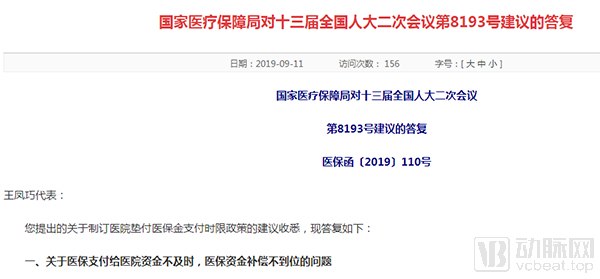
VCBeat (WeChat ID: vcbeat) has learned that on September 11, the National Healthcare Security Administration responded to a proposal from deputies to the National People’s Congress regarding the establishment of policies specifying time limits for hospitals’ advance payments of medical insurance funds. The administration further stated that, in the process of promoting universal coverage under the basic medical insurance scheme, the country will also improve and facilitate the development of commercial health insurance and leverage its role.
Standardize the Time Limits for Medical Insurance Fund Disbursements and Strictly Investigate and Punish Fraudulent Claims by Healthcare Institutions
It is understood that Proposal No. 8193 submitted to the Second Session of the 13th National People's Congress raised issues such as untimely medical insurance payments to hospitals, inadequate reimbursement of medical insurance funds, and a bias in the allocation of medical insurance funds toward public hospitals. In response, the National Healthcare Security Administration stated:
Overall, most regions have been able to disburse medical insurance funds to designated medical and pharmaceutical institutions within the timeframes stipulated in their agreements; however, arrears do exist in some areas. Recent inspections conducted through the State Council’s “Internet + Supervision” platform have exposed such issues. The relevant localities have since carried out comprehensive screenings and rectification measures within their pooling areas and have promptly disbursed the reasonable amounts due to the designated medical and pharmaceutical institutions.The National Healthcare Security Administration has attached great importance to the issue of arrears in medical insurance payments, having held discussions with relevant provinces, cities, and districts/counties, conducted on-site inspections in certain areas, and launched a nationwide rectification campaign to address the problem of overdue payments to designated medical institutions and pharmacies.
Next, the healthcare security authorities will guide localities in further improving total budget control and agreement-based management, revise model agreements, establish long-term mechanisms, standardize timelines for the disbursement of healthcare security funds, and ensure implementation across all regions. Leveraging conduct improvement as a key initiative, we will advance the enhancement of administrative conduct within healthcare security departments nationwide, while simultaneously optimizing business processes of handling agencies to further standardize settlement and payment with medical institutions. In conjunction with the ongoing development of the National Healthcare Security Information System, we will optimize the system at the national level to achieve full-process monitoring and traceability of healthcare fund settlement and disbursement across all regions, thereby strengthening oversight by healthcare security authorities at all levels over fund disbursements.The finance departments will actively coordinate with the healthcare security authorities and other relevant agencies. Based on a comprehensive assessment of the current situation, they will adopt measures such as further raising the level of healthcare security funding, improving the financial accounting system for healthcare security funds, and strengthening equitable negotiations between healthcare security agencies and hospitals, so as to properly address the issue of overdue payments to hospitals from healthcare security funds.
Meanwhile, in the management of designated medical and pharmaceutical institutions, healthcare security authorities have consistently adhered to a policy of equal treatment for medical institutions of different natures and categories. Reimbursement from the healthcare security fund is not based on differences in ownership; rather, it requires the establishment of effective mechanisms to encourage medical institutions to strengthen the management of medical service practices, proactively reduce costs, and improve the quality of medical services while curbing the rapid growth of medical expenses.
Furthermore, since its establishment, the National Healthcare Security Administration has attached great importance to fund security and has taken a series of measures to severely investigate and punish fraudulent insurance claims by medical institutions, including private hospitals.Next, the healthcare security authorities will strictly implement the directives of the CPC Central Committee and the State Council, continuously carry out campaigns to crack down on insurance fraud, plug loopholes, strengthen supervision, impose severe penalties, and maintain a strong deterrent effect. They will enhance the supervision of healthcare security funds by guiding localities to conduct special governance against insurance fraud, achieving full coverage of inspections for designated medical institutions and pharmacies, and expanding the scale of unannounced inspections. Actively promote the construction of demonstration sites for intelligent monitoring of medical security, explore big data-based mining and analysis of fraudulent insurance activities, and improve the informatization, intelligence, and efficiency of fund supervision. Meanwhile, third-party forces such as information technology service providers, accounting firms, and commercial insurance institutions will be introduced, and a multi-departmental coordination mechanism involving public security, health, market regulation, and discipline inspection and supervision authorities will be established. By innovating fund supervision methods, initiating the drafting of the Regulations on the Supervision and Administration of the Use of Medical Security Funds, and launching pilot programs for innovative supervision models and the construction of a credit system for fund supervision, we will advance the establishment of a long-term mechanism for healthcare security fund supervision.
Encourage the development of commercial insurance and guide insurance institutions to provide medical insurance administration services.
In its response, the National Healthcare Security Administration also stated that it aims to achieve universal coverage by expanding multi-tiered protection systems, including commercial health insurance and medical assistance, and to introduce mechanisms for insurance companies to manage healthcare security funds.
In recent years, commercial health insurance has demonstrated strong momentum, leveraging the advantages of market mechanisms to play a positive role in the construction of a multi-tiered medical security system. Its significance in meeting the growing public demand for health protection has become increasingly prominent. Looking ahead, as the Healthy China strategy is progressively implemented, the development of commercial health insurance will transition from an exploratory phase to a period of sustained and rapid growth, entering a new stage.
Premium income from commercial health insurance grew from RMB 86.276 billion in 2012 to RMB 544.813 billion in 2018, representing an average annual growth rate of 24.12%. In 2018, claim payouts amounted to RMB 174.43 billion, a year-on-year increase of 34.7%. The primary product mix consisted of critical illness insurance and medical expense insurance, which effectively met the health protection needs of insured individuals and accumulated over RMB 900 billion in health protection risk reserves.
Since 2001, the insurance industry has leveraged its advantages in actuarial technology, professional services, and risk management to proactively assume social responsibility. At the request of governments and healthcare security authorities, it has actively and prudently participated in the administration and management of various medical security programs. In 2018, the insurance industry was involved in the administration of diverse medical insurance schemes, managing entrusted funds totaling RMB 38.145 billion, generating premium income of RMB 28.5 billion, and serving 845 million people.
The China Banking and Insurance Regulatory Commission (CBIRC) attaches great importance to leveraging market mechanisms to address medical security issues, actively encouraging, supporting, and guiding insurance institutions to carry out various types of medical insurance administration services and vigorously developing commercial health insurance.Next, the China Banking and Insurance Regulatory Commission (CBIRC) will continue to implement the strategic deployment of the Healthy China Initiative, encourage the insurance industry to accelerate the development of commercial health insurance in various forms, increase product supply, and guide the insurance sector to deeply integrate with the construction of a multi-tiered medical security system. These efforts aim to contribute to the comprehensive establishment of a medical security system with Chinese characteristics and promote the sustainable development of the healthcare industry.
In the process of advancing the goal of achieving universal coverage under the basic medical insurance system, the national healthcare security authorities will also improve measures to promote the development of commercial health insurance and leverage its role:First, encourage commercial insurance companies to develop marketable insurance products and services that meet the multi-level, diversified, and personalized healthcare security needs of the public. Second, explore mechanisms such as entrusting commercial insurers with administering critical illness insurance through government procurement of services, thereby leveraging the advantages of commercial insurers and improving the operational efficiency of the system.
Furthermore, the healthcare security authorities will collaborate with relevant departments to accelerate research and improve the critical illness insurance and medical assistance systems, strengthen the triple-layer protection mechanism, and achieve tiered burden reduction. They will supervise and guide localities to further refine classified and stratified assistance plans for major and catastrophic diseases on the basis of fully implementing the Three-Year Action Plan for Healthcare Security Poverty Alleviation, increase the intensity of direct assistance, promote coordination between the healthcare security system and other systems such as social assistance and charitable aid, explore the establishment of long-term mechanisms to prevent poverty caused by or returning to poverty due to illness, and adopt various measures to further reduce the medical cost burden on patients with critical illnesses and those in poverty.
Source: National Healthcare Security Administration