

Genomics Leader 10x Genomics and DTC Orthodontics Pioneer SmileDirectClub Launch IPOs on Nasdaq

SmileDirectClub
Orthodontic Service Provider
10x Genomics
DNA Sequencing Technology Developer
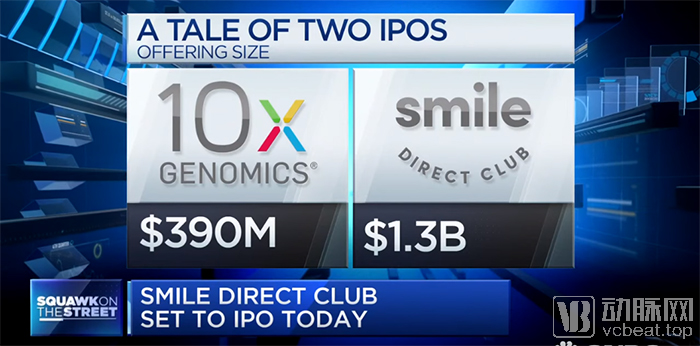
VCBeat (WeChat ID: vcbeat) has learned that on September 12, U.S. Eastern Time, gene sequencing unicorn 10x Genomics and invisible orthodontics unicorn SmileDirectClub officially listed on the Nasdaq. The stock ticker symbols for 10x Genomics and SmileDirectClub are “TXG” and “SDC,” respectively. By the market close in Beijing time early this morning, one stock surged 35.26%, while the other plummeted 27.52%.
10x Genomics
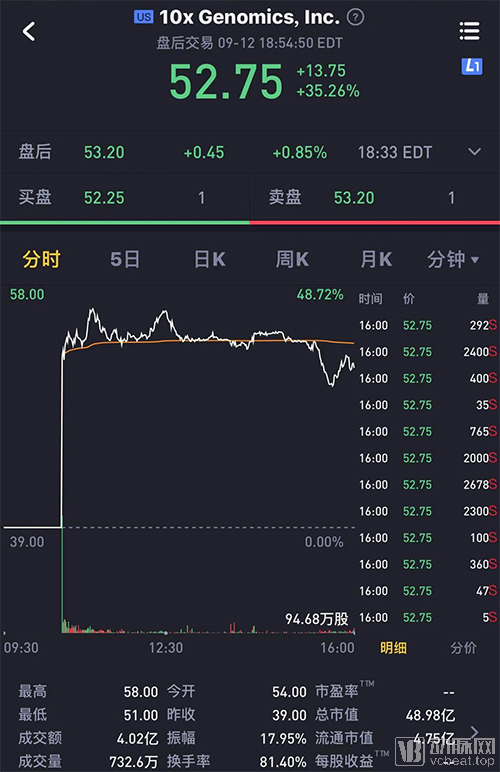
10x Genomics (hereinafter referred to as “10x”) offered 10 million shares of common stock in its initial public offering (IPO) at $39 per share, exceeding the expected range of $31–$35. Despite grappling with thorny patent issues, the stock surged by as much as 49% during its market debut on Thursday. It opened at $54, reached an intraday high of $58 per share, and ultimately closed at $52.75, representing a 35.26% gain and bringing its total market capitalization to $4.898 billion.
10x Genomics is a leader in the field of genetic testing. Founded in 2012 and headquartered in California, United States, the company has offices in more than ten countries, including the United Kingdom, France, and Switzerland. With its revolutionary DNA sequencing technology, 10x Genomics helps people access genomic information that was previously difficult to obtain, thereby accelerating the development of biological and genetic sciences. For a detailed introduction to 10x Genomics, VCBeat previously published an article titled “10x Genomics: Seeking an IPO Amidst Turmoil, Patent Risks May Pose the Greatest Threat” article.
10x Genomics was co-founded by Serge Saxonov and Ben Hindson. Co-founder and CEO Serge Saxonov has been the driving force behind the company’s development. He holds a Bachelor’s degree in Applied Mathematics and Biology from Harvard Medical School and a Ph.D. in Biomedical Informatics from Stanford University. Co-founder and CSO Ben Hindson earned his Ph.D. in Chemistry from Deakin University in Australia and previously served as Co-founder and Chief Scientific Officer of QuantaLife. He has published extensively in the field and holds numerous patents for assays and instruments.
10x Genomics is a rising star in the field of single-cell sequencing. In 2015, at the 16th Annual Advances in Genome Biology and Technology (AGBT) conference, 10x Genomics launched its first product—the GemCode Genomics Platform for DNA sequencing. This product, which includes instruments, chemical reagents, and bioinformatics software, partitions DNA samples into “GEMs” (Gel Beads-in-Emulsion) using a customized microfluidic system. As an upgrade to existing short-read sequencers, it provides information on haplotypes, structural variants, and long-range genomic fragments.
In 2016, 10x Genomics launched its flagship product, the Chromium system, a molecular barcoding and analysis platform based on microfluidics technology. This system enables simultaneous acquisition of expression profiles from 1,000 to 10,000 cells, facilitating cell population stratification and detection of inter-population gene expression differences. It has become the gold standard for studying tumor cell heterogeneity, profiling immune cell populations, and investigating embryonic development.
Furthermore, its software system offers comprehensive compatibility with Illumina sequencers. 10x Genomics rose to prominence at the 2016 J.P. Morgan Healthcare Conference, emerging as the most surprising standout in the field of single-cell transcriptome sequencing at that time, and Illumina entered into a strategic partnership agreement with it.
Since 2012, 10x Genomics has secured a total of six rounds of financing, ranging from the seed round to the D+ round. In its D+ round on January 7, 2019, the company’s valuation reached $1.28 billion.
10x Genomics generated $109.4 million in revenue in the first half of 2019, an increase of nearly 85% from the $59.2 million recorded from January to June 2018. For the full year 2018, the company’s revenue more than doubled, rising from $71.1 million in 2017 to $146.3 million.
In fiscal year 2018, 10x Genomics reported total revenue of $146.3 million and a net loss of $112.5 million. The company also noted that its net loss for 2018 was associated with $62.4 million in expenses related to “intellectual property acquisitions for R&D purposes,” as well as $38 million in litigation costs incurred in the fourth quarter of 2018. In the first half of fiscal year 2019, 10X Genomics spent $15.9 million on patent litigation fees.
Not only is it highly favored overseas, but 10x Genomics is also gaining significant traction in China. The GemCode and Chromium platforms are priced at $75,000 and $125,000, respectively—quite affordable compared to other major competitors. Moreover, the Chromium platform enables single-cell sequencing. In China, 10x Genomics has amassed a large following, including prominent clients such as BGI, Berry Genomics, Boao Jingdian, Novogene, Annoroad, OE Biotech, and Phesgene.
However, alongside its strong product sales, 10x Genomics encountered a significant patent dispute. In February 2015, Raindance Technologies and the University of Chicago filed a lawsuit against 10x Genomics in the U.S. District Court for the District of Delaware, alleging that nearly all of 10x Genomics’ products utilizing GEM microfluidic chips infringed upon seven U.S. patents owned or exclusively licensed by Raindance (the “Delaware Action”). In May 2017, Bio-Rad Laboratories replaced Raindance as the plaintiff following its acquisition of Raindance.
In November 2018, the jury unanimously found that all single-cell and linked-read genomics products sold by 10x Genomics willfully infringed upon three U.S. patents licensed by the University of Chicago to Bio-Rad Laboratories. Under the ruling, 10x Genomics was required to pay Bio-Rad $23.9 million in damages. The final judgment in this dispute is scheduled to be announced in late September, which could prohibit 10x Genomics from selling its GEM microfluidic chips in the United States and may significantly impact the company’s future stock performance. On the eve of its initial public offering, Bio-Rad filed a new lawsuit against 10x Genomics.
10x Genomics stated that the proceeds from its IPO would be used for general corporate purposes, including “working capital, operating expenses, and capital expenditures.”
“In addition, we may use a portion of the net proceeds from this offering to acquire businesses, products, or technologies. However, we currently have no agreements or commitments for any material acquisitions,” the company added.
SmileDirectClub
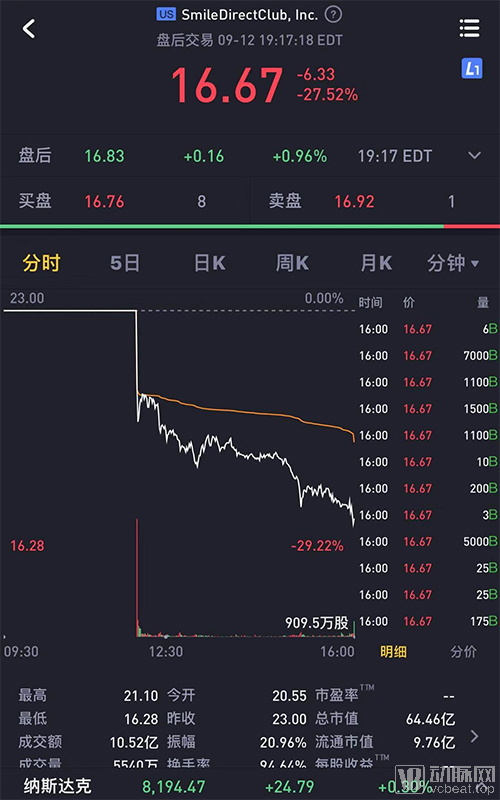
SmileDirectClub issued 58.5 million Class A common shares in this offering. The offering price was $23 per share, exceeding the company’s initial forecast, as SmileDirectClub had originally expected the price to range between $19 and $22 per share. This values the company at $9 billion, significantly higher than the $3.2 billion valuation in its latest funding round 11 months ago. According to a person familiar with the matter, the pricing was driven by oversubscription.
However, the stock suffered a sharp decline on its first day of trading, plunging 27% at the open on the 12th and closing below $17. As of now, its market capitalization stands at less than $6.5 billion.
SmileDirectClub plans to raise $1.3 billion, with the proceeds partially used to repurchase shares held by pre-IPO investors and to fund international expansion and R&D.

SmileDirectClub Listed on NASDAQ
SmileDirectClub, founded in 2014, sells clear aligners directly to consumers through its website and SmileShops, with prices starting at $1,895 for a two-year treatment plan.
Regarding its core business model, VCBeat has previously published a detailed report titled “Skipping the Dentist-to-Consumer Model, This Clear Aligner Company Now Generates $400 Million in Annual Revenue and Is Set to IPO After Five Years》, mainly manifested as:
First, the price is low. Traditional orthodontics costs $5,000–$8,000, while SmileDirectClub charges only RMB 1,895.
Second, it offers high convenience. Traditional orthodontics requires 10–15 in-person visits over a period of 12–24 months, whereas SmileDirectClub conducts supervision and treatment planning entirely through its telemedicine platform, SmileCheck, shortening the duration to 5–10 months. Approximately every six months, most members purchase a set of retainers.
Third, high accessibility. The United States also faces a shortage of orthodontists, with 40% of counties lacking any orthodontic specialists. Through orthodontic kits and more than 300 offline stores across the United States, Canada, Australia, and the United Kingdom, patients can access orthodontic treatment.
Fourth, payment diversity. SmileDirectClub also offers patients two simple payment options: a one-time payment or the SmilePay plan, which requires a $250 down payment and average monthly payments of just $85. This convenient monthly installment plan requires no credit check. Additionally, since 2019, the company has established partnerships with insurance providers such as United Healthcare and Aetna. Customers are eligible for a prorated refund within the first 30 days if dissatisfied for any reason.
Founders Alex Fenkell and Jordan Katzman aimed to disrupt the orthodontics industry by acquiring customers through more affordable teeth aligners, more convenient services, and eye-catching television and social media advertising. Based on the stock price after the first day of trading, Katzman’s equity stake was valued at $1.3 billion, while Fenkell’s was valued at $1.2 billion, quickly making them the two youngest billionaires in the country.
According to the prospectus filed last month, the company’s sales last year amounted to $423.2 million, representing a 190% increase from $146 million in 2017; however, it reported a net loss of $74.8 million last year, more than double the net loss recorded in 2017.
For SmileDirectClub, acquiring new customers is expensive. Last year, SmileDirectClub spent $289.3 million on marketing and general expenses.
According to available information, Jordan Katzman’s father, David Katzman, funded SmileDirectClub’s seed round through his venture capital firm, Camelot Venture Group, and serves as the company’s CEO. The 59-year-old holds 31% of the Class B shares, valued at approximately $1.6 billion. Camelot has also invested in other direct-to-consumer (DTC) brands, such as 1-800-Contacts and Quicken Loans.
In July 2016, SmileDirectClub secured Series A funding from Gin Lane. In October 2018, SmileDirectClub announced a $380 million financing round, led by Clayton, Dubilier & Rice, with participation from Kleiner Perkins and Spark Capital.
SmileDirectClub’s previous prospectus revealed that six out of ten counties in the United States lack orthodontists. In just five years, SmileDirectClub achieved rapid growth by leveraging its business model. In 2016, the company opened its first manufacturing facility and launched its first SmileShop in Tennessee. In 2017, it opened a flagship SmileShop on the West Coast of the United States. In 2018, SmileDirectClub completed nearly $400 million in financing and expanded into the Canadian market. In 2019, the company expanded into Australia and the United Kingdom, while establishing partnerships with CVS, Walgreens, United Healthcare, and Aetna to sell impression kits in their stores.
Currently, it has 700,000 users, 300 SmileShop stores, and 5,000 employees.
David Katzman’s brother, Steven Katzman, is the Chief Operating Officer. Following this offering, the Katzman family will retain a combined voting power of more than 65% among the three members.
SmileDirectClub’s rapid growth can be attributed to its continuous innovation centered on clinical orthodontic outcomes, cost efficiency, and customer satisfaction. However, by bypassing the need for in-person dental consultations, it has also faced substantial criticism and numerous complaints.
Not only SmileDirectClub, but Walmart, a major supermarket chain, has also opened convenient dental clinics within its stores, as innovative models disrupting traditional orthodontics continue to emerge.
Following its IPO, SmileDirectClub will remain in a phase of rapid expansion, entering international markets such as Canada, Australia, and the United Kingdom. Recent news indicates that the company has launched a new aligner designed to be worn only at night.