

Jinmu Health Secures Prestigious AHA Award for AI-Driven TCM Pulse Diagnostic Device Backed by 144 SCI Publications
Recently, the American Heart Association (AHA) awarded the Paul Dudley White International Prize to Changzhou Jinmu Health Technology Co., Ltd. (hereinafter referred to as “Jinmu Health”) in recognition of its efforts to serve heart disease patients by integrating Traditional Chinese Medicine theories with advanced technologies.
In the paper, Jinmu Health elaborated in detail on how the Jinmu Pulse Diagnosis Device leverages electronic pulse-taking data to more accurately predict the risk of cardiovascular disease in patients with type 2 diabetes. This award signifies the American Heart Association’s (AHA) recognition of the scientific validity of the Jinmu Pulse Diagnosis Device. Furthermore, this marks the first time the award has been granted to an academic paper related to Traditional Chinese Medicine (TCM).
Amid the current national policy environment supporting the development of Traditional Chinese Medicine (TCM), many companies have emerged to develop TCM pulse diagnosis devices. However, few have gained genuine academic recognition, particularly from top-tier Western medical institutions. How has Jinmu Health achieved this? To find out, VCBeat conducted an exclusive interview with Dr. Wang Jinzhong, founder of Jinmu Health, to hear his insights.
“Traditional Chinese Medicine (TCM) relies on pulse diagnosis, which involves palpating the pulse with fingers to diagnose diseases. In traditional pulse-taking practice, TCM practitioners often use terms such as ‘floating,’ ‘deep,’ ‘moderate,’ ‘slippery,’ and ‘choppy’ to describe pulse conditions. However, pulse diagnosis lacks quantitative indicators and is highly dependent on the practitioner’s experience and sensory perception. The pulse wave contains abundant physiological and pathological information about the human body and has long been valued by both Chinese and international medical communities. It has now become a focal point of joint research in integrative medicine.”
Dr. Wang Jinzhong, founder of Jinmu Health, introduced to VCBeat that the Jinmu Pulse Diagnostic Instrument is the result of over thirty years of research by his father, Professor Wang Weigong, with its core technology originating from Professor Wang’s Biophysics Laboratory.
In 1984, Professor Wang Wei-Gong, the founding chair of the Department of Physics at National Sun Yat-sen University in Taiwan, proposed the theory of qi-blood resonance, which posits that each internal organ has a critical resonant frequency. Based on this theory, Professor Wang initiated research on pulse wave measurement technology and subsequent data analysis.
In 1989, Wang Weigong began publishing papers in AHA. To date, the entire R&D team (including Wang Weigong’s laboratory) has conducted 35 years of clinical and scientific research on pulse diagnosis, accumulating 144 SCI papers in the fields of mechanics, biophysics, and medical devices.
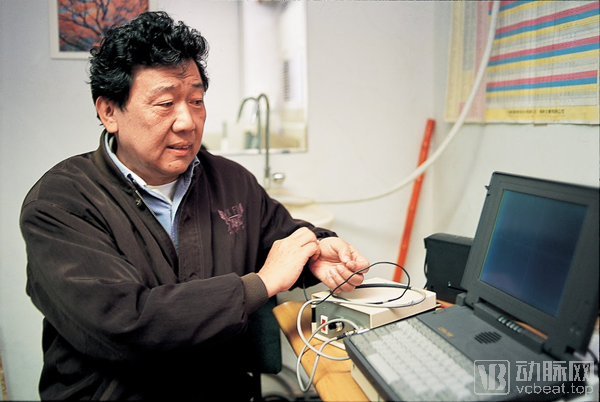
In 1989, Professor Wang Weigong unveiled the prototype of the pulse diagnosis instrument (photo provided by the interviewee).
As the eldest son of Professor Wang Weigong, Wang Jinzhong was immersed in the field from a young age and has actively dedicated himself to the medical and healthcare industry. After earning his bachelor’s degree in Electrical Engineering from National Taiwan University and completing his postdoctoral research in Electrical Engineering at the University of California, Berkeley, Wang Jinzhong successively served as a Medical Device Researcher at GE Global Research and as Laboratory Director at Toshiba Medical Systems’ Research Institute.
Chinese culture emphasizes “filial piety in body, heart, and aspiration.” In 2015, when Professor Wang Weigong fell ill, his son Wang Jinzhong chose to stay by his father’s side. More importantly, driven by the desire to “carry on his father’s legacy,” he abandoned an annual salary of tens of millions in the United States to join Professor Wang Weigong in researching pulse diagnosis measurement technology, aiming to digitize and scientize Traditional Chinese Medicine (TCM) pulse diagnosis. In 2016, Dr. Wang Jinzhong witnessed the booming development of the TCM industry on the Chinese mainland. After comprehensively evaluating factors such as policy support, scientific research capabilities, and market potential, he crossed the strait and established Jinmu Health on the mainland.
Jinmu Health is a high-tech company dedicated to the research and development, production, and sales of Traditional Chinese Medicine (TCM) pulse diagnosis instruments. The core team members all graduated from prestigious international universities and have work experience at renowned global enterprises, possessing extensive expertise in product development and marketing. Wang Jinzhong, who specializes in electronic engineering, brought with him comprehensive experience in the development of large-scale medical equipment. He seamlessly integrated his professional expertise with TCM pulse diagnosis. Under his leadership, the core product, the Jinmu Pulse Diagnosis Instrument, entered mass production in June 2017 after just one year, successfully achieving the commercialization of the technology.
According to the Kim Health team, in a series of clinical trials, the Kim Pulse Diagnostic Instrument achieved 76% sensitivity and specificity for myocardial infarction indices when compared against nuclear medicine imaging. When compared with diagnostic results from renowned senior traditional Chinese medicine practitioners in Jiangsu Province, the diagnostic concordance rate of the Kim Pulse Diagnostic Instrument exceeded 80%.
The Jinmu Pulse Diagnosis Instrument is the core product of Jinmu Health, comprising three components: a signal acquisition device, mobile device software, and a cloud server. The signal acquisition device uses optical sensors to record changes in light intensity transmitted through the finger, thereby capturing signals related to cardiac pulsations and periodic variations in vascular volume.
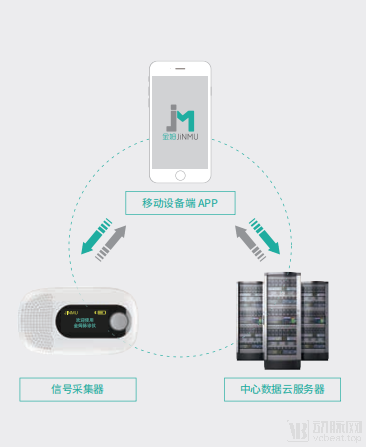
Jinm Pulse Diagnostic Instrument (Image provided by the interviewee)
Signals are transmitted from the mobile device to the cloud server. The server employs core algorithms to analyze the strength of meridians associated with the heart, liver, kidneys, spleen, lungs, stomach, gallbladder, and bladder within 90 seconds, and provides personalized conditioning and treatment recommendations based on individual conditions.
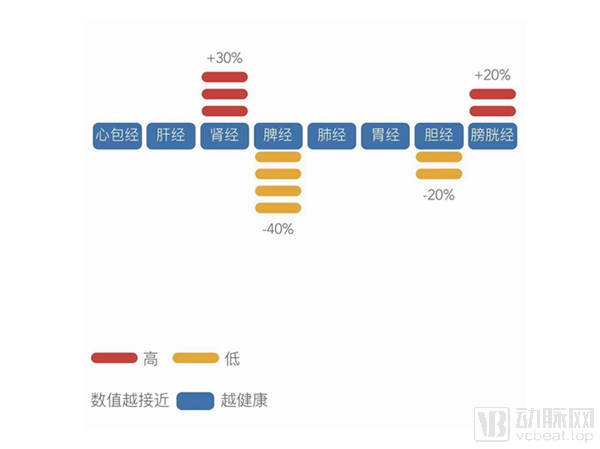
Meridian Bar Chart Analyzed by the Kim Pulse Diagnostic Instrument (Image provided by the interviewee)
A robust database support is a key feature of the Jinmu Pulse Diagnostic Instrument. Wang Jinzhong introduced that since his father began researching this technology 30 years ago, it has accurately served millions of users.
The Kim Health mobile application can assess chronic disease risk within two minutes, complemented by therapies such as physiotherapy massage and dietary treatment. Currently, the application scenarios for the Kim Pulse Diagnosis Device include cardiovascular diseases and women’s health. Moving forward, Kim Health will expand the application of this technology to cover kidney diseases, liver diseases, and non-alcoholic hepatitis.
Wang Jinzhong revealed that Kim Health will launch a new round of financing to support product marketing and promotion. Interested institutions are requested to contact Xiaoyun, the VCBeat Financing Assistant: DongMai_Investent