

Junlian Medical Global New Drug Insights Newsletter – Issue 22: Key Updates from WCLC 2019
Sep 16, 2019 18:02
CST Updated
18:02

In September 2019, the 20th World Conference on Lung Cancer (WCLC), organized by the International Association for the Study of Lung Cancer, was grandly held in Barcelona, Spain. Here, we share with you the core cutting-edge advances from this conference.
❖Tumor Mutational Burden (TMB) was previously regarded as one of the core predictive biomarkers for the efficacy of PD-1/PD-L1 inhibitors and was even included in the NCCN guidelines. However, results from KEYNOTE-021 and KEYNOTE-189 demonstrated that TMB fails to predict the efficacy of Keytruda (pembrolizumab) combined with chemotherapy as first-line treatment for advanced non-small cell lung cancer (NSCLC). Furthermore, PD-L1 expression showed no correlation with TMB. These findings are devastating for Bristol Myers Squibb (BMS). Previously, BMS’s Opdivo (nivolumab) was outperformed by Keytruda and Tecentriq (atezolizumab) in the first-line treatment of NSCLC and small cell lung cancer (SCLC), respectively. Now, its prominently promoted biomarker is facing significant skepticism. Although no final conclusion has been drawn, if BMS wishes to regain momentum, it must deliver compelling clinical trial results demonstrating a remarkable comeback.
❖AMG 510 (a KRAS G12C inhibitor) has continued its impressive performance from the June ASCO conference. Amgen presented data from 32 patients with non-small cell lung cancer (NSCLC), demonstrating consistent safety, tolerability, and efficacy, which has generated significant excitement. Amgen’s subsequent plans primarily focus on expanding indications and exploring combination therapy with Keytruda (pembrolizumab), while Opdivo (nivolumab) was once again conspicuously overlooked. Currently, numerous Chinese companies have initiated R&D efforts targeting KRAS G12C inhibitors. Given Amgen’s aggressive stance on patent rights and its history of successfully challenging other companies over patent disputes, domestic firms considering international market entry should proactively prepare for potential intellectual property challenges.
ConcertAMG 510 demonstrated favorable efficacy, safety, and tolerability in a broader population of patients with non-small cell lung cancer (NSCLC), with approximately 50% of NSCLC patients achieving partial response.
Amgen Announces Latest Trial Data for AMG 510Data indicate that AMG 510 demonstrates favorable efficacy in a broader population of patients with non-small cell lung cancer (NSCLC).Efficacy, safety, and tolerability: approximately 50% of NSCLC patients achieved partial response
AMG 510 is a first-in-class KRAS G12C mutant inhibitor. KRAS is the most common oncogene in human cancers. KRASG12C GeneMutations occur in approximately 13% of lung cancer patients.
Phase I clinical trial, including 34 NSCLC patients with KRAS G12C mutations, who had received a median of 3.5 prior lines of therapy, and the majority of whom had previously been treated with PD-1 inhibitors
Among these 34 patients, the efficacy could be evaluated in 23 patients; of these, 11 (48%) achieved partial response (PR), and 11 (48%) had stable disease.
Phase 1 Treatment Data for AMG510
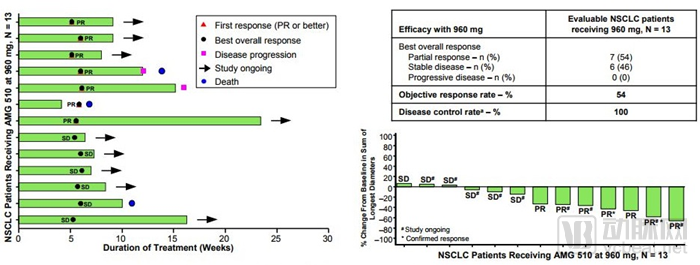
Data Source: WCLC
Daiichi Sankyo Releases Phase 1 Results: ADCs Targeting HER3 and TROP-2 Show Promising Preliminary Outcomes in Treating TKI-Resistant NSCLC Patients
Daiichi Sankyo Releases Results: Preliminary Data for Its HER3-Targeting ADC U3-1402 and Trop2-Targeting ADC DS-1062 in Treating TKI-Resistant NSCLC Patients Are Both Positive
U3-1402 is an antibody-drug conjugate targeting HER3; DS-1062 targets Trop2.
Both trials were Phase I studies. In the U3-1402 trial, 30 patients with metastatic non-small cell lung cancer (NSCLC) harboring EGFR mutations and exhibiting resistance to tyrosine kinase inhibitors (TKIs) received treatment at varying dose levels. In the DS-1062 trial, 46 evaluable patients were enrolled, receiving DS-1062 at doses ranging from 0.27 mg/kg to 10.0 mg/kg.
In the U3-1402 trial, 26 patients were evaluable; tumor shrinkage was observed in 22 patients, with a median best change of -25.7%, and 6 patients achieved confirmed partial response. In the DS-1062 trial, 12 patients achieved partial response; among the 7 patients who received the recommended dose of 8.0 mg/kg, 5 achieved partial response, while the other two patients currently have stable disease.
KEYNOTE-042 China Study: Pembrolizumab Monotherapy Improves Overall Survival in NSCLC Patients Compared with First-Line Treatment
The KEYNOTE-042 China study demonstrated that pembrolizumab monotherapy improved overall survival (OS) and exhibited a favorable safety profile compared with first-line treatment in Chinese patients with advanced/metastatic non-small cell lung cancer (NSCLC).
Pembrolizumab is a blockbuster drug in the field of immune checkpoint inhibitors. It works by inhibiting PD-1 receptor-mediated immunosuppressive signals, thereby enabling T lymphocytes in the human body to be activated and attack tumor cells.
A total of 262 PD-L1–positive (tumor proportion score [TPS] ≥1%) NSCLC patients in China were enrolled. Among them, 146 patients (55.7%) had a PD-L1 TPS ≥50%, and 204 patients (77.9%) had a PD-L1 TPS ≥20%.
Pembrolizumab improved overall survival (OS) compared with chemotherapy in patients with PD-L1 TPS ≥50%, ≥20%, and ≥1%. In the subgroup of patients with TPS 1%–49%, pembrolizumab also demonstrated superior improvement in OS over chemotherapy (19.9 vs. 10.7).
Lilly Announces That Its RET Inhibitor, Acquired from Loxo, Achieved a 68% Objective Response Rate in NSCLC, with an ORR of 91% in the Subgroup of Patients with Brain Metastases
Lilly Announces RET Inhibitor Selpercatinib Achieves 68% Objective Response Rate in NSCLC, with ORR Reaching 91% in Patients with Brain Metastases
Selpercatinib (LOXO-292) is a highly selective oral RET inhibitor with high potency and specificity, demonstrating activity against central nervous system (CNS) metastases.
In the Phase 1/2 clinical trial, 105 previously treated NSCLC patients received selpercatinib, and 35% of the patients had brain metastases.
The overall ORR reached 68%. Up to 50% of NSCLC patients with RET gene fusions may develop brain metastases. In the subgroup of patients with brain metastases, selpercatinib demonstrated an ORR of up to 91%, with a CR rate of 18%.
AstraZeneca Announces That Its PD-L1 Antibody Imfinzi, in Combination with Chemotherapy, Met the Primary Endpoint in a Phase 3 Clinical Trial for First-Line Treatment of SCLC
AstraZeneca announced that its PD-L1 monoclonal antibody Imfinzi (durvalumab), in combination with chemotherapy, met the primary endpoint in a Phase 3 clinical trial for the first-line treatment of extensive-stage small cell lung cancer (ES-SCLC).
Imfinzi is a humanized PD-L1 monoclonal antibody that binds to PD-L1 and blocks its interaction with the PD-1 and CD80 receptors.
In the randomized, open-label Phase 3 CASPIAN trial, patients with SCLC received Imfinzi plus etoposide and platinum-based chemotherapy (cisplatin or carboplatin), or chemotherapy alone.
Compared with standard chemotherapy, the Imfinzi combination therapy reduced the risk of death by 27%. The median overall survival (OS) was 13.0 months in the Imfinzi combination therapy group versus 10.3 months in the control group.
Takeda Announces Data on TAK-788 for NSCLC Patients with Exon 20 Insertion Mutations: Overall ORR of 43%, with an ORR of 25% in Patients with Brain Metastases
Takeda Announces Data on TAK-788 for NSCLC Patients with Exon 20 Insertion Mutations: Overall ORR of 43%, with an ORR of 25% in Patients with Brain Metastases; Overall DCR of 86%, Reaching 100% in Patients without Brain Metastases
TAK-788 is a novel oral EGFR/HER2-targeted therapy indicated for the treatment of EGFR/HER2-mutated non-small cell lung cancer (NSCLC), including patients with NSCLC harboring EGFR exon 20 insertion mutations.
A total of 137 patients with EGFR exon 20 insertion-mutant NSCLC received TAK-788 at various doses, including 72 patients who were treated with 160 mg once daily (qd).
The overall ORR was 43%, with an ORR of 25% in patients with brain metastases and 56% in those without. The overall DCR was 86%, with a DCR of 67% in patients with brain metastases and 100% in those without.
In the first-line treatment of NSCLC with Keytruda combined with chemotherapy, TMB showed no significant correlation with ORR, PFS, OS, or PD-L1 expression levels.
The KEYNOTE-021 study demonstrated that in the first-line treatment of advanced NSCLC with pembrolizumab combined with chemotherapy, TMB was not significantly associated with ORR, PFS, or OS in patients receiving immunotherapy combination regimens. Furthermore, TMB showed no significant correlation with PD-L1 expression levels.
TMB, short for tumor mutation burden, was previously considered one of the predictive biomarkers for the efficacy of PD-1/PD-L1 inhibitors.
Inclusion Criteria and Study Design: A total of 145 patients were randomly assigned in a 1:1 ratio to receive either pembrolizumab combined with pemetrexed and carboplatin or chemotherapy alone. Tumor mutational burden (tTMB) was assessed by whole-exome sequencing of tumor tissue and paired normal DNA.
Correlation analysis treating TMB as a continuous variable revealed no significant association between TMB and ORR, PFS, or OS in patients receiving pembrolizumab plus chemotherapy or chemotherapy alone.
Previously, TMB was considered one of the important biomarkers for IO.
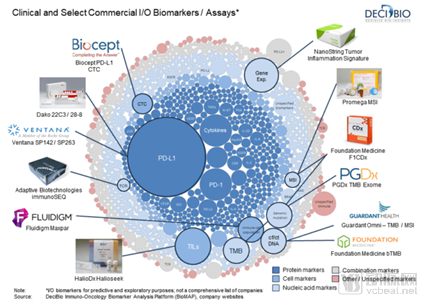
Data Source: ASCO