

Rapidly Rising Real-World Evidence Sector Files IPO Amid Calls for Robust Data Foundation
In 2019, both China and the world took a significant step forward in their understanding of real-world evidence (RWE). In April 2019, Pfizer’s Ibrance received FDA approval for a new indication in male breast cancer, becoming the first new drug indication approved solely based on real-world evidence (RWE). In May, the Center for Drug Evaluation (CDE) released the “Basic Considerations for Real-World Evidence Supporting Drug Development (Draft for Comment),” sparking a surge of interest in real-world studies (RWS) in China and establishing it as a highly sought-after new frontier.
Yet, alongside its surge in popularity, the industry has raised many questions for us to consider. What are the core application scenarios for real-world evidence? Is the approval of Ibrance universally applicable? How is the real-world study industry developing in China? And what key points deserve attention in its future development? These are all topics worth exploring.
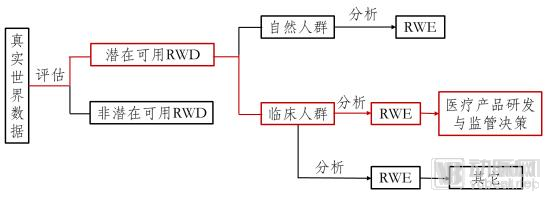
The Path from RWD to RWE
The “Basic Considerations for Real-World Evidence to Support Drug Development (Draft for Comments)” (hereinafter referred to as the “Basic Considerations”), released in May 2019, represents a key policy signal in China. The Center for Drug Evaluation (CDE) has already provided clear definitions of relevant concepts related to real-world studies therein.
The Center for Drug Evaluation (CDE) defines Real-World Study (RWS) as the process of collecting patient-related data in real-world settings (Real-World Data, RWD) and, through analysis, obtaining clinical evidence on the utility, potential benefits, or risks of medical products (Real-World Evidence, RWE). The primary study type is observational research, though it may also include pragmatic clinical trials.
Real-world data (RWD) is defined by the Center for Drug Evaluation (CDE) as data related to patients’ drug usage and health status, and/or data collected from various routine medical processes. Broadly speaking, real-world studies (RWS) encompass both population-based studies involving the general population and those involving clinical populations; the real-world evidence (RWE) derived from the latter can be used to support research and development of medical products and regulatory decision-making, as well as for other scientific purposes.
In the "Basic Considerations," the Center for Drug Evaluation (CDE) also provides a relatively clear classification and interpretation of the application scenarios for Real-World Evidence (RWE), with most of its content aligning with existing international policies on Real-World Studies (RWS). In formulating these policies, China has incorporated additional elements specific to its domestic drug development environment, such as the clinical development of hospital preparations of Traditional Chinese Medicine (TCM).
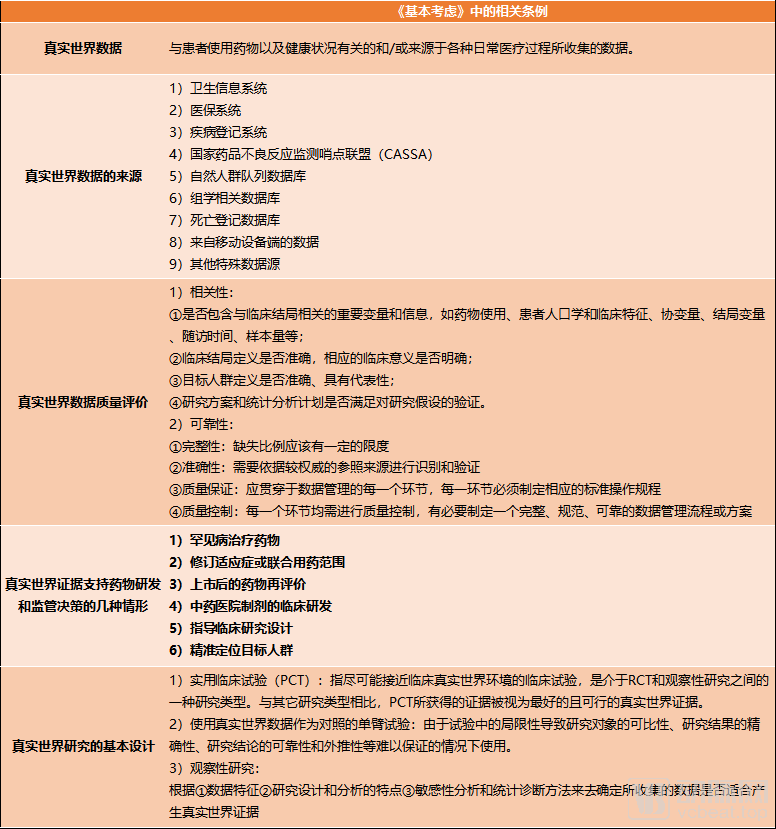
Excerpts of Relevant Provisions from “Basic Considerations”
Based on the application scenarios outlined in the current “Basic Considerations,” the use of Real-World Evidence (RWE) in drug development and regulation primarily serves to support decision-making. This includes guiding clinical trial design and precisely defining target populations during the pre-marketing phase, as well as providing end-to-end support for post-marketing drug re-evaluation and indication updates. Real-World Studies (RWS) emerge either as a supplement to clinical trial evidence or to facilitate the conduct of clinical trials, thereby collectively forming a comprehensive product evidence chain.
Revising indications and conducting post-marketing drug re-evaluation are currently the application scenarios where Real-World Studies (RWS) are most frequently employed. This trend is driven by two main factors: first, pharmaceutical companies have a need for post-marketing drug management, which aligns precisely with the capabilities of RWS; second, drugs already on the market have accumulated substantial patient data, making them well-suited for RWS integration. Furthermore, the newly released version of the Drug Administration Law explicitly mandates full-lifecycle drug management, suggesting that demand for this application scenario will continue to rise in the future.
“Many drugs are used off-label in clinical practice. For such uses to ultimately gain official approval and be included in the product labeling, real-world studies (RWS) that analyze historical data can play a key role in supporting indication applications, in addition to rigorously designed traditional clinical trials. The new Drug Administration Law also requires lifecycle management of pharmaceuticals. Consequently, the RWS industry will meet substantial demand for post-marketing re-evaluation of drugs, thereby becoming an essential component of drug regulation,” said Shi Yanling, Head of Real-World Studies at HLT (Happy Life Technology), in an interview with VCBeat.
The clinical development of hospital-prepared traditional Chinese medicine (TCM) formulations is a special application scenario added in the Basic Considerations based on domestic conditions. This scenario is akin to post-marketing drug re-evaluation. Due to the unique characteristics of TCM, many domestically produced TCM formulation products did not undergo rigorous clinical trials prior to market approval; however, these drugs have subsequently accumulated a substantial amount of patient data suitable for analysis after reaching the market. For such TCM formulations, real-world study (RWS) has emerged as a highly appropriate research approach. Nevertheless, the descriptive nature of TCM syndrome differentiation is largely subjective and difficult to quantify into real-world data (RWD). Consequently, many current studies on TCM formulations in China have adopted Western medical methods for symptom description.
Guiding the design of clinical studies is a relatively new application scenario for real-world study (RWS) interventions. “For certain clinical trials, the difficulty in identifying patients who meet strict inclusion criteria and the prolonged enrollment period have historically led to excessively long overall study timelines. Now, we can use algorithms to first assess the feasibility of inclusion and exclusion criteria or examine the nationwide distribution of patients. This helps accelerate patient enrollment and optimize clinical trial design. This is precisely what HLT is currently undertaking in collaboration with clinical experts and enterprises in China. Internationally, exploration in this direction has only begun in recent years and remains in its early stages,” Shi Yanling told us.
Shi Yanling stated, “Judging from the policies released to date, domestic regulatory authorities maintain a relatively open stance toward real-world studies (RWS). However, the National Medical Products Administration (NMPA) has also emphasized in its policies that RWS cannot replace randomized controlled trials (RCTs). In fact, RWS and RCTs are more complementary in nature, with neither supplanting the other.”
Although there are precedents such as the approval of new indications for Ibrance (palbociclib) based on evidence from real-world studies, the use of real-world evidence (RWE) as the sole basis for approving new indications is not widely applicable. Currently, it is limited to exceptional circumstances where clinical trials are infeasible or suboptimal due to challenges in patient recruitment or ethical concerns. RWE primarily serves as a supplement to clinical trials within the drug development and regulatory process.
In April 2019, Pfizer announced that the FDA had approved a supplemental application for a new indication of Ibrance (generic name: palbociclib, hereinafter referred to as PAL), based on real-world evidence. The approval was for the use of PAL in combination with an aromatase inhibitor or fulvestrant (hereinafter referred to as ET) for the treatment of male patients with HR-positive, HER2-negative advanced or metastatic breast cancer.
Pfizer disclosed the specific details of the corresponding study at the subsequent ASCO 2019 conference. IQVIA provided Pfizer with treatment data for 1,139 male breast cancer (mBC) patients from February 2015 to April 2017, among whom 147 patients received palbociclib plus endocrine therapy (PAL+ET). In terms of efficacy, patients receiving PAL+ET as first-line treatment (n=37) demonstrated a significantly longer median duration of treatment compared to the non-PAL group (n=214) (8.5 months vs. 4.3 months). Notably, the most pronounced extension in treatment duration was observed in patients receiving palbociclib plus letrozole (n=26) compared to those receiving letrozole monotherapy (n=63) (9.4 months vs. 3.0 months). Similar treatment outcomes were also evident in data provided by Flatiron Health.
It is estimated that approximately 5,500 new cases of male breast cancer occurred in the United States during the statistical period covered by IQVIA data. The sample size provided by IQVIA represents approximately 20% of the new cases during this period. Patient data clearly demonstrate that palbociclib plus endocrine therapy (PAL+ET) as first-line treatment yields significantly superior therapeutic outcomes compared to endocrine therapy (ET) alone in patients with male breast cancer. Therefore, the combination of a large patient dataset and significant efficacy constitutes the fundamental basis for the approval of Ibrance for the indication of male breast cancer.
In addition, the specificity of the approved indication was also a key factor contributing to this approval. The indication for Ibrance approved this time is completely consistent with the original indication in terms of molecular subtyping, disease staging, and treatment regimen; this approval merely expands the eligible population from females only to include both sexes. As male breast cancer is a rare disease with low incidence, the small patient population makes clinical recruitment difficult, rendering it inherently challenging to validate drug efficacy through clinical trials. Under such circumstances, real-world studies (RWS) have become an appropriate approach to verify the effectiveness and safety of the drug.
Therefore, the approval of Ibrance for the indication of male breast cancer represents a modest expansion of its indicated scope, based on large-scale real-world studies (RWS), given that traditional clinical trials were not applicable. The approval of Ibrance does not imply that RWS will be widely adopted as the sole standard in drug approval; rather, it signifies that high-quality real-world evidence can serve as primary supporting data for regulatory approval when conducting clinical trials is challenging. Its symbolic significance arguably outweighs its practical impact.
The approval of Aiboxin also reflects the rapid development of the Real-World Study (RWS) industry abroad. While China’s RWS sector is still in its nascent stages, international markets have accumulated years of experience. As early as 2016, the U.S. Food and Drug Administration (FDA) released draft policies related to RWS and has continued to explore innovative approaches in the approval process in recent years. The relatively advanced state of healthcare informatization abroad, coupled with clearer laws and regulations regarding data ownership and usage rights, provides a more favorable ecological foundation for the development of the RWS industry internationally compared to China.
From the perspective of information technology infrastructure in healthcare institutions, the lack of unified data standards within China’s hospital system has profoundly impacted the development of the real-world study (RWS) industry. However, this issue is difficult for physicians or hospitals to resolve effectively in the short term. Given the already high workload of physicians in China, mandating improvements in data source quality would undoubtedly place a significant additional burden on them. Consequently, an approach focused on source-level governance has gradually emerged in China. This strategy involves initiating prospective cohort studies, optimizing data quality at the source by working backward from end goals, and building real-world data (RWD) platforms, implemented by disease type and region.
Artificial intelligence can indeed perform the deep structuring of Real-World Data (RWD) more efficiently; however, due to the complexity of clinical descriptions and the high degree of specialization required for certain medical logic, there are inevitably aspects that natural language processing cannot handle. Therefore, the need for manual intervention in RWD governance in China will remain unavoidable for a certain period.
“China’s real-world study (RWS) industry started relatively later than its overseas counterparts, resulting in a slight gap in the current landscape,” said Luan Xianpeng, Business Director at LinkDoc Technology, in an interview with VCBeat. “However, China’s RWS sector is now seizing opportunities for rapid growth, with active exploration and collaborative innovation across government, industry, and academia. In its future development, we are highly likely to achieve remarkable accomplishments at a speed that will surprise the world.”
The large population base has become a unique advantage for the development of China’s real-world study (RWS) industry, which relies heavily on extensive data support. Clinical studies on rare diseases or precision diagnosis and treatment, which are often severely constrained abroad by difficulties and slow pace in patient enrollment, are likely to overcome these bottlenecks in China, enabling patients to benefit earlier. Therefore, abundant medical data will serve as one of the key pillars for China’s RWS industry to catch up with its international counterparts.
“Data is the foundation of real-world studies (RWS) and one of the key drivers for the development of this industry. Only through efficient multi-source data collection, high-granularity structured processing, professional human-machine quality control, and standardized normalization can real-world data (RWD) with greater practical value be generated,” Luan Xianpeng told us.
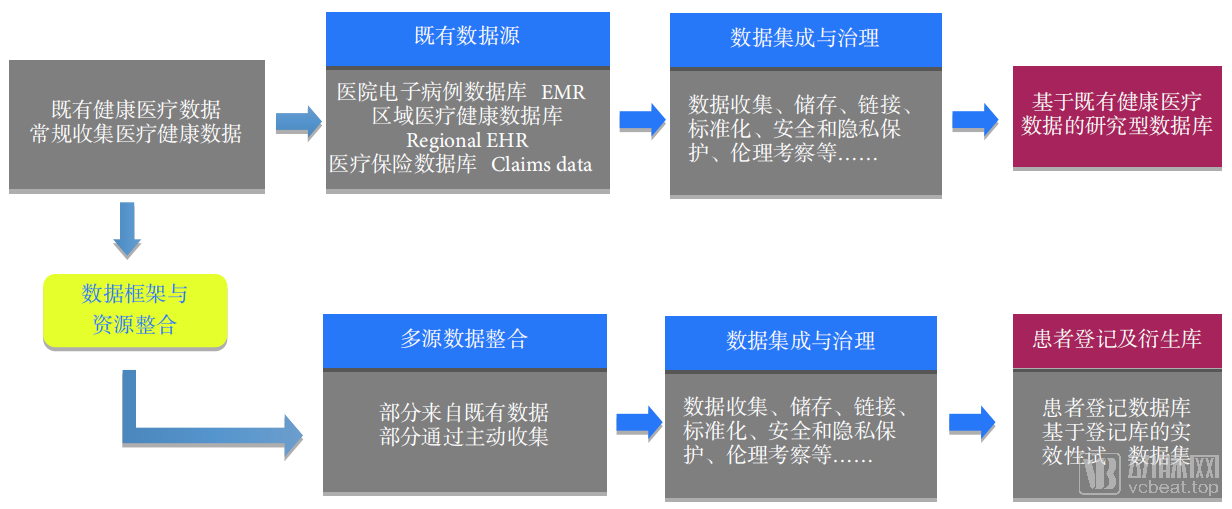
The Transformation Process from Real-World Data to Research-Oriented Databases
Image source: Sun Xin, Tan Jing, et al. Establishing Technical Standards for Real-World Data and Research to Promote the Generation and Use of Real-World Evidence in China.
Regarding data content, beyond structuring and cleaning with quality control, a critical aspect is integrating multi-omics data to establish a comprehensive real-world database. Such data encompass medical information generated by patients across diverse settings, ranging from clinical data and out-of-hospital test results to other relevant data obtained only through active follow-up or patient-reported outcomes, all of which fall within the scope of real-world data.
In the process of transforming real-world data (RWD) into real-world evidence (RWE), single-dimensional databases often fail to meet the requirements of real-world studies (RWS), making the interoperability of multi-scenario and multi-omics data critically important.
“Companies in China that have embarked on real-world data (RWD) governance vary in their understanding and practices regarding RWD collection and processing. Some merely focus on integration, i.e., consolidating data scattered within hospitals; others stop at light processing, performing only minor structural enhancements based on the original structured granularity of hospital data; still others limit their efforts to in-hospital data, excluding patients’ out-of-hospital conditions from the scope of RWD governance. Our perspective is that it is normal for companies to differ in their definition of RWD governance due to variations in corporate DNA and business models. However, one point is relatively certain: if RWD governance can be oriented toward clinical research scenarios, achieving near-research-grade management from ‘collection’ to ‘utilization,’ the resulting RWD will more directly empower real-world studies (RWS) and offer greater imagination and feasibility for empowering broader medical or healthcare scenarios,” said Luan Xianpeng.
The future development of the real-world study (RWS) industry will heavily rely on policy-driven initiatives, particularly those fostering collaboration between data holders and RWS research institutions. Big data companies themselves do not own the data; in China, the primary data holders remain public institutions such as hospitals, research institutes, and government agencies.
Hospital data currently represents one of the primary sources of real-world data (RWD). To meet their research needs, hospitals can leverage real-world studies (RWS) to analyze and generate insights from their own de-identified data. In contrast, access to medical insurance data, disease registry data, and mortality registration data in China is subject to stricter controls. The difficulty in obtaining such data compromises the comprehensiveness of domestic RWD. If policies were to clearly define the scope of data application, encouraging more data-holding institutions to be willing and confident in utilizing their data for RWS, it would significantly boost the development of the RWS industry.
In the transformation from Real-World Data (RWD) to Real-World Evidence (RWE), the technological accumulation achieved thus far is sufficient to meet the technical demands of the Real-World Study (RWS) industry in its next phase of development. However, targeted data cleaning and reclassification may be required for structured data depending on specific application scenarios. Therefore, the RWS industry will continue to prioritize data quality management in its upcoming stage of development.
“Over the years, many national and regional health data platforms have approached us for collaboration, hoping to create a turnkey solution for the entire process of data collection, governance, and application, thereby benefiting the public, enterprises, and government. Some forward-thinking individuals have recognized that without AI-driven data governance, efforts in healthcare data application would ultimately fail. Although existing data platforms often face issues with data standardization and usability, requiring rework or remediation, there are still successful cases demonstrating scientific, economic, and social benefits,” said Ma Handong, Vice President of Senyi Intelligence.
The quality of data directly determines the authenticity of real-world evidence (RWE) generated in subsequent studies. Rigorous data is essential; otherwise, inaccurate conclusions will inevitably result. In the absence of clear data standards, some companies may conduct real-world studies (RWS) using poorly governed real-world data (RWD), posing a hidden risk to the development of the RWS industry.
“During our period of implementing data governance and conducting Real-World Studies (RWS), the vast majority of our efforts were dedicated to enhancing data quality. I personally believe that, as RWS serves as crucial evidence for future decision-making, the industry must adopt a more robust and solid approach going forward. Greater attention must be devoted to methodologies for assessing and governing data quality, as well as to data analysis in real-world studies.” Ma Handong reiterated the critical importance of data quality to the industry during the interview.