

Shanghai HeartValve Testing Carves a Niche in Cardiovascular Device Testing with Specialized Solutions
Within our hearts, the heart valves are delicate, gossamer-thin “petals.” They function as gates between the atria and between the ventricles and the major arteries, opening only in the direction of blood flow to ensure unidirectional passage through the heart and prevent backflow.
The normal opening and closing of heart valves depend on structures such as the valve leaflets, annulus, chordae tendineae, and papillary muscles. When structural or functional changes occur in the heart valves, blood cannot be ejected smoothly, or ejected blood regurgitates, thereby increasing cardiac load. The resulting spectrum of clinical conditions is referred to as valvular heart disease.
In China, the incidence of valvular heart disease is relatively high. According to the "Report on Cardiovascular Diseases in China 2017," there are approximately 2.5 million adult patients with rheumatic heart disease in China. According to the "2017 White Paper on Cardiac Surgery and Cardiopulmonary Bypass Data in China," the total number of cardiopulmonary bypass procedures performed in 708 hospitals nationwide capable of conducting cardiac surgeries was 164,201 that year, among which 65,749 were valvular heart surgeries, accounting for approximately 40%. This currently ranks first among adult cardiac surgeries in China. Mechanical valve implantation remains the predominant practice domestically, whereas bioprosthetic valve implantation is the global mainstream.
China's heart valve industry has developed for nearly a decade, with domestic companies such as Lepu Medical, BaiRen Medical, MicroPort Medical, and Venus Medtech emerging to fill the gap in domestically produced high-value consumables.
In the localization of high-value medical consumables, the trend is not only prevalent among downstream products but also evident across the entire industry chain, where many manufacturers have achieved domestic production.
VCBeat has learned that Shanghai Xinban Test Equipment Co., Ltd. is the first Chinese company specializing in the R&D and production of testing equipment for artificial heart valves and cardiovascular-related products. Previously, this market was predominantly dominated by foreign manufacturers.
In automotive testing, functional, durability, and safety analyses are conducted on complete vehicles or automotive components. For products intended for human implantation, testing requirements are far more stringent. Test systems for artificial heart valves can perform accurate hemodynamic evaluations of the performance and durability of these devices, generating realistic pressure and flow conditions that closely mimic those found in the human body.
In this market, foreign companies from the United States and Canada had previously held dominant positions. In 2018, Shanghai Xinban Testing Equipment Co., Ltd. was established as a high-tech company specializing in the research, development, and production of scientific instruments and testing equipment for artificial heart valves and cardiovascular-related products, while also providing a range of services including technical training and contract testing. Bao Xiangyu, founder of Shanghai Xinban, told VCBeat, “Within one year of its establishment, Shanghai Xinban has gained a firm foothold in China’s artificial heart valve market.”
Currently, Shanghai Xinban has developed a series of specialized testing equipment for the cardiovascular field, including fatigue resistance testers for prosthetic heart valves, pulsatile flow performance testers for prosthetic heart valves, steady-flow performance testers for prosthetic heart valves, and portable multi-functional test simulators. These products have been adopted by the Medical Device Inspection Center of the National Institutes for Food and Drug Control (NIFDC) under the National Medical Products Administration (NMPA), as well as the Beijing Medical Device Testing Institute. The company has established strong collaborative relationships with numerous R&D and manufacturing enterprises of prosthetic heart valves, medical device testing institutions at all levels, hospital research departments, and university laboratories in Los Angeles, San Francisco, Minneapolis, and Boston (USA); Montreal (Canada); and Beijing, Shanghai, Zhejiang, Shandong, Shenzhen, and Gansu (China).
Recently, Shanghai Xinban has launched the next-generation AWT-2000 high-performance fatigue testing machine for artificial heart valves. Leveraging patented linear motor drive and control technology combined with a unique structural design, the system maintains high pressure, high flow rates, and rapid response even at extremely high testing frequencies. Consequently, the AWT-2000 supports fatigue testing of larger-sized valves at higher frequencies, making it particularly suitable for durability assessments of valves with diameters exceeding 30 mm, especially mitral valves. The product has received strong market acclaim.
The ability to rapidly develop products within a short timeframe is primarily underpinned by the mature technical R&D team at Shanghai Xinban Testing Equipment Co., Ltd. The core R&D team possesses many years of experience in the design of artificial heart valves and in establishing and managing testing technologies. The leader of the core technical team previously served at the U.S. Food and Drug Administration (FDA) for many years, where he was responsible for the review of cardiovascular devices.
Having gained recognition in China’s heart valve testing sector, Bao Xiangyu stated that the company plans to expand into overseas markets. He also revealed that the total market size for heart valve testing approaches RMB 200 million. While Shanghai Xinban is currently expanding its market presence, it will primarily focus on tapping into the hospital market in the next phase.
Hospitals have vastly different needs for cardiovascular research instruments compared to companies developing artificial heart valves. The heart is a vital organ with complex anatomy, and cardiac surgery is highly challenging; it was once referred to as the “no-go zone” of surgery and “God’s trump card.” However, during the training of a cardiac surgeon, understanding of cardiac structure and function can only be acquired through medical teaching models, animal experiments, or clinical surgeries. These approaches present various limitations.
Building on its independently designed and developed MPD-1000 Modular Pulsatile Flow Performance Tester for Prosthetic Heart Valves, Shanghai Xinban has achieved ex vivo pulsation of animal hearts and silicone models. This system is suitable for scientific research, preclinical animal studies, and surgical training. Integrated with pressure sensors, flow meters, endoscopes, and color Doppler ultrasound systems, it measures aortic pressure, ventricular pressure, atrial pressure, forward flow, regurgitant flow, and other relevant parameters during ex vivo cardiac pulsation. Additionally, it monitors internal cardiac structures, such as the opening and closing of the aortic and mitral valves, and their interactions with interventional devices.
In simple terms, the cardiac pulsation model enables ex vivo "pig hearts" to beat as if they were in a living body while monitoring various parameters. Physicians can use this ex vivo heart model for surgical demonstrations and training. With the pig heart exposed and saline solution substituting for blood, doctors can directly observe the internal conditions of the heart using an endoscope and monitor the entire process of device intervention and deployment.
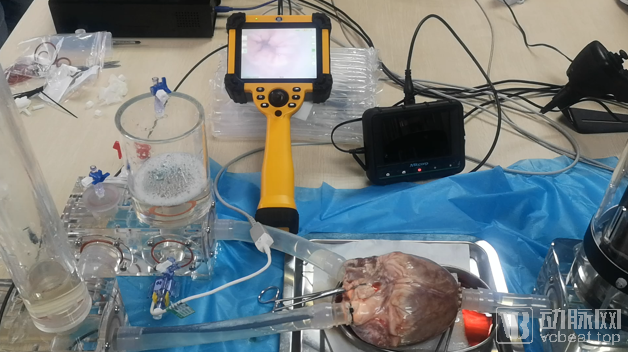
Ex Vivo Pulsating Heart Model: Mitral Valve Viewed from the Atrium
In addition to cardiac surgery, physicians in departments such as radiology and echocardiography can also utilize ex vivo pulsatile models for surgical training and device practice. These models offer distinct advantages over animal experiments, vascular or cardiac silicone models, and traditional medical models. Taking echocardiography as an example, if ultrasound physicians lack a thorough understanding of cardiac anatomy, they may encounter significant challenges in diagnosis and differential diagnosis, potentially leading to missed or incorrect diagnoses that adversely affect subsequent clinical decision-making and management. Given the anatomical similarities between porcine and human hearts, ex vivo pulsatile heart models enable cardiac sonographers to become familiar with cardiac structures earlier and more effectively.
Beyond physician training, the ex vivo pulsating heart model can also be applied in clinical R&D. The development and testing of cardiovascular medical devices, particularly artificial heart valves, require extensive animal experimentation. The ex vivo pulsating heart mode of the MPD-1000 device can serve as a preclinical study prior to animal experiments, eliminating the need for preoperative procedures such as anesthesia and blood pressure reduction, as well as postoperative disposal of animal carcasses. This significantly reduces experimental complexity and time consumption, offering substantial cost-effectiveness. Furthermore, the use of endoscopy with the ex vivo pulsating heart model allows for direct visualization of the entire device intervention process and its operational status, helping R&D companies identify and resolve issues.
Shanghai Xinban Testing Equipment Company has even greater ambitions—to provide comprehensive testing solutions for cardiovascular products. The company aims to become a domestic leader and a strong competitor in the international market in the field of testing cardiovascular-related products, such as artificial heart valves, stents, artificial hearts, and vascular grafts.